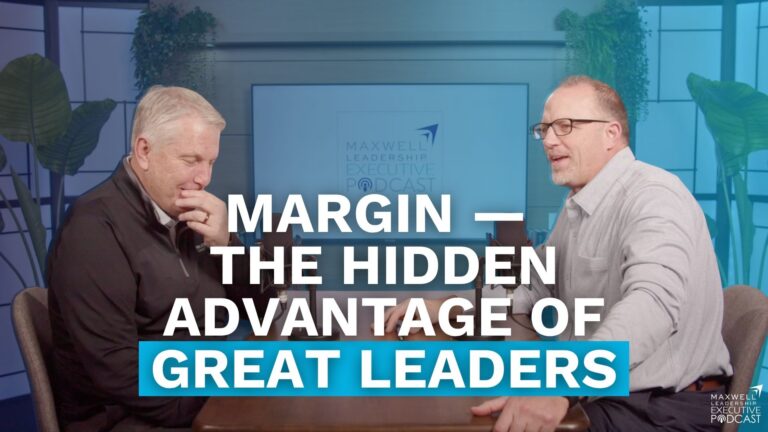
In this episode, Perry Holley, Chris Goede, and guest Don Yeager the critical role momentum plays in leadership. They share research and real-world stories to clarify why leaders must not only recognize but also actively create and sustain momentum within their teams. The discussion highlights the importance of spotting and leveraging the “spark” that ignites progress, as well as celebrating small victories to build belief and engagement. Listeners gain practical strategies for fostering a positive team environment, staying alert for opportunities, and understanding how energy and enthusiasm can spread through effective leadership.
Perry Holley:
Welcome to the Maxwell Leadership Executive Podcast, where our goal is to help you increase your reputation as a leader, increase your ability to influence others, and increase your ability to fully engage your team to deliver remarkable results. Hi, I’m Perry Holley, a Maxwell Leadership facilitator and coach.
Chris Goede:
And I’m Chris Goede, executive vice president, Maxwell Leadership. Welcome and thank you for joining. Before we get started today, we have some exciting news for you today with the guest that’s going to be joining us. I want to encourage you to go to MaxwellLeadership.com/ExecutivePodcast. And there, if you have a question, if you want to download the learner guide from today’s content, which you’re going to want to do that, we have some show notes that’s going to direct you some free content. Or if you even just have a question or a topic that we can help address on a future episode, that’s what we want to do. We want this to be real-time leadership stuff that you’re dealing with, with your organization. Or your team.
Chris Goede:
Well, today’s topic is called the Law of the Big Mo. Now, those of you that listen to us, you go, here we go, another 21 Laws. We’re going to talk about the Law of Momentum. A little bit different today, though, because a dear friend of John’s and Mark Cole’s and ours as well, Don Yeager, is joining us today. For those of you real quick that don’t know Don, he’s a bestselling author. I always love talking to him because we talk about sports. So he’s been in the Sports Illustrated world for a long time. Incredible communicator, incredible speaker.
Chris Goede:
I always think about him in regards to storytelling because he does a phenomenal job doing that as well. But, Don, thank you for joining us. And, man, I just love even being able to call you a friend. And the fact that you would take some time out to add value to Perry and I, but also our listeners today, we’re glad you’re here.
Don Yaeger:
I love you guys and love the podcast. Been listening for years, and you all have inspired me in a lot of things. So thank you. Thanks for giving get a chance.
Chris Goede:
Absolutely.
Perry Holley:
We’re excited about telling Chris so many of your books, and recently you seem to be picking up the pace. I don’t know how you’re doing that, but some of the ones that really stood out to me, Bubba Watson. I’ve been a golf fan, but didn’t know Bubba’s whole story, and you just told that so well. Thinking the Walter Payton, which was— I’ve heard you tell that story, and that just rings your heart around how you embedded yourself in that life and really told that story at the end of his life. I just want to encourage all of our listeners, So if you haven’t read a Don Yager book, you should do that. And there’s lots of things to pick from.
Don Yaeger:
Hey, my children would appreciate it as well, by the way. I got kids to put through college, so I need as many— I need royalties.
Chris Goede:
Yeah, I think actually one of us got a text message that said, listen, if I’m gonna be able to afford Georgia Tech, uh, what we’re going to do is I need you to follow and get on there and buy a book.
Perry Holley:
So yeah, and please look up him throwing a banana. I think that’s—
Chris Goede:
oh, that’s something I learned.
Perry Holley:
You just search social media to make sure that you’ll see all sides. That’s right.
Don Yaeger:
Yeah, including the backside I’m crawling around. Pretty embarrassing.
Chris Goede:
That’s right. And the reason we asked him to join us today with the Law of Big Mo is his most recent book is The Science, The New Science of Momentum.
Perry Holley:
You know what I told him? I said I would only buy a book that had the word science in it because it was from him. From him. I don’t buy books with the title science in the title. But that’s right.
Chris Goede:
How the Best Coaches and Leaders Build a Fire from a Single Spark. And then I know that Bernie Banks also wrote it with you as well. But momentum is something that we talk about quite a bit around here is from a leadership principle. So, Don, you know the 5 Levels of Leadership, and Perry and I build all of our content conversations over that model because it’s really what helps organizations have a common language of leadership inside there. And so when we talk about momentum, a lot of people know what it is. They go, yeah, I know what momentum is., but they really don’t know how to maybe create it, how to find it, how to manage it, how not to maybe lose it. And so while we talk about culture and engagement strategy all the time, we don’t hear a lot of people talking about this momentum. And so I know you have spent a ton of time researching, talking about this again in the sports world, but even in the business community.
Chris Goede:
What made you dive into this and then write this book? What made you study?
Perry Holley:
Momentum.
Don Yaeger:
I’m going to share that story in one second, but I do want to offer this because of the way you introed that, Chris. You said many of us talk about we know what momentum is. So, a healthy piece of the research around this book involved us going into the field with a research firm to actually interview 4,000 American adults who were in the workplace. So, these 4,000 adults in the workplace, asked them a handful of questions related to momentum. Number 1, we asked them, do you believe in momentum? 99%, 98+ percent believe in momentum. Can you define it? Most couldn’t. Right. And then do you know it when you see it? Most believe that they did.
Don Yaeger:
But the number that really jumped out in the polling that I think maybe might most resonate in this conversation because you’re speaking to leaders, is that 72% of them— we asked this question: if you perceived that a company you were competing against had momentum and you had lost it, what would your reaction be internal to your company? 72% said they would start looking for work. They’d start looking to leave because the losing of momentum doesn’t just cost you opportunity, it might cost you your employees. Right? So, this concept, what we’re going to talk about today is not just a nice, fun conversation. There’s an ROI to having your finger on the pulse of momentum and actually not just waiting on it, but doing the work to create it. But back to your question.
Chris Goede:
Yeah.
Don Yaeger:
Sorry, I had to divert for a second because I thought the numbers might help you put your arms around how real what you’re saying is, right? People believe it. They just don’t know how to define it. But if they believe that it’s working against them, they’re checking out. They’re trying to figure out what the exit plan looks like because if you’ve lost momentum and you don’t project the ability to turn things around, people aren’t going to hang out on sinking ships.
Chris Goede:
That makes sense.
Don Yaeger:
But back to how it started, it was Super Bowl 2008. You guys are Atlanta folks.
Perry Holley:
Oh, he’s going to tell that story again.
Chris Goede:
2017.
Don Yaeger:
Sorry, 2017.
Chris Goede:
Turn the audio off.
Don Yaeger:
Yeah, I know. Trust me, I actually, when I do this as a speech, when I speak to audiences, I actually open with this little picture of the Atlanta Falcons logo. And I said, by the way, is there anybody in here who’s an Atlanta Falcons fan? Very few people admit to it, by the way. But those that do, I actually pull out little earplugs that I bring and I pull it. I keep— and I said, by the way, for the next 6 minutes, you get to wear these. Everybody else has to listen. You can you can block me out. But I’m sitting there and I’m watching the Super Bowl, and as you know, Atlanta’s up 28-3, middle of the third quarter, late in the third quarter.
Don Yaeger:
The prognosticators had Atlanta with a 99.6% chance of winning, right, at that stage, because never in the history of the Super Bowl had any team come back from more than 15 points down. And now we’re late in the third quarter, right, and nothing New England was doing was working. But then Brady is, you know, is sitting on the sideline. He actually says out loud, just do something. You don’t wait on everybody else. You do something. In the next series of offensive downs, the Patriots are out. It’s 3rd and 8, and Brady gets trapped behind the line of scrimmage.
Don Yaeger:
And Tom Brady, who is the least athletic quarterback in the history of the NFL, had not run for 8 yards but once all season long, right? Scrambled and scrambled for 14 yards. And his teammates were like, oh my God, like, our star, our quarterback just did something he is not known to do, but he did it in service of us actually getting a chance to score. 3 plays later, they score a touchdown. They missed the extra point because that’s what was going on with Atlanta that time— I mean, in with New England at that time. But they’re now only down 28 to 9. Next thing you know, they score another field goal. Now it’s 28 to 12. Brady’s running up and down the sideline going, “We’re only 2 scores down.” Now, we know that’s 2 touchdowns and 2 2-point conversions.
Don Yaeger:
Odds of that in the high 90% to work against you. But he’s convincing people we have a chance, right? And he steps into this void as a leader, convincing people. And as you know, things continue to unravel. And actually, I had a chance to interview many of the players who were on the field that night from both teams. And Devin McCourty, a defensive back from the Patriots, actually said that when it got down to one touchdown, we were only down a touchdown. He said, you could see it in their eyes. He said, our eyes got narrow because we were focused. We believed we had a chance.
Don Yaeger:
Their eyes got wide because they were like, Oh, crap, this is going to happen, right? We’re going to be embarrassed on TV. And so the game ends, New England wins in overtime. And the next morning, I come back to my office downstairs, open up the whiteboard in the conference room. And I pulled in all of our creative folks at the time. And I just wrote the words, how do you turn a moment into momentum? How did what happened last night occur? Like, we all talk about it, we see it, But can you make it happen? Does it have to— is momentum just something we have to wait on, or is it something we can generate? And that began an 8-year journey, literally interviewing the biggest names on the planet, right? CEO of, founder of NVIDIA, right? About how NVIDIA turned itself from this small little gaming company into the most valuable company in the world today. How did they take advantage of moments to take them through momentum? Political leaders like Carl Rove and James Carville sat in the same room with me to talk about how you build momentum in political campaigns. Sports leaders were— it was the number of sports leaders that jumped in on this conversation was crazy. And, you know, we just, we wanted to try to look at it from multiple lenses so that this wasn’t a sports book.
Don Yaeger:
You know, we wanted business, we wanted politics, we wanted the military. We interviewed David Petraeus. Stanley McChrystal, two of the greatest military minds of our time. How do you build momentum into a battle plan? Sorry, this is a really long answer, but the bottom line is we went all in and came out with a model of what you can do and how momentum can actually become a part of your game plan.
Perry Holley:
Fantastic. And the stories in the book are just spectacular. All those interviews you did and how you communicate that, we’ll love that. So Chris started the topic today, the podcast with the Law of Big Mo, and that John Maxwell says it’s the great exaggerator. With momentum, everything’s easier. Without it, everything’s tougher. So your stories are resonating with that. But I’m in the classroom a lot, in the workshops with leaders, and same thing you found.
Perry Holley:
If you say, can you recognize momentum? And I’ll usually tell a story in sports when the announcer says, momentum has shifted. What happened? And they can tell me of everything’s working. They threw a pass and somebody caught it and it was, they stumbled into a first, something happened and they got that. But then I have to translate that into what does it mean in business? And can you recognize momentum in your business? How would you explain if you, and I love that you had so many interviews in the book with non-sports people about momentum. But if you were in a workshop right now and you wanted to tell a leader about how to recognize momentum or the power of momentum, what would you tell? Sports, I kind of get it. But when it comes to business, some of them struggle.
Don Yaeger:
So I’m going to share a sports discussion because at the end of the work with this coach, we started applying it into businesses. Right. We started thinking about how businesses could use this. So one of my favorite interviews in the entire book, you’ll probably hear me say that like 10 times in this conversation, was with a basketball coach named Buzz Williams. Buzz was at Texas A&M when we did this interview, right? Now he’s at Maryland. But Buzz believes that the one thing that is missing for most people, most sports athletes, and even business leaders is a failure to think about momentum as something you can be looking for constantly. Like, how do you keep your antenna up for opportunity? Most of us, the moment occurs, and by the time we notice it, it’s gone. Right? And so one of the things that Buzz does all season long is he brings in his players and he’ll say, “Gody, get in here.” And you’ll sit down next to him, and he’ll open up his laptop, and there on the screen is some sporting event, usually not basketball, because he doesn’t want his guys looking at you.
Don Yaeger:
It might be a women’s softball game, might be volleyball, might be baseball. But he’ll have you watch 5, 6, 7 minutes of the event. You have no idea when he’s going to do this. And when he does, he closes the lid of the laptop and he looks at you and he says, “Gody, what’s the time? How much time is left in the contest? What’s the score right now? Right when I close the laptop, what’s the score? And who has momentum? Who is actually— who is the game coming to? And, you know, and who is actually having it taken to them?” and explain why. And the reason he does that is he wants his players to always be present, looking for opportunity, looking at the game for opportunity, right? And what he shared with us, what he shared with me is that late in games, he might often, because there are some players who understand the power of momentum, right? And its value to us and keeping momentum is really important. Maybe more so than jacking up a shot, even though I think I’m open, right? And he said, the truth is there’s some players that if they’re not aware of those three things, time, score, momentum, they might come down. We as a team might be up by 6. There’s a minute left to go in the game.
Don Yaeger:
Nothing would be better than if we could run 25 seconds off the clock, right? But they come down 6 seconds into the shot clock and they see themselves as open. So you know what, I’m just going to shoot. Well, yeah, that’s— that could be good for them but bad for the team, right? If they miss, now the other team has, you know, 55, 54 seconds ready to, you know, to, to try to cut into that lead. So he said he often, at the end of the game, you would look at his— you would look at who he has on the court and you would be like, his two best players are on the bench. Why is that? Because they’re not as good at TSM as the 2 players he’s replaced them with. And so these players might recognize the clock is more of our friend right now than 2 more points might be. And so, so he actually shared this with me. 2 nights later, I’m watching Texas A&M play number 1 ranked Auburn, best— many people thought best team in the country that last year.
Don Yaeger:
And, and in that process, you watch and there it is. You know, they’re getting ready to upset Auburn. And their two best players were on the bench. And I thought, wow, there it is. He understood it. So, now we move this forward into business. He said, if you are a business leader, you need to once a month host a lunch in which you just say, everybody comes to the room with some crazy idea, something that could happen in the world that might affect our business. And then let’s talk about how we would take advantage of that., right? So, crazy idea.
Don Yaeger:
Now, we all know this would never happen, right? But what if the CEO of our opponent, right, the team we most love to compete and beat, what if the CEO of our opponent was caught on a video at a Coldplay concert hugging up one of his HR directors? Now, that would never happen. But if it did, if it did, how would we take advantage of it, right? How would we make sure we got the most of it? Now, We know the President of the United States would never issue tariffs on every planet, on every other country in the world. But if he did, how would that affect us and what would we do? So you do these what-if conversations as a team. Two things happen. You might actually strike gold in one of them. I mean, the CEO of your opponent might get caught on a video at a Coldplay concert, and you will already have in mind what you should do to take advantage of the moment. But the second thing that happens is even if none of those things actually occur, you’re creating within your environment this idea of constantly thinking about how we would take advantage of opportunity if opportunity presented itself. Too often the spark comes and it’s extinguished before we get a chance to use it to light a fire.
Chris Goede:
That’s so good.
Perry Holley:
It really is.
Don Yaeger:
Yeah.
Chris Goede:
I got a couple of thoughts and I want to ask you this question though, and then I want to share a thought I had. About— you were just talking about being able to take advantage of that spark or that energy. In the book, you say one of the key properties of the momentum is the transference of energy. And just like you were talking about with Brady walking up and down the sideline, right? He started on the bench, and then he got a little bit more, and he’s trying to transfer that energy into his team, which then became a force multiplier. For what they ultimately did. Do you believe in all the study that you’ve done? Is that a modeling thing? Like they’re modeling the good. Perry and I talk about leadership is contagious and people are watching you all the time. It’s a visual sport.
Chris Goede:
Do you think there’s more to it or is it just modeling that? Can they see through you? Do they know that you believe it? Give us a little bit of context behind that transference of energy so that as leaders we can begin to understand that and maybe even look for that in ourselves.
Don Yaeger:
So one of the things you want to look for— this is one of the places, Perry, where we actually got into science. I know you failed all of your science classes, so probably that’s why you don’t buy books with that word.
Chris Goede:
But hey, you are the first— I think you’re the first guest ever with the word science. Yeah. 400 episodes later. Okay. That’s where Perry and I live at. Okay.
Don Yaeger:
So, so in one of the— this is a space where we dug into the neuroscience of what’s called mirror neurons, right? Mirror neurons are where, you know, you walk into a room and somebody yawns and what happens, right? Everybody else in the room kind of yawns, right? The reason is because if we’re in a room in which we’re reasonably comfortable, we— if you’re feeling something, and I feel comfortable in your presence, I can often feel what you feel through this transference of what’s called mirror neurons, right? It’s human nature. It is something. But one of the things that’s really important, Chris, so this, to your point, like, if you’re a leader, your transference is in part because your job is to, as you’re doing it, right, as you’re expressing yourself, others can pick up on it if you are in the presence of the right people. So this becomes the important aspect of this. Are you hiring people who actually are open to receiving that? Are you hiring people who are also willing, in the shape of— in the mirror neurons they are releasing, to be positively impacting other people?, right? One way to look for this is, let’s say, you know, you have your A-dog, your number one salesperson, and now suddenly someone else has just made an enormous sale, and you bring everybody into the conference room to celebrate that person that just made an amazing sale. Where’s your A-dog in that moment? Are they in the corner going, should have been mine? Or are they over high-fiving that person, saying, thank you, congratulations, man, I love that in you, right? It’s the one place in the book where we actually use a negative example. We tell the story of— you might remember Michael Jordan, right? Very top of his game, weirdly decides to go play baseball. Dumbest decision ever made by an athlete.
Don Yaeger:
Leaves to go. He still can’t hit a curve, but Michael Jordan leaves to go play baseball and And for years, Scottie Pippen had been Robin, right? He was Robin to Batman. And he actually didn’t like it. He wanted to be the A-Dog. And now Jordan’s gone. Now he’s Batman, right? Now he’s the A-Dog. Everybody’s got to lean into me. Well, that next year, they make their way to the playoffs.
Don Yaeger:
And in the third game of the playoffs, they’re playing against the New York Knicks. Game’s tied with 5 seconds left to go. The coach, Phil Jackson, calls a timeout, brings the team to the bench. Pippen’s like, “This is my time, right? They’re going to give me the shot. I’m going to win the game. Hero status belongs to me.” And Phil Jackson draws up a play. And it’s for another player, Toni Kukoc, to take the shot. Pippen is to be a decoy.
Don Yaeger:
And they break the huddle. And Scottie Pippen won’t leave the bench. And the coach says, “Well, we need you in the game.” He goes, “No, man, if the shot’s not for me, I’m not in.” He was so self-absorbed in that moment that then they had to call a second timeout. The two of them got into a cursing match in front of the other players. From that moment on, no one on the Bulls ever saw Scottie Pippen as a leader again, because he was projecting this negative sense to everybody else that if it’s not about me, I ain’t playing, right? In fact, to this day, to this day, kids who weren’t even alive when that happened, it’s known in the NBA, if you commit a completely selfish act, there’s a phrase that’s used called pulling a Pippen. You just pulled a Pippen, right? And, and so this, so it, it’s like, it’s far outlasted Scottie Pippen’s career, is, is the reputation he has in that space. So this idea that you have to hire people who can cheer for each other, right? Because the mirror neurons, they flow all the time. They flow back and forth, and you create greater chemistry.
Don Yaeger:
And in that creation of that better chemistry, you are more available to be ready for the spark.
Chris Goede:
Love that.
Perry Holley:
Well, that’s so good. So you said it a couple of times, and it could be the spark. It sounds like you’re just casually saying a word, but it’s not. It’s a very important part of your model, which we have him back for 2 weeks, right?
Chris Goede:
We are.
Perry Holley:
Yeah. And I want to go through the model next week as we get all this foundational, because the model, I never thought you could model how momentum works, but it’s fascinating. But in the middle of that is this thing called a spark. You mentioned it in the Falcon game about Brady running and you see that. But tell me, I’m thinking about again to our business leaders who are listening and watching, I’m guessing, not because I read the book. So can you manufacture the spark?
Don Yaeger:
Can you notice— Brady manufactured it by running.
Chris Goede:
Right. Yeah. By walking up and down the sideline.
Perry Holley:
Right.
Don Yaeger:
And then walking up and down the sidelines afterward, pumping people up.
Chris Goede:
Right.
Don Yaeger:
Just get me the ball back. Just get me the ball back. We’ll score. Right. So, yes, you can. The answer is absolutely.
Perry Holley:
But then you’re also hinting that I can hire people that are more disposed to the spark and that maybe can help create it or see it, notice it. Play on it. This spark, it sounds like a throwaway term, but it’s not. It’s a central part of how it works. But I’m thinking for our business leaders again, how would you encourage them around the essence of the spark and position themselves for that?
Don Yaeger:
The beauty of this word, right, the spark, and the beauty of the way that we construct it in the book and we talk about it is that it can come from almost any place. The spark could be hiring the right person. Right? The spark could actually be bringing in a leader that’s the right leader for a team. Um, the spark could be a natural disaster that occurs that suddenly creates an opportunity. The spark could be your opponent doing something stupid. There’s a lot of ways that the spark can— so, so one of the things we’re real careful here with Perry is, is not telling people there’s one spark, right? There’s one way you’re gonna see this. The spark can come from any one of 100 different places, right? And so how do you— but are you thinking about a spark? Are you looking for it? And maybe sometimes it’s nearly imperceptible to other people, but it is to you and your team because you’re always thinking about how you’re going to capture the moment. We don’t know what the moment is going to look like..
Don Yaeger:
But when it’s here, we’re going to be ready. We’re going to be ready because you have a leg up on everybody else if you’re just plain thinking about it, because most people are not.
Perry Holley:
We talk—
Chris Goede:
just sorry.
Perry Holley:
No, go ahead. We talk a lot about common language when we talk about 5 levels and common language of leadership. As I’m hearing you, I’m thinking, this is a real— is this a common language moment that we need to be talking about? Using the word spark. We need to be using the word manufacturing the spark. We need to be getting people’s mindset about we’re always alert and looking for ways we can create it or play on it when we see it and not go sailing past it.
Don Yaeger:
Please use it as often as possible and then I’ll charge you for royalties.
Chris Goede:
Yeah, that’s right. I think it’s an awareness thing. Yeah. Isn’t it true? Aware or your bias becomes of one way of thinking, then it just opens up an entirely different world.
Don Yaeger:
TSM, Time Score Momentum, right? Yeah, I love that. Williams, right? How do you build into the framework of your organization a belief that a spark is going to occur and we need to be first to notice it?
Chris Goede:
Yeah, that’s awesome. All right, so one more little story. Before we wrap up from you talked about earlier how you talk about General Petraeus in the book and about momentum and creating it. And it happened without one. It didn’t happen without one big breakthrough for him. Talk a little bit about that example and what you learned from that and connect that to the leader of what they need to be thinking about doing, what’s in their awareness around creating momentum.
Don Yaeger:
So he was brought in, as some might remember, you know, the war in Iraq was falling apart, right? And in fact, it was almost universal public opinion that we needed to withdraw. And we needed to get— we need to just say that’s, that was a lost effort. And the president brings him in and says, look, we got one last shot to try to turn this thing around. Can you help us? And so, A, his credibility from years past made a big difference. His ability to have to have led people through tough times suddenly gave credibility to the leadership role in that moment. But the first thing he did was he openly acknowledged the challenge. He didn’t try to put spin on it. He didn’t try to tell you, you know what, it’s really not as bad as you think, guys.
Don Yaeger:
Because if you’re trying to spin your employees, they know what’s really going on. And what ultimately happens is that they’ll, they’ll, they’ll lose confidence in you as a leader if they see you spinning. So you acknowledge the challenge. Then he shared with them how he had been in something similar in the past and had found their way out of it. So suddenly they don’t just know him to be credible, they see him as somebody who actually can take them out of this bad situation with a positive outcome. And so first two things, right? He acknowledged the situation. He presents a game plan, right? An opportunity. It’s Tom Brady running up and down the sidelines.
Don Yaeger:
Give me the rock one more time and let’s see what I can do. So good leaders present a path forward. Then the third thing is, once things went well, he celebrated them like they won the war. Right. It only took— but he was celebrating small victories. Yeah. Because the small victories are how you build momentum.
Perry Holley:
Right.
Don Yaeger:
Small victories are what ultimately allow things to happen. It’s seldom some dramatic, massive thing that occurs. That is that moment if you’re trying to turn things around. And that’s what he was doing. And so— but it’s a leadership exercise. And that’s really why we point to Petraeus here, because leaders this has to be an arrow in their quiver, right? They have to know how to pull their team together in this moment. And again, it’s being honest, no spin, projecting something forward, celebrating small victories, and then stacking those small victories are really what matters.
Chris Goede:
All right, so there’s so much content, there’s so many stories. Don and his team, they said, hey, there’s one thing that we would love to do about this, which is the book is out. But we’d love to give a chapter of the book away. And so those that are listening, or maybe you want your team to read the chapter together and then talk about it at your next team meeting, what I want you to do is go to DonYaeger.com/FreeChapter. We’ll have that in the show notes as well. But we want you to do that. And for those of you to go, no, forget the chapter. I want the book.
Chris Goede:
The closest Amazon to you, you right-click, you can find that book for Don Jaeger. And of course, we’ll have that title and the spelling. And everything in the show notes.
Don Yaeger:
Just remember it has the word science in it because you can always remember that Perry didn’t want to pick it up.
Perry Holley:
It wasn’t for you. It had your name on it. I went for it. That’s right.
Chris Goede:
Influence, baby. So we’re going to have Don back because as Perry mentioned, we want to talk about this model and we’re going to talk about that and dig in a little bit deeper next week. I’m going to throw it to you to close for us, Perry. But two things I kind of was thinking about. Is that momentum, no doubt, is a great multiplier for us through small steps. Right. Don just said through the small wins, through celebrating that, it’s not the Big Bang Theory and one thing happens. The other thing is that it builds belief in your team.
Chris Goede:
And there is a belief deficit in our world right now. I would say even in our own selves, if we checked ourselves. But also, man, in the people around us. And how do we help create momentum that then builds belief? And I think belief then grows and their effort shows up, engagement increases, and then you got to protect all those things as a leader that we do comes back to starting with momentum. So, Don, I’m excited. Next week we’re going to dig in. I’m so grateful for you and the content, the stories and the application. And I’m telling you, if you’re listening, you’re watching on YouTube, you want to be a part of listening next week with us.
Perry Holley:
Absolutely. Don, so great to have you with us. Can’t wait to do the next episode. Also advising all of you that Don has an award-winning podcast as well. I think you’d really enjoy his podcast as well as the free chapter that he’s offering at DonYaeger.com/FreeChapter. And you can also find us at MaxwellLeadership.com/ExecutivePodcast where you can learn, get that learner guide, learn more about our offerings, especially Don’s podcast, as well as leave us a comment or a question. We love hearing from We’re very grateful you’d spend this time with us. That’s all today from the Maxwell Leadership Executive Podcast.
Transcript created by Castmagic.
Maxwell Leadership delivers corporate training that strengthens executive leaders, aligns teams, and transforms culture. Discover how our proven frameworks equip your organization to lead with clarity and impact.