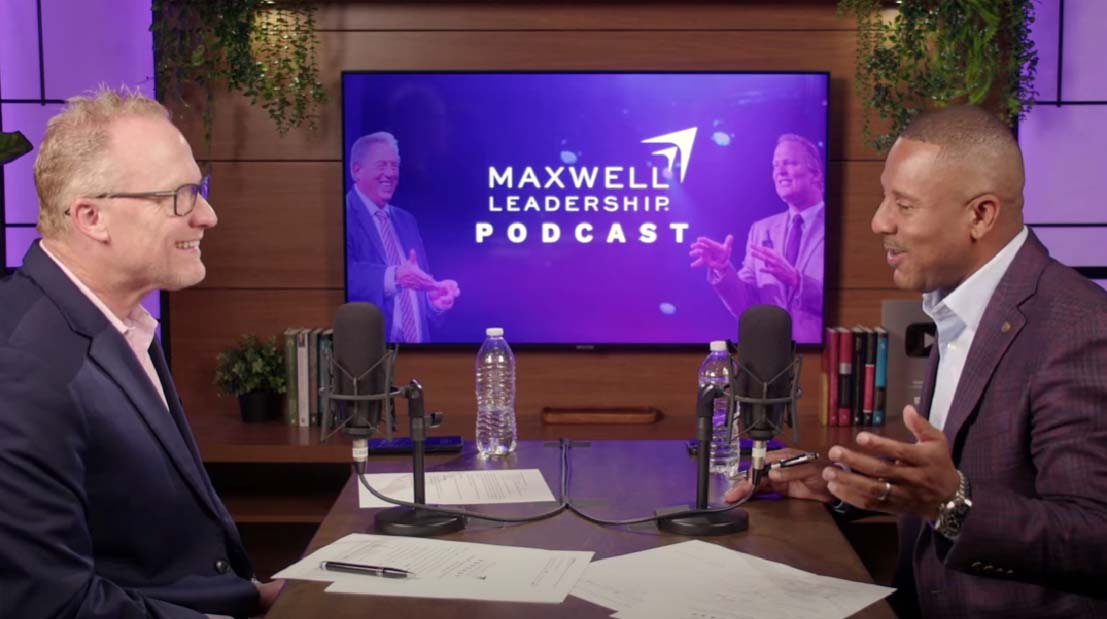
After his lesson, Mark Cole and Traci Morrow unpack the practical steps you can take to apply these principles in your own leadership.
Our BONUS resource for this episode is the Be Aware of Your Blind Spots (Part 2) Worksheet, which includes fill-in-the-blank notes from John’s teaching. You can download the worksheet by clicking “Download the Bonus Resource” below.
Mark Cole:
Humility listens, pride defends. Are you defending most of the time or are you listening most of the time? We’re talking about blind spots. And if your resistors go up pretty quick, check yourself on pride. Welcome back everybody to the Maxwell Leadership Podcast. And I say welcome back because today we’re in the second part of being aware of blind spots. And so I’m super excited about it. Traci, I’m so glad you’re back with us today. I got to ask you a question after last week.
Traci Morrow:
Yes.
Mark Cole:
What’s the best way or the most easy way for you to learn and discover blind spots in your life and leadership?
Traci Morrow:
Definitely trusted people. Well, of course, self-reflection, but again, we can’t see our own blind spots, right? So, trusted people who I know are for me and for the best for me and the people that I serve, and just being vulnerable enough to really hear them when I know they have the best, they’re looking out for me. Open myself up regularly to hear them speak into my life.
Mark Cole:
Yeah. Well, for me, it really is people too. I just can’t see them. And it’s robust dialogue with people. It’s got to be somebody that can stand toe to toe with me because I’ve been called before hardheaded. I don’t know. The jury may still be out with that, but that means that when you’re going to point something out that I can’t see, you got a lot of convincing to do. So, People that can handle robust dialogue is probably my answer to you, Traci.
Mark Cole:
Hey, if you are like me or Traci today and you walk in with an understanding that most leaders, this is what John says, most leaders have blind spots. Hey, podcast listener, podcast viewer, that includes you. That means you and I, Traci, we have blind spots. And today’s podcast is all about helping you to discover What we mean by blind spots. Last week, John started in his teaching, he started teaching about certain areas that a lot of leaders have blind spots. And last week, he talked about a singular perspective. A mindset that’s pretty closed is the first area. Today, we’re going to pick up and find out 4 more areas that are blind spots in most leaders’ life and leadership.
Mark Cole:
So get ready, grab a pen. Hey, by the way, if you would like to fill out and follow along with a guide, we have a guide for you that is all yours. You can print for yourself, your team, whoever’s listening to the podcast. Go to MaxwellPodcast.com/BeAware. You will also find the link to YouTube where you can watch this podcast and join Traci and I there.
Mark Cole:
Hey, get ready.
Mark Cole:
This is going to continue to enhance your leadership, I promise you. Here is part 2 of your blind spots.
John Maxwell:
Okay, blind spots. I think the number one blind spot that leaders have in commonality is a singular perspective. Now let me give you the other ones. Number 2 is insecurity. Major blind spot, I think, among leaders. Insecure leaders are a detriment to themselves and to their organization at which they lead. They place their followers in jeopardy. They place their organization in jeopardy.
John Maxwell:
They even place themselves in jeopardy. Insecurity causes the leader to think only of himself. Boy, this is a very key phrase. And the very essence of leadership is others. And therein is the blind spot. You have never met an insecure person who was other-focused. So how do you spot an insecure leader? Let me just give you some basic things here quickly. Number 1, an insecure leader has a hard time giving credit to others.
John Maxwell:
Why? Well, insecure people need the credit. Therefore, it becomes bothersome to share. Remember, insecure people are needy people. Carnegie said, no man will be a great leader who wants to do it all himself. Or get all the credit for doing it. Number 2, an insecure leader keeps information from his staff or her staff. You see, communication is a form of empowerment, and when you release information, you convey trust and confidence in others. And when you conceal information, you convey the opposite— no trust, no confidence.
John Maxwell:
Number 3, an insecure leader does not want his staff exposed to other leaders. They may see qualities in others that they like and that you don’t possess, so they keep you away. Number 4, an insecure leader is threatened by the growth of others. Insecure people will never let other people ever excel, exceed. They’ll pull them down every time. Number 5, an insecure leader is often a micromanager. They’re control freaks. They have to have tight reins on everyone and everything so that they can ultimately take credit for Everything.
John Maxwell:
Now here’s the danger zone. There is a danger zone in which insecure leaders eventually place themselves in their organization. Here are some symptoms of the danger zone that insecure leaders create. Number 1 danger, insecure leaders are really not leaders. Why? Boy, this is so important. You cannot lead people that you need. If you need people, you’ll not ever lead them effectively.
John Maxwell:
Because your need for them will be so great that you’ll never make the right decisions. You’ll make palatable decisions. You’ll make decisions that they like, but you can never lead them. You can especially never lead them in uncharted territory because you’ve got to have approval. You have an approval addiction. Secure leaders love people, but they do not need people. And I want to be very careful when I say they don’t need people. It’s not that they have a distaste for— they love people.
John Maxwell:
Get the picture. They love people, but they don’t have to have the affirmation of people before they can make those tough decisions. They can look you right in the eye and say, I want you to know I love you very much, and no, we’re not going to do that. Here’s the direction we’re going to go. A second danger is that insecure leaders don’t provide security for those they lead. You’ve never seen a secure staff with an insecure leader. You just haven’t. Anxiety, apprehension, that’s just part of the— DNA of a staff that is led by insecure leaders.
John Maxwell:
And the reason why all this is you cannot give what you do not possess, and you just can’t. So if you’re insecure yourself, you can’t pass out and pass on security. Secure leaders empower and appreciate others. They just do. And to become an effective leader, you must make your followers feel good about themselves and what they’re doing. Third danger, insecure leaders take more from people than they give. It’s just a fact. Insecure people are on a personal quest for validation and affirmation.
John Maxwell:
Instead of giving validation and affirmation to their followers, they need to receive it from them. Secure leaders contribute to the benefit of others. Secure leaders do all they can to help others win. That’s just the way it is. Number 4 danger, insecure leaders limit the best people. Insecure leaders cannot genuinely celebrate victories won by others. Why? They’re jealous of them. And who gets most of the victories? The best people.
John Maxwell:
So therefore, they’re constantly limiting the best people. Secure leaders release the best people and allow them to go for it. Secure leaders thrive on seeing others succeed and love to see them reach their God-given potential. Number 5, the 5th danger, insecure leaders limit their organization. Because if you limit your best people, then you have no recourse than to limit your organization, whereas secure leaders allow their organization to soar. Nothing is a greater impediment to being on good terms with others than being ill at ease with yourself. How true, how true. 2 basic blind spots we’ve talked about with leaders.
John Maxwell:
One, a singular perspective. Number 2, insecurity. Number 3, As I look at leaders and again try to generalize or put in a common pool things that I think leaders have blind spots in, I think number 3 is without any question in my mind, that’s devaluing people. Leaders who devalue other people will constantly have blind spots. Again, in Winning with People, the people principle number 10, it was called the number 10 principle, believing the best in people usually brings out the best in them.
John Maxwell:
Let me give you these thoughts on leaders here. Leaders who value their people give them their best effort. Leaders who devalue their people give them their least effort. Can I tell you that is an absolute fact? When you and I as leaders devalue people, I have never known a leader who devalues people who gave them his or her best. It is not in the DNA. In fact, here’s what I have always said. A leader will give his or her effort Based upon his or her evaluation of the people they lead. So if I evaluate you, if I’m your leader and I evaluate you as a 3, guess what I’ll give you? I’ll give you about a 3 effort.
John Maxwell:
If I evaluate you as a 9, I’ll give you a 9 effort. In other words, how I evaluate you will determine my effort I give to you. That is a fact. And when you devalue people, the blind spot becomes huge in your life because The effort you give is going to be corresponding to how you see them. Leaders who value their people serve their people, where leaders who devalue their people want to be served by their people. Leaders who value their people empower them. Leaders who devalue their people control them. Leaders who value their people motivate them.
John Maxwell:
Leaders who devalue their people manipulate them. Okay, let’s go to the 4th blind spot of many leaders. and ego out of control. Many, many leaders, pride and ego has been their blind spot. You see, pride is concerned about who’s right. Humility is concerned about what’s right. 2 different agendas. What does pride do in a leader? Pride is costly, destructive.
John Maxwell:
It’s the inverse of humility. Instead of taking responsibility, you blame others.
John Maxwell:
Instead of being objective, you live in denial. Instead of being open-minded and receptive, you’re closed-minded and defensive. Instead of flexibility, you have rigidity. Instead of team spirit, you end up with low morale. Instead of loyalty, you experience a high turnover rate among the volunteers and paid staff. And boy, this is so true about prideful, ego, out-of-control leaders. Instead of being connected, you find yourself out of touch with the client, customer, or the community or people you’re trying to reach. We’ve talked about 4 basic blind spots of leaders: a singular perspective, insecurity, devaluing people, and ego out of control.
John Maxwell:
Number 5, a lack of character. Interestingly enough, character sometimes is overrated in leadership in the fact that I’ll say, what is a quality of a leader? And they’ll say character. I said, no, that should be a quality quality of a person. The thing about character is what it does is it doesn’t make you a leader, but what it does is it protects you as a leader. Many people with talent make it into the limelight, but the ones who have neglected to develop strong character rarely stay there long. Absence of strong character eventually topples talent. Why? Because people cannot climb beyond the limitations of their character. Talented people are sometimes tempted to take shortcuts.
John Maxwell:
Character prevents that. Talented people may feel superior and expect special privileges. Character helps them to know better. Talented people are praised for what others see them build. Character builds what’s inside them. Talented people have the potential to be difference makers. Character makes a difference for them. Talented people are often a gift to the world, and character protects that gift.
John Maxwell:
Now, here’s the key. When values, thoughts, feelings, and actions are in alignment— get the sequence— values, thoughts, feelings, and actions— when they are in alignment, a person becomes focused and their character is strengthened. And character is the sum total of all our everyday choices.
Mark Cole:
Welcome back, everybody. As we’re listening to this, Traci, I’m going, okay, okay. I want to see the blind spots. Why do I want to see the blind spots? For the people. Hey gang, this is for the people. In fact, it’s Simon Sinek that said it well. He said, leadership is not about being in charge. Leadership is about taking care of those in your charge.
Mark Cole:
So we’re discovering blind spots last week, this week, we’re discovering blind spots for the people. So get over yourself, get over yourself. You have them, you have blind spots. Get over yourself and let’s dig in. And I know that’s what John just did with you with these 4 additional areas. And so Traci, welcome back.
Traci Morrow:
Thank you. Welcome back, everybody. So excited to go through these. I have a ton of questions. And why are blind spots, we know them, but why are they always so surprising when we hear them? So John talks about insecurity. you. But when I think of somebody with insecurity, I just have such compassion when I hear the word insecurity because I know what it feels like. I can tap right into what it feels like to feel insecure.
Traci Morrow:
But then he lists this whole list of things of how to spot an insecure leader. And they are kind of unlikable qualities. They’re qualities that make you feel annoyed or agitated. And so, what he’s really describing is pride. And pride is actually, you know, that the kind of things that he’s describing is something when you think about a boss or a leader or somebody, a manager, somebody in your life that has these qualities, you tend to think of them with a bad taste in your mouth. Maybe somebody who’s like, oh, they’re, they’re so prideful. They’re so, you know, full of themselves. And so, what is pride? Let’s first identify that pride is really insecurity worn inside out.
Traci Morrow:
So, when we look at somebody, we tend to think they think they are everything. But really, it is insecurity. It’s just showing up differently. So that when we can think of that, maybe we can have a little bit more compassion for For them. And so how long would you say, Mark, that you were a leader? I mean, I guess it takes being an adult for a while, or maybe some people knew this right out of the gate. I certainly didn’t. But how long would you say that you were a leader before you realized that this list of symptoms that John lists off and how to spot an insecure leader were actually insecurity rather than the opposite of what they were trying to project?
Mark Cole:
I think often, and I would say much more than 50%, I would say most of the time that it’s birthed. And most of the time when I talked a little bit in the last episode, I talked about my hotspot of working with people that say they’re very open to being coachable and trainable, and they have great respect for you in their life. And then all of a sudden you point out something that they don’t accept and they don’t believe in, and they shut you off, shut you down, never talk to you again, whatever, whatever. I find that most of of the time, that’s because of insecurity. It’s because of this insecurity in their leadership. See, it’s funny because you said, I hear insecurity and I kind of feel bad for people. And I went, man, Traci’s a lot more compassionate than I am. I don’t feel bad for them at all.
Mark Cole:
I feel irritated with them. But let me tell you this, right? Because I feel bad for everybody around them. I don’t feel bad for them. I’m like, man, Get secure. But there’s a difference in insecurities and vulnerabilities.
Traci Morrow:
Right.
Mark Cole:
And I find that leaders that are vulnerable because they never were shown good leadership, leadership that are vulnerable because they never could perform and be loved unconditionally by others in their life, and they’re constantly trying to get love, those are vulnerabilities. And insecurities are a lot harder for me to tolerate in a life. That’s why I think you read this list and you go, man, all of them are pretty negative. And that’s because I think how John and I have interacted with insecure leaders through the years, the people that suffer the most because of the insecurities are the people that work for those insecure leaders. And the insecure leader is the last one to even recognize that everybody around them has a problem with them because they see it through the lens of their insecurity. Therefore, they won’t accept responsibility because the insecurity won’t let them.
Traci Morrow:
Yeah.
Mark Cole:
And that’s why the blind spot for insecure people, and that’s why John took so much time talking about insecure leaders within blind spots. And here’s what I’ll tell you. If you are an insecure leader and there are insecurities in your leadership, you need to get counseling. You need to get mentoring. You need to surround yourself with at least a person that you believe will love you despite your areas of insecurity and get somebody to speak into you because your leadership is wreaking havoc on those around you. I promise you it is.
Traci Morrow:
Yeah. Or maybe it’s just immaturity as well, because I would say, just falling on my own sword, when I was young, if I’m really honest, when I was a person who was in charge in a very low, low level of leadership, I would say that I was a person who wanted to— maybe it was because of how I was taught in the school system or in the pecking order system of growing up, that I thought I wanted whoever was in charge of me to know that I was the one who got the win, who made the sale, who closed the deal, who did whatever it took, because I thought that’s how you raised up in the organization or in the system. And it did not feel good. I felt sick inside. It felt out of alignment with who I was. But I thought that’s how it was supposed to be. And so, when I learned from John through cassette tapes, through which is now a podcast, you know, like it’s all of that grows with time. But it was freeing for me.
Traci Morrow:
So, maybe someone is listening and it’s not even as much a counseling thing for some of our listeners will be like, maybe like me, maybe it will be like, oh, thank God, I don’t have to do this anymore. Thank God that there is a different way that I— maybe it’s just permission. Maybe someone just needed to hear, John, you say, you don’t have to do that anymore. There is a better way. And so, what would you say in a person’s makeup for those other people who aren’t maybe like me, who just needed someone to give them permission? What would you say is the difference between as a leader, when you’re raising up, how you can tell the difference in a team member between being collaborative and competitive versus being insecure and competitive? How can you recognize the difference of that in your team member?
Mark Cole:
I think competitive and completing— well, let me give you 2 buzz phrases that I absolutely believe applies to the question, and they’re more than just clichés. Teamwork makes the dream work. You will not accomplish great things without people around you. And that also brings me to another cliché. Leadership is not about being right. It’s about getting it right. And too many people, they’re competing because they want to be right. They’re competing because they’re comparing themselves to the other rather than feeling like they’re completing the other.
Mark Cole:
It’s this competition because it’s a comparison, not a completion. And you got to be around people that complete you. That’s more than just a sweet little buzz line in a great romantic movie. You complete me. You’ve got to have that as a leadership mantra to the people. You complete my leadership rather than you need my leadership. You complete my leadership. And so oftentimes that we can’t get the competition out because our insecurity needs to feel like that we got it, that we are right, or that we won, or that we are the best in the room rather than we make the room best.
Mark Cole:
I want to be the best in the room. No, I just want to make the room best. My insecurities won’t let me do that. So you talked about your insecurities coming from a younger child. And my family listens to the podcast and I love my family, but I didn’t grow up understanding religion or even familial family love as unconditional. It was very conditional. Now, I’m not saying that my family or my faith was conditional. It probably wasn’t.
Mark Cole:
The way I received it, was very conditional.
Traci Morrow:
Right.
Mark Cole:
Therefore, I always had this propensity to be good so I could earn love, to behave so I could stay in the group. I always had to do the right thing so I could have a sense of belonging. Well, how does that work in my leadership now? When I feel like my leadership is bad, I’m making bad decisions, the results of my leadership is not what I want it to be, the team that I’m leading is not as productive as I want to be, I then start going into, well, I’m not lovable then. I’m not good then. I am not— I don’t deserve to be on the team. And then what my insecurity does is I have to start reminding people how good I am, or I have to start telling myself that the hammer’s getting ready to fall. John’s going to be mad at me for the rest of my life. He’s going to kick me out.
Mark Cole:
He’s going to— Because that insecurity of not experiencing unconditional love still plays at 57 after what little bit of accomplishment I’ve had in life. I still, when I don’t see myself as a good leader, I get concerned that I’m going to fall out of favor with those around me because I’m not being a very good leader. And so it still comes and I’m aware of that. Therefore, I talk to those close to me and saying, hey, I’m in a real vulnerable place right now. I’m in a real insecure place right now because I’m starting to feel like I have to Prove that I’m lovable because my leadership is not proving that I’m lovable.
Traci Morrow:
I would bet there are a great many people who are listening can really relate to that because they just get— you being so close to John, I feel like what our audience really got is 2 very different spectrums with you and John. Sometimes John’s story is not as relatable when he talks about like, I was unconditionally loved. So it makes me, I am my own best friend. I really like myself. And so, I think it’s very helpful for you to be uniquely you, being so close to John, being the CEO of Maxwell Leadership, but to stand in your own space and say, I’m still struggling with this at 57, and I’m still working this through, for our audience to hear we all don’t have to be John Maxwell to be the legs of the legacy. We can still be ourselves in our story and carry the legacy forward to be our own leader in our own right. But we don’t have to be John. So thank you for sharing that.
Traci Morrow:
I think that’s—
Mark Cole:
Absolutely. And it’s true. It’s so true, Traci. And John says that, I was unconditionally loved and I’m my own best friend. I went, man, that’s kind of nice. I’m my own best critic. Does that count? I mean, I’m really good at criticizing myself. Can I get in my own best club since I’m my best something? But I do love that.
Mark Cole:
And I have tasted unconditional love. And it is, oh, it’s astounding.
Traci Morrow:
Yeah. And you’re getting that from John. And you’re still working it through. And as we’re all working through all of our stuff. So that’s— and it doesn’t discount us. If our beginning doesn’t look like John, it doesn’t discount us. We’re all just us. And we’re doing the best we can as us.
Mark Cole:
Hear, hear.
Traci Morrow:
So, moving forward, he said, you know, he talks about putting a 10 on people’s heads. But what happens, Mark, when Um, you know, when you put a 10 on somebody’s head, I think sometimes that’s hard to work that through. What does that actually look like? So you put a 10 on everyone’s head, meaning you value everybody in the highest level of, of their value in— because we’re people of faith, you don’t have to be a person of faith to, to, to follow this principle, but to just see them made in the image of God as just, uh, they are, they have the highest value. But if someone behaves as a 3 to 6, 3, a 4, a 5, a 6. Let’s just say right there smack in the middle. 3 is on the real low end. They’re rude to people. They do things that you can’t even imagine that they would do on a team.
Traci Morrow:
They are snappy. They don’t follow through. They don’t show up on time. They don’t show up at all. They’re takers. They’re a negative on the team. You know the, you know the drill. So you’re treating them as a 10.
Traci Morrow:
But how do you as a leader in response How do you respond to that as far as how much time they get, how much effort and energy they get from you, how long they stay on the team? Because that’s where I think it gets a little cloudy when you’re trying to value somebody and not devalue them, but also understand that they don’t get the amount of time from you based on how much they show up in the team. Can you help walk us through that a little bit?
Mark Cole:
I can. I think the timing, however, the timing element of your question, how long do you give? I don’t think that’s a rote answer. I think that rests in the art of leadership, not the disciplines or the practical of leadership.
Mark Cole:
I think it varies each person, each different— it depends on their demeanor. It depends on did they develop at all? Are they done? Did you give them chances? So I can’t speak clearly, articulately, or with great action step on how long is enough time. What I can tell you is kind of the process. I see trust and belief in potential of a teammate as 2 things that a leader has to put a 10 on people’s head if they give them a job opportunity or an opportunity to be on the team. Again, I believe you put a 10 on their potential and a 10 on your trust of them to do what you’re asking them to do as a teammate. I believe that. You got to start there. If you’re hiring somebody and you’re just 50/50 on whether they’re going to make it, I think that is a leadership— I believe you have violated leadership.
Mark Cole:
You need to get people and do the due diligence that when you assign a task, when you give people an opportunity to be on the team, you need to give them a 10 that they have the potential to step up and step into it, and a 10 that you’re going to trust them to do it. Now, in our organization, we have what we call a trust meter, and it is the responsibility of the leader to keep that as a 10. And when it slips, and it does, and it does often, and it slips down to a 9 or an 8. So what that means to me is I’m asking somebody to do a job, and 9 times out of 10, they’re going to get it right, or they’re going to do it. Not always right, but they’re going to do it because we believe in failure around here. They’re going to do it. When that slips down to a 7 or a 6, you’re in trouble because somebody is barely over half the time going to do what you’re expecting them to do. You’ve got a real problem.
Mark Cole:
But anything from 7 to 10, they have dropped down. They were late. They keep coming late to meetings. You sit down with them and saying, hey, my trust of you is not a 10 anymore. It’s a 9. But here’s the great news. I’ve identified it. I’ve had the hard conversation about it, and I’ve given them a path forward to get it back to a 10.
Mark Cole:
See, a leader that loses trust and doesn’t communicate it is not a good leader. A leader that doesn’t have trust and communicates it is a good leader, but you’re not a great leader until you have lost trust, communicated it, and given a path to redeem it. Now you’re a great leader. And so every leader needs to start again with both trust, we’re talking about that, as well as belief in their potential as a 10. And you need to be committed to keeping it a 10 or giving a pathway toward a 10 in both their potential and in your trust of them to do the job you’ve asked them to do.
Traci Morrow:
I love that. That’s a great recipe. Okay. Closing out, he talks about ego, which is Enough said. And then lastly, he talks about character. Are there any character-revealing questions you ask when bringing on a new member? Or is this something that is only revealed in the reality of working with someone? Because I feel like with all of the books that are out there, someone could come in and speak Maxwell, but very quickly, you can find that they don’t actually live the John Maxwell way. So, I’m curious if that’s something that’s only revealed once they’re on the team, or if there are any character-revealing questions that you ask in the hiring process.
Mark Cole:
Well, yeah, we do. At the very beginning, we try to answer the character question. I’ll come back to that. But to your point, character is really only revealed over time. And character’s really only revealed in difficult times. So, it takes time and it takes pressure. Character can only, only be revealed in time, pressure, and I believe temptation too. But time and pressure and temptation, more about that on another podcast in another venue.
Traci Morrow:
Yeah.
Mark Cole:
But time and pressure is really the revealer of character. And if you’ve not seen somebody under pressure, you don’t know their character. And if you haven’t spent enough time with people, you really don’t know know really them. But to your other part of your question, yeah, we’re very diligent around here at Maxwell Leadership and we teach companies all over the world that you need to hire on the 3 C’s, character, competence, and culture. Character, competence, culture. We’ll talk about competence and culture in another podcast. But on character, we ask We ask everybody to rate their potential hire with character, but really who gets the final sign-off on character is the people that’s going to work with them most throughout the day. So the supervisor answers the competence question.
Mark Cole:
The HR rep that’s in the room answers the culture question, but the teammates answer the character question because we’re trying to go, will our values match? Does our thinking complement one another? How do we feel? There is an emotional thing to character determination. And then what are their actions? Find out what they spend their time doing. What are they like outside of the office? What were they like with the people in the last office? And we’re asking questions like that because we’re trying make sure that their values, their thoughts, their feelings, and their actions are all aligned like John Maxwell talked right here. There’s a great statement that our team put in front of me. Character doesn’t make you a leader, but it protects you as a leader.
Mark Cole:
And so a good character doesn’t make you a great leader, but it’ll protect a good leader. And so finding out character and character questions on the front side is incredibly important. In fact, I’ve got an application question for you today, podcast listeners, viewers. What does your character look like when no one’s watching? And does it match the character you show publicly? Where are there differences or discrepancies between what you are to yourself and what you are with the team? And I think we also need to protect ourselves against pride. So humility listens, pride defends. Are you defending most of the time? Or are you listening most of the time? We’re talking about blind spots. And if your resistors go up pretty quick, check yourself on pride. If your curiosity kicks in when people are giving you observations, then there’s a good chance you’re operating in humility.
Mark Cole:
And I would just ask us all, when somebody gives you feedback you did not anticipate, in other words, perhaps a blind spot, do you defend first? Or do you listen first? Do you push back or do you accept as a natural tendency? If you’re rejecting it, I’m going to challenge you that that is probably a great indicator that there are blind spots in your life. If not in the area that somebody’s trying to point out today, it’s in other areas and they’re just not telling you because your natural response is to defend. Traci, you are a gift to me and our podcast listeners. Thanks for joining us today. For all of you, I want to put another podcast in, I think, that will complement, augment this one. It’s How to Make Your Future Bigger Than Your Past. Don’t let character, don’t let blind spots hold you back. That’s why we spent 2 weeks on it.
Mark Cole:
Thank you so much for being such a committed person to the podcast. Tell us how we’re doing. Give us a comment, give us a question, give us a reference, refer somebody. Let us continue adding value so that we together can multiply value to others. And go bring some powerful, positive change to the world around you because everyone deserves to be led well.