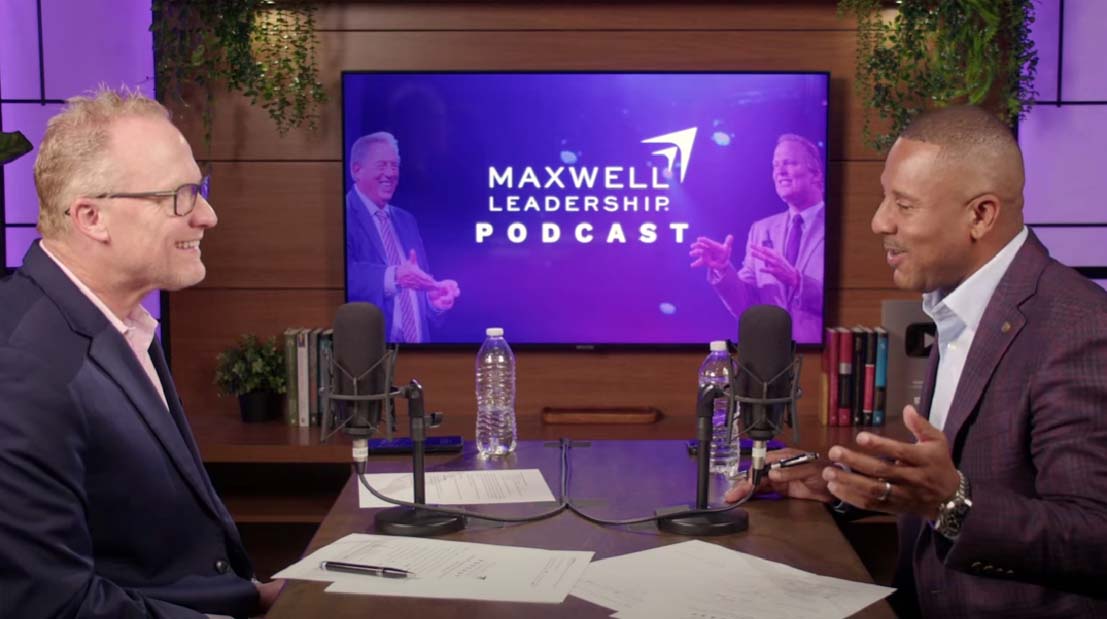
What does it take to lead with vision and purpose when the stakes are as high as the next generation’s future? In this week’s bonus episode, Mark Cole is joined by Texas Education Agency head Mike Morath to explore the guiding values that shape public education at scale.
Our BONUS resource for this episode is Mike Morath’s farm gate resource. You can download the worksheet by clicking “Download the Bonus Resource” below.
Commissioner Mike Morath:
This organization exists to ensure that every other organization can function. Literally every profession in the country started with teaching. That is where every other industry emerges from, is the impact of teachers and what they do to grow eager young minds.
Mark Cole:
Welcome to the Maxwell Leadership Podcast. I am so excited for you to join us today on a bonus episode. About 6 months ago, I was on stage with Commissioner Mike Morath. Mike Morath is the head of the Texas Education Agency, which regulates the second largest school system in the country. 5.5 million students are educated in that system every single year, over 800,000 educators. And today he sits down with us and he talks about leadership, about education, about the next generation. And if any one of those Intrigue you, I promise you, you will be left wanting more at the end of this podcast. In fact, stay with me because in the middle of the podcast, I’m going to put Commissioner Morath on the spot and ask him to join us for another podcast because you will love this.
Mark Cole:
When John Maxwell and I sat down in front of over 2,000 of our coaches, we knew immediately that we needed to have him back and have him in studio with us. So get ready, Commissioner. I am so excited about Today, podcast listeners, podcast viewers, get ready. This is going to be an impacting time together. So, Commissioner, thank you so much for joining. As I said in the introduction, just what you did on stage with John Maxwell that riveted our coaches, I know that’s going to happen in the podcast today. So I’m so glad you’re here, so excited about what we’re going to share today. But before you were Commissioner of the State of Texas, you still had a passion for leadership.
Mark Cole:
So talk about before Commissioner. commissioner for just a moment. What were you doing before you were a Texas commissioner?
Commissioner Mike Morath:
Well, I had definitely a long and winding road. You know, you reflect on this as you get to a point in life and you don’t know why the Lord has you on the path that he does, but, um, uh, that I am grateful for it. I, I, um, right out of college— so if we go, it depends on how far back you want to go. When I was, when I was very young, I was raised— my, my parents were both entrepreneurs at varying stages of their life. So I started working from a very young age because I was working in with them in their businesses. When I was, I think when I was 12 or 14, my dad enrolled me in an accounting class at Eastfield Community College with him because he couldn’t work a computer and I did all of his bank statements in Lotus 1-2-3 as a preteen. So, I got an undergraduate degree in business and came back. This was the time of the dot-com era and I had visions of dot-com billions.
Commissioner Mike Morath:
And so, I started a dot-com and we raised a bunch of money and lost all of it. And it was a catastrophic failure and I’m very happy to not be alcoholic. And after that, I spent some time reflecting on what I was going to do with the rest of myself. It’s strange to have a midlife crisis at 21 or 22. And And then I joined forces with a very small software company and became the leader of that company, had the dominant equity interest in it, grew it over the course of 10 years, and was— I was blessed. I lived the American dream. And the American dream is not for the faint of heart. You know, you too can work twice the hours for half the pay, at least in the early years.
Commissioner Mike Morath:
So, But I’d always, independent of this desire to achieve and to lead in this way in business and to develop some degree of financial independence, I always was called to serve as well. So, my high school alma mater calls me when I was like, again, when I was trying to start my dot-com because the computer science teacher at my high school that actually had taught me resigned suddenly in September. And they called me and said, would you come teach? And I was like, no, under no circumstance. I’m not qualified. I got this thing going on. No. And they called like 5 times and the sales pitch ended up something like, it’s either you or a monkey. Please, please come do this.
Commissioner Mike Morath:
And so I was like, well, I could probably outperform a monkey. So I did end up teaching part-time advanced computer science and I was stone terrible at it. And the kids need their money back for that time period. But, you know, it was always, I was always called to serve. I did a lot of volunteer work in juvenile justice facilities all throughout my young adulthood. I met my wife on a medical mission trip in the middle of nowhere in Mexico. She’s an eye doctor and was giving sight to the blind. And, I have no medical skills and don’t speak Spanish, so I was mostly cooking breakfast, but it was attached to this orphanage in rural Mexico.
Commissioner Mike Morath:
I did some I did some mission work in southern India. We put in water filtration systems in orphanages in Chennai. And independent of all that, I did a lot of volunteer work in schools in the North Texas area, in Dallas. And I was a Big as part of the Big Brothers Big Sisters program for really a decade. I had 2 different Littles that I was matched. And again, back to your question about leadership. Servant leadership is the only way to go. Like, the only— if we have any skills to offer with whatever gifts that we may have, we have to use that in service to others.
Commissioner Mike Morath:
And so, I did this. I tried to enrich myself and I had a company, took care of my employees, took care of my customers, but was also called to serve in other ways. My first little— we were matched for maybe 7 years, 6 or 7 years. And he turns 16, he wants to get a job at Braum’s. Your listeners may not know anything. It’s a fast food chain in North Texas. And he couldn’t fill out the job application without my help. His level of literacy was not sufficient to do the open-ended applications, the job questions.
Commissioner Mike Morath:
And so, I mean, I sold my software company. I ran for the school board because I never wanted that to happen to any of my brothers and sisters ever again. And then I had to become a student of public education. How to, you know, I knew a lot about managing business, managing people, trying to get results, being accountable for results. You know, you never lived until you had to meet payroll, right? This is a high-stakes environment, the American dream and entrepreneurialism. But what did I know about teaching and learning? I mean, it’s not like I was taught, and I didn’t do well as a computer science teacher. And so, I had to spend a lot of time studying how the system worked and try to bring that really student-focused lens to my leadership role in a governance capacity over what was probably about a $1.5 billion a year organization, the Dallas Independent School District. That’s what leads me up to this current role that the governor has me in.
Mark Cole:
So I mentioned in the prenotes that John and I get to meet with a lot of educators. A lot of statewide systems now are using our values curriculum. But Mike, I’ll never forget the time where we walked out and John Maxwell said, Commissioner Morath is a leader in an environment that needs leadership. And we have a leadership radar. And so now hearing your story and hearing kind of the leadership bent, entrepreneur to school board, to being a teacher, to saying, okay, now, and we’ll talk about the size of the state of Texas in just a moment, but what shaped your leadership? I was asking you that a little bit before the show, and you talked about this framework. Talk to us a little bit about your framework of leadership.
Commissioner Mike Morath:
Yeah. Along my path, I had time to invest in myself and my own leadership. You have to reflect and grow. This is how you really grow. We learn from our mistakes typically more than our successes. But I actively tried to seek out opportunities to grow my craft as a leader. There was a professor of leadership that did executive coaching. He was from Austin College and his name was Pete DeLisle.
Commissioner Mike Morath:
And he had a framework that he described as the Farm Gate Theory of Leadership. So, I want you to imagine imagine what a farm gate looks like in your head. There’s these horizontal slats, right? And then there’s that crossbar that’s kind of diagonal. And this was a visualization meant to describe the key characteristics that leaders need to possess. And you think about people at lower levels in an organization, at mid-management in an organization, at higher levels, the executive levels. And he described this, and this really made perfect sense to me, and I have I’ve seen this play out many times in my leadership roles. At the highest level, the sort of big L leadership, you need to understand how to motivate, how to plan, how to organize, in some cases, how to control. This is resource utilization.
Commissioner Mike Morath:
You have to have your vision carried out through other people. This is the essence of of large-scale leadership, which means you have to possess a vision. This is kind of a key piece of it. You have to be able to communicate that vision clearly to others. And then, you have to understand the levers of influence or authority that you have and then use those wisely. So, we’ll call those like the big L leadership skills. You also have to have a pretty healthy amount of interpersonal skills. Nobody likes working with a jerk.
Commissioner Mike Morath:
Right? So, how do you put the interests of others? How do you care about them as people and grow them? And this is, you know, how do you recruit? How do you promote? How do you manage performance inside of an organization? So, this is about managing process, but also about managing people and working with people. So, these interpersonal and sort of managerial skills are also pretty critical. But then there’s this third component in the framing of the gate, You can think about these as diagonals. The sort of big diagonal on the top right-hand corner is sort of resource utilization, big L leadership. The interpersonal bar sort of spans the entirety. So, the C-suite needs interpersonal as well as line-level employees in any organization. But then you have technical skill. What is it that the business does? What is it that the enterprise does, the organization does? So, stated a different way, if you’re gonna be the CEO of General Motors, it’s a good idea to understand cars, right? Yeah.
Commissioner Mike Morath:
You’re not leading a ballet. If you were leading a ballet organization, you gotta understand dance. And so, a good example of this, we sometimes see this, I would say, sophistry of non-domain-specific leadership embraced, that someone who possesses a great amount of broad leadership talent, who knows how to inspire, who knows how to motivate, but is actually not an expert in the domain of relevance. You can, in an organization like that, you can build an organization that’s efficient and goes right off of a strategic cliff because you don’t have enough domain knowledge to see this kind of, like, you know, in our business, that dog don’t hunt kind of thing. Yeah. And so, you know, When I think about those 3 sets of skill sets, you have to have a great deal of domain expertise to understand your product, your service better than everybody. You have to have a great deal of interpersonal skill to understand how to manage with both authority and influence through others. And then resource utilization, again, how to lead through layers, lead through systems, cast a vision of leadership.
Commissioner Mike Morath:
This is, I think, a framework that I bring. And so, what I’ve tried to do even with my own path as a leader is not short shrift any of those. You know, you can interact with people who are charming, who have cultivated that interpersonal skill, but they lack domain-specific knowledge. And as a result, you get along with them really well, but you might not achieve in the industry within which you work. So, for my own background as Commissioner of Education, that means I spend a great deal of time understanding how memory is formed, because that is the essence of what education is, and thinking about what memories are important for kids to learn. How do you organize curriculum? How do you organize instruction? How do you organize talent systems? These are technical questions. But then how to recruit, how to support, how to retain, how to grow the talent of the people that are with. And then in this system with many, many layers and many, many lateral stakeholders that interface with it, how do you cast a vision? How do you communicate that vision? How do you try to inspire people to recognize change as a necessity and then be willing to make the changes necessary to positively impact lives of students.
Commissioner Mike Morath:
So, this is broadly speaking a framework that I bring with me that I carried in my old software days and I bring in this, I guess, second career that has less rewards in this life and more in the afterlife.
Mark Cole:
That’s for sure. Okay. So, we’re going to get to education because that’s why we’re here. But I knew this was going to happen and I told John Maxwell, Right before the recording, this was going to happen. I said, we’re going to start talking about leadership, and I’m not going to want to leave leadership to go talk education. But I promised you guys I would introduce you to the leader that, in my opinion, and I’ve been around a lot of educators, a lot of top educators, that is literally changing the landscape of, I think, Commissioner, one of the largest in the world, if not the largest education systems in the world. I know it is in the United States, but I think it may be in the world. Talk to us a little bit.
Mark Cole:
So the governor tapped you on the shoulder, said, come be Commissioner. What did you say yes to? Give us a little bit of the size and the magnitude of what you’re thinking about each and every day.
Commissioner Mike Morath:
Yeah, I am blessed. I get to wake up every day and my job is to think about how to help 5.5 million souls. That is the size of our system. It’s roughly 5.5 million students enrolled in public education in the state of Texas. The scale is significant. There are 1,200 school systems in the state of Texas, a combination of what we call independent school districts and public charter schools. Those school systems then have 1,200 local CEOs, our superintendents, plus, say, 7,000 or 8,000 school board members. There are 9,000 individual campuses.
Commissioner Mike Morath:
There are roughly 380,000 classroom teachers. There’s about 800,000 total employees, a little bit more than that actually, in public education in the state of Texas. We spend over $90 billion per year on this core function of our republic in Texas alone. So like that $90 billion a year is Texas-specific K-12 spending. So it is an enormous industry. And we have other large industries in Texas, although I will say that regardless of the city you’re in, whether you’re in little Dumas ISD, which is actually not our smallest school district, but up in the Panhandle or Dallas ISD, everybody kind of knows where Dallas is. Public education is the largest employer in pretty much every single town, city, hamlet, county, you name it in the state. It is gargantuan by size, but also by both civilizational and moral importance.
Commissioner Mike Morath:
You can think that the This organization exists to ensure that every other organization can function. Literally every profession in the country started with teaching. That is where every other industry emerges from, is the impact of teachers and what they do to grow eager young minds. But then also, again, I’m not just Commissioner of Education, I’m also a client. I got 4 kids of my own and I’m I’m pretty passionate about what happens to my kids. And we as a civilization, we as a species would have killed ourselves off if we didn’t love our young people. So we really want what is best for kids. And so we get real fired up about it.
Commissioner Mike Morath:
And this is good. This is a good thing. But it does mean that there’s a lot of opinions about public education that have to be navigated.
Mark Cole:
Well, and here’s what I love. Every time I talk to you, Every time I talk to you, you keep it as a practitioner. I mean, again, podcast listeners, viewers, $90 billion under Commissioner Morath’s responsibility, 5.5 million kids, 800,000+ employees, if you will, of Commissioner Morath. And this is what I love about you, Commissioner. Number one, I love that you personalize it. You told me the story of dropping your kids off at school the first day of school. You personalize it. But here’s the other thing I love.
Mark Cole:
I’ve been in your office multiple times. I’ve been with your staff, your teammates, both regional and central multiple times. And I watched you. You love the story of the one, the one kid that was impacted by some curriculum decision you made or some story of a kid making a character decision. And I watched your mouth just drop open when you hear the story of one— Not the story of $90 billion. And I love that about you. And I can say that’s unique because I’ve been in a lot of offices like yours. So, talk to me a little bit about what do you think is the greatest opportunity facing education over the next 10 years?
Commissioner Mike Morath:
I think it’s a great question. And what I am sort of most hopeful about, most optimistic about is we stand at a time now where the conversation we’re having with ourselves as a country with regard to education is beginning to return to sort of core principles. You know, there is a— it’s really easy to be distracted by all of the shiny objects in education. You can talk about that $90 billion. You can talk about all the people that you employ. There are books you got to buy. There are buses that you got to run. There are buildings you got to put them into.
Commissioner Mike Morath:
And the thing is though, why do we send kids to school in the first place? Why do— why is it— as a dad, do I entrust my local school system with my child every day, 7 hours a day for equivalently 13 years of their lives? And, you know, at its core, we send kids to school to grow academically, to learn how to read, learn how to write, learn how to do math, to learn our history, to learn science, to grow in their knowledge of the world, but to grow also in their character. And I don’t mean that school should take the place of the parent, not by any stretch of the imagination, but the school should reinforce the values and character, discipline, hard work, self-sacrifice, the things that we know our young people need. I think about this in the context of love. A classroom’s first necessary ingredient is love, but there is no love without discipline. That just doesn’t exist. And then, to help our kids grow even physically in their athleticism. And so, in many ways, the work that we are doing in the state of Texas at the state level, the work that I see our superintendents, our principals leading, the work that I see classroom teachers doing is trying to return to this fundamental mission of what is it that we are teaching our children? What is the history that they’re learning? How is it that they are learning how to read? How much are they writing? How much are we pushing and growing them? And so I think the biggest opportunity that I see is this refocusing on the fundamentals of the mission of public education that We exist to help take the combined wisdom of 250 years of our own republic, several thousand years of civilization, boil this down into core bits of knowledge that we want to pass on to our next generation and make sure that that’s actually what is being taught and that our teachers are trained and supported on, loved on to do this, that we focus on the growth and merit and achievement of our kids. It is really this return to the fundamentals that I see happening in schools all over our state that I’m most excited about as an opportunity for us with our young people writ large.
Mark Cole:
You said something a while ago, just showing love and showing kids their value and that they can live values. And you talked about that. I was reminded, I just put last week here in our school system, Go Buford Wolves, And I took our 7-year-old grandson and dropped him off. And the first day the teacher said, hey, Emery, it’s his name. She says, you get a hug when you come in and you get a hug when you go out because you matter. And I watched this little boy just light up and lean into what school was just because this teacher took a little bit of extra time. What are the schools doing well today that often go unnoticed by us as parents or us as a society?
Commissioner Mike Morath:
Well, I think we can stay there. I mean, I will say that school as a business enterprise is complicated. Yeah. We’re doing the hardest thing that one can do in civilization, the process to try to mold eager young minds to become the best versions of themselves. And with that complexity comes some failures that do happen. But we have so many really dedicated professionals that signed up for this work because they love kids first and foremost, and they want them to become the best version of themselves. So every day in schools all over the state, all over our country, that sort of relational investment is happening so that kids know that they are valued by the adults that they’re going to spend a decent amount of time with when they’re away from their parents. Again, we got to make sure we’re teaching them how to read, teach them how to do math.
Commissioner Mike Morath:
And so, we’re not just trying to store the children in a loving environment for 7 hours, we’re actually trying to grow them academically. And so, there’s a lot of, I think, good practice back into the fundamentals. I’m seeing kids improving their handwriting instruction and kids sounding out letters when they’re in kindergarten, first grade, growing in their phonics. I think in terms of in high school, kids having a discussion of like, these were the great debates during the Civil War, and this is what Lincoln said, and let’s unpack what he meant by that. And, you know, you see this reinforcement. It’s like this merger of the values of adults who love kids also being, you know, telling the great stories of the challenges that we’ve overcome as a people and the values that sort of have won out even civilizationally. You know, these are things that I think are exciting. These are things that they don’t happen every day.
Commissioner Mike Morath:
They don’t have it everywhere. And we have bad days. That happens. But generally speaking, we got an army of angels that work for us that sign up to work every day to pour the best versions of themselves into our young people to become the best versions of themselves. And it’s my job to support them and make them— to help them have, you know, build action plans that next week is better than the last.
Mark Cole:
Well, and I’ll tell you this, Commissioner, I’ve met with you a couple of times. I’ve met with John Maxwell all the time. The last 26 years, I’ve met with with all that that means, which is presidents, prime ministers on a weekly basis. But when I’m asked, name one of the top 3 people that have impacted your life as a leader in your life, it’s my 3rd grade teacher, Ms. Richardson. And it wasn’t because of how she made me feel, although that mattered, because you get asked the question, do you remember what people say or do you remember how they made you feel? Right. And we all know it’s how you made you feel. But Ms.
Mark Cole:
Richardson made it make sense on why I wanted to learn. She talked to me about how I would get better. So, as you’re thinking about the responsibility of 5.5 million, and for those of you who listen internationally, Texas is not just 5.5 million students. As Texas goes, and Commissioner Morath is going to love me for saying this, it’s almost like the country of Texas. It’s not just the state of Texas. But as Texas goes, oftentimes in the US, it’s an influencer. It’s the bleeding edge. So, I ask this question from that perspective, not just from Texas, But not just from the United States, but across the globe.
Mark Cole:
What characteristics or what values maybe even would you believe to be as important to students to develop just beyond their academic achievement?
Commissioner Mike Morath:
I’m going to go— let me start in one place in particular, which is about expectations. And this is not just for the students themselves. It’s the partnership between the student and the adult. It’s our job to grow them. We want them to grow. In order for us to be successful in public education, really in order for any of us to be even successful in life, you have to start with high expectations. You have to hold yourself and those around you to the highest expectations. And I’ll talk about this in the context of a school setting.
Commissioner Mike Morath:
So there’s an individual member of our legislature, he’s an amazing thought leader in education, and he’s relaying the story of when he was in grade school. And he goes to school and he had broken his right arm. And so, the teacher’s taking the roll and asking for homework. And the teacher gets to him as a young student and says, young man, where’s your homework? And he responds with, well, I broke my arm. I broke my right arm. And the teacher says, You didn’t break your left arm. And the reason why this is important is kids are amazing, creative, experimental sponges. And they can rise to our expectations.
Commissioner Mike Morath:
Now, we have to scaffold. We have to provide support. We’ve got to provide structures so they can succeed and achieve. But it really starts first and foremost with that North Star. That, um, do you believe that all children can learn and achieve? Do you believe that you can help them achieve? Does the child, him or herself, believe that with his hard work, um, and with the support of the adult, that they can— that the child can achieve at that level? Um, this is, this is such an important ingredient in public education and education writ large, and we have to, we have to instill that belief on our young people. That, hey, you know, life is complicated and there’s going to be things outside of your locus of control. It’s like the Serenity Prayer. God, grant me serenity for the things I cannot change, but the courage to change the things that I can and the wisdom to know the difference, right? This, we have to impress upon all of our young people that with your hard work, with my support, you can achieve great things.
Commissioner Mike Morath:
And that’s what we will do together.
Mark Cole:
So another thing that I love about your administration and what you’re doing is how you’re bringing the entire community together to make public education a community project. So what role does the community, parents, educators, community leaders, employers, policymakers, how does each of this community element play in preparing the next generation and how can we better work together in my school district to play a role there?
Commissioner Mike Morath:
This is a great question that I’ll give you like multiple layers of answers because a lot of it depends on how deep you want to get into the pool. But let me just start with this basic principle. Schools, public schools in particular, these are schools that the public owns. We’re the shareholder. Our kids are the value coming out of that. And either we take responsibility for what happens in those schools or we abdicate that responsibility and turn it over to somebody else. And I don’t think our schools can be as successful as they need to be without us, this citizenry of America, wrapping our arms around them. So it starts, I think, at the level of an individual child.
Commissioner Mike Morath:
Mother Teresa was once asked, thinking about the scale of poverty in India, isn’t it overwhelming? And she responds with something I’m going to paraphrase. If all you can do is help one child, help that child. And so, you know, volunteer as a Big Brother, Big Sister, be a reading tutor, sign up for a reading mentoring program where you can read, or, you know, or an actual mentoring program like Big Brothers Big Sisters. This is, I think, the first way to get involved in, one-to-one adult to a student. And there are structured mentoring programs that exist all over the country. There are sometimes unstructured programs. You can do this both directly with the school, you can do it maybe with local churches, these sorts of things. Thanks.
Commissioner Mike Morath:
If I move up a level from the individual school, most campuses have some sort of way for people to volunteer and bring resources to help. You see, like, I’m going to come in, I’m going to volunteer, I’m going to help the teachers, you know, organize their supplies. I’m going to bring a love offering. I’ll bake them some cookies. These kinds of things, like, show them that they’re not alone, that there are people that are cheering for them. If I go up a level from that, Especially when I think about, say, Maxwell Leadership coaches, which is like undoubtedly many of the people that are listening to this. Principals are, they’re not really mini CEOs, but they are like colonels in an army. So, they have an environment within constraints within which they must operate, but have a large amount of leadership over an individual school, a $3, $4 million a year operation.
Commissioner Mike Morath:
That’s a relatively small school. Big schools can $15, $20 million a year operations. And so, many of them have local campus advisory boards. And I’m not thinking like just normal PTA council, but ways to be a thought partner for a principal to help coach the principal up, help be a sounding board for the principal with some modicum of independence. So, it’s, I don’t want anything from you, I just want to help you be a leader. So, like most of the public schools in Texas, for example, have these what are referred to as site-based decision-making committees that you can sign up, join, and you can serve in that formal. advisory role. Then you get another layer up from that, and you’ve got, say, school board leadership, superintendents.
Commissioner Mike Morath:
And so, school board members need good people whispering in their ear, helping be a voice of reason while they make courageous, farsighted decisions. Many of our schools, they’re going to face what I will call the 2 kinds of hard. They’re going to face hard, which is opaque. They can’t actually tell what the right decision is. And then they’re gonna face hard where, no, they can tell what the right decision is. It’s just gonna be upsetting and painful to execute. And we have both kinds of hard. And when people know what the right course of action is, they need to have good voices of wisdom whispering in their ear, telling them, this is the right thing to do.
Commissioner Mike Morath:
You should do this, even though it might upset some adults. And so this is, I think, the layers of involvement. And then I’ll also say my own personal experience. If you’ve truly lost your mind, you should run for school board. We need good people. We need good people. That throw their quiet life away and step into the arena and say, if not me, who? If not now, when? And will run for office and try to bring the moral North Star that says, look, we exist to serve students first and foremost, taxpayers right behind, and everybody else is secondary. This is our mission.
Commissioner Mike Morath:
And so these are the ways that I would encourage Anybody that’s listening to this podcast to get involved.
Mark Cole:
So I’ll come back to Commissioner Morath in just a moment, but I want to talk for one final question, but I want to talk to Leader Mike that is resourcing, stewarding $90 billion, administering that through 800,000+ people to make an impact on 5.5 million next generation leaders. And so, with that frame of reference for you and for us, what’s the hardest leadership lesson you’ve had to learn?
Commissioner Mike Morath:
Oh, what a great question. There were, I mean, along the way, I think about my failed business, my successful business, all the personal experiences people have in life, a lot of lessons learned. Let me share a more unique lesson that I learned. after I got elected to the school board in Dallas. And it is that leadership, especially in the public space, in the public eye, you have to be able to stay focused on what that moral North Star is, what your objective is, and be willing To face intense personal attacks and not melt under it. And like, there’s— and there’s— this is it. I will say it’s a balancing act because you— there are some people who, when they are placed into a position that is, I’d say, high visibility and high public criticism, their response is to wall themselves off from the criticism. And to some extent, for somebody who’s personally done this, I understand why people do this.
Commissioner Mike Morath:
It’s like necessary psychologically to maintain your sanity, but you cannot wall yourself off from that criticism because there’s— in that criticism, there are people with legitimate perspectives that you must hear and synthesize their perspectives in order to make better decisions. So, you can’t You can’t wall yourself off from it, but you also can’t let it get you debilitated into a corner where you’re like curled up into the fetal position saying, if they would only meet my mother. I mean, I am a good person. So, I think that one of the challenges is how to manage that criticism in ways that’s productive to your mission. This is, I think, one of the greater lessons that I had to learn. in my newer leadership roles that I did not face really running a private sector company. I didn’t have people lighting me up on social media every day. And so, that part of it was a key lesson learned.
Commissioner Mike Morath:
And if you can’t develop, you know, skin of a Naga hide with the ability to listen with wisdom to the legitimate criticism that’s coming for you, then, like, this ain’t the job for you. Do something else. There’s a There’s a great Kipling poem, If, that has served me well. And there’s like, if you can bear to hear the truths you’ve spoken twisted by knaves to make a trap for fools, if you can watch the things you gave your life to broken and stoop and build them up with worn-out tools, these are pretty valuable life lessons. So anyways, this is, I would say, That is an aspect of a leadership lesson that I’ve learned that I would not have learned still as a successful private sector CEO, but that I have had to learn in the public sector.
Mark Cole:
All right, so I’m going to finish with that Commissioner Morath question, but I’ve got to ask you live in front of everybody, please promise me you’ll come back and have a leadership conversation with me.
Commissioner Mike Morath:
Absolutely.
Mark Cole:
I’ve got 2 dozen questions I want to go deeper with leadership on with you. All right. You brought up how important the parents are to the process, and I know the answer to that. So if you had the attention of every parent in your schools around the state of Texas for 1 minute, what would you use that minute to tell them?
Commissioner Mike Morath:
Oh, I mean, pay attention to homework. Listen to your children for sure, how their school day was. Ask them. Meet with your teacher to Develop a relationship with your teacher. The school works best when it is a partnership between the parent and the teacher, the parent and the school. And that means that we can’t just like, oh, that’s the school’s business to teach them how to read. I don’t need to be involved in that. It is— I need to know what the school is doing.
Commissioner Mike Morath:
I need to support that at home. I need to make sure that I’m continuing to encourage my child and their values and their virtues, make sure that I hold high expectations at home. But I want to know what the school is doing and hold the school accountable. For results, right? Because there, we have a lot of good people working, but school’s complicated and it’s easy for kids to get lost. So never cease advocating for your own children, but also work in partnership with the school.
Mark Cole:
Hey, State of Texas, you’re lucky to have a leader like Commissioner Mike Morath at the helm. For the rest of us, we’re lucky because I am talking to a guy today that believes the best leaders are yet to They’re sitting right now in school districts all around the state of Texas. They’re sitting in your school districts. They’re mining your kids, speaking of what Commissioner Morath just told us. So I promised you at the beginning of this, you would love this time together. I promised you that you would want more when it was over. And I put Commissioner Mike Morath on the spot and he said he would give us more, and I’m going to hold him to that. In your bonus resource, Of course, Commissioner Rath talked about the Farm Gate method of leadership, the models that he used.
Mark Cole:
We’re going to provide that for you in our show notes. Go take advantage of that and you’ll see how this leader has reinvented himself multiple times to make a difference for the world around them. Hey, that’s what we all need to do. Go make powerful, positive change because everyone around you deserves to be led well. Thanks for listening. Thanks for being with us today. Thank you.