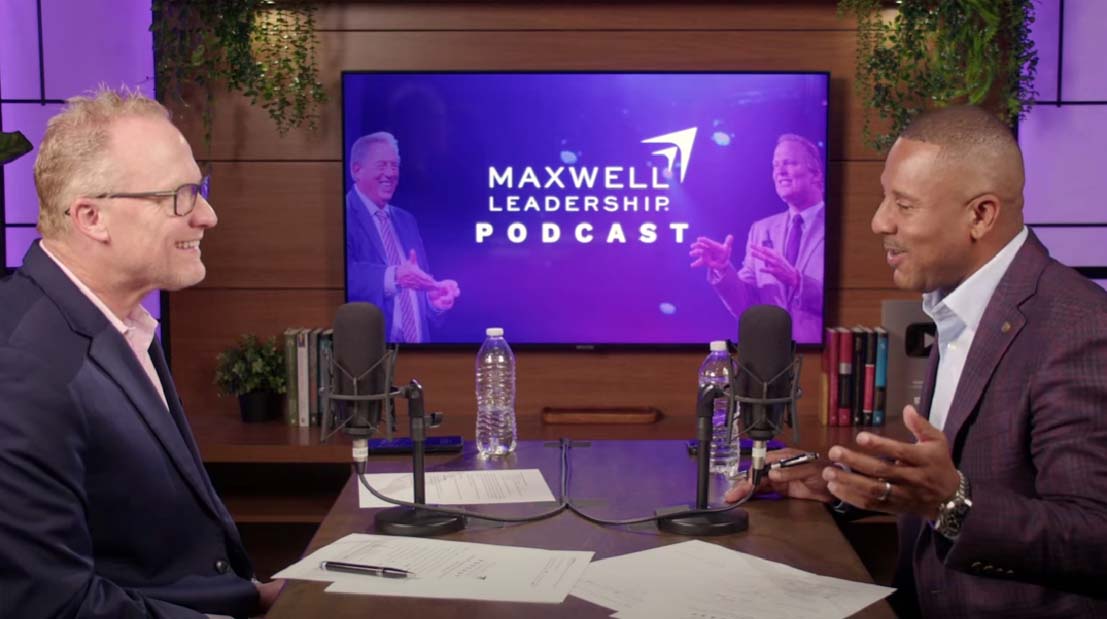
Are you a true team player or just playing the part? The answer shapes not just your success, but the culture and results of your team. In this week’s episode, John reveals the defining differences between players and pretenders in leadership—and how to recognize them in yourself and others.
After his lesson, Mark Cole and Chris Robinson share real-world strategies and candid insights for putting John’s insight into action right away.
Our BONUS resource for this episode is the Differences Between Players and Pretenders (Part 1) Worksheet, which includes fill-in-the-blank notes from John’s teaching. You can download the worksheet by clicking “Download the Bonus Resource” below.
Leaders, stop trying to do it all yourself. The best leaders know their limits, operate out of their strengths, and set others up for success. Find freedom with BELAY — pairing you with vetted U.S. virtual assistants so you can focus on what matters.
To help you get started, BELAY is offering Maxwell Leadership listeners a free download of their resource, Lead Higher: The Effective Delegation Playbook. Just text MAXWELL to 55123 for FREE access.
Belay ad:
There’s a difference between handing off a task and handing off ownership of it. Most leaders never make that leap, and it costs them. Effective delegation isn’t just about getting things off your plate. It’s about trusting someone else to own the results, whether that’s an executive assistant running your calendar and inbox or a bookkeeper owning your financials from the ground up. BELAY personally matches leaders to US-based, highly vetted assistants and bookkeepers. who take real ownership. The right person matched to how you work, not just the next available one. No offshore teams, just flexible fractional support built around you.
Belay ad:
Their new free resource, Lead Higher: The Effective Delegation Playbook, walks you through how to delegate well to both an executive assistant and a bookkeeper so you can lead at the level you’re called to. Text Maxwell to 55123 to download it for free. That’s M-A-X-W-E-L-L to 55123.
Mark Cole:
When John offered me the final promotion that I got from John, which was CEO of his companies, this is what I went home and told my wife, Stephanie. I said, Stephanie, they finally figured out that I’m the CEO of the organization. I’ve been the CEO for a long time. They finally figured out. There was no sense of reward because I got the position. There was a sense of appreciation that what I was already doing had been noticed. Welcome to the Maxwell Leadership Podcast. We are committed to adding value to you today, and I believe that’s exactly what’s going to happen.
Mark Cole:
We do it though with an expectation. We want you to multiply value to the people under your influence that are able to grab something from you as a pass-through from this podcast. And today I’m really, really excited because not only is Chris Robinson in the studio with me, but John John’s going to talk about something that he’s just started talking about in the last year, maybe 2, and that is how to know the difference between a player and a pretender. In fact, before we even teach the content, identify yourself. Are you a player or are you a pretender? And Chris, one of the things I love about us in getting to do this podcast is we get to talk real time about applying what we’ve learned from John, right? Yeah. But also what I love is I don’t get to talk about this much, podcast family, but Chris Robinson’s day job is actually mobilizing 61,000 certified coaches, speakers, and trainers to do good in their communities and to do good in the world around them. We say often, everyone deserves to be led well. And we believe every community that we have a coach in deserves good leadership.
Mark Cole:
And that’s why we have an ambassador of good leadership in all these communities. In fact, since our last podcast, we now have a coach in 170 countries around the world. The globe. Come on, man. This thing might work.
Chris Robinson:
It just might.
Mark Cole:
And there’s a coach in your community, podcast listener, podcast viewer. So what’s going to— well, first let me ask you this. So it’s a bunch of people making a difference. What’s it like to be leading a community of 61,000+ people that’s pursuing being a player rather than a pretender?
Chris Robinson:
Hey, well, it’s an incredible feeling and an incredible privilege to get to do this because John Maxwell can call up anybody in the world and say, hey, come and lead this organization. Yeah. And for me to get the opportunity to do this, it truly is humbling as a product of the product. Meaning that, hey, when I started this program, I was simply just trying to figure out how do I get paid to coach, speak, and train for a living? So I started out, was one of the very first to be certified in this program, built a business utilizing it, the tools and resources that you all had given to me, and then served the community and was then able to become part of the faculty And of course, come alongside you and get the privilege of leading this organization. And so, it’s truly amazing what I get to do each and every single day.
Mark Cole:
Yeah, exactly. So, in other words, pinch me unless it’s gonna wake me up, ’cause I’m enjoying the dream. Okay? So, you can pinch me, because it doesn’t feel real, but don’t wake me up, ’cause this dream is fun. Hey, not only that, we’re gonna spend 2 episodes, this week and next week, we’re gonna spend it talking about the difference between players and pretenders. And what I’m gonna tell you is you’re gonna get convicted In this lesson, both this week and next week. Both episodes are going to give you something to think about, areas in your life that you’re pretending when you should be playing. The second thing it’s going to do is it’s going to give you a filter for the people around you, the people that is capturing your time, on whether they are playing with your time, they’re making you better, or they’re pretending like they’re going to do something to make you better. And so I’m so excited to offer this to you today, but I have one more surprise.
Mark Cole:
Because in the studio with us today for part 1 and part 2 are 4 of our 61,000+ coaches from different parts of the world. They’re in the office with us today. They’re in studio. And I’m gonna introduce you to 2 this week and 2 next episode. I can’t wait for you to meet them. In fact, they can’t wait to meet you because they want the whole microphone from Chris and I. So, I’m gonna keep hold of the microphone where they don’t take the show. But I’m so excited to introduce you to them and get a chance to share that with you.
Mark Cole:
Grab your pen, grab your paper. By the way, if you would like to follow along as John is teaching, you can go to MaxwellPodcast.com/Players and you’ll be able to get the fill-in-the-blank resource. Also, you’ll see the YouTube link there. We’ll put some other show notes, some other additives to you, but you’ll see the YouTube link right there at MaxwellPodcast.com/Players. And trust me, you want to view it today because Chris and I is going to look better in just a minute because we’re going to bring some people that’ll make us look better. Hey, grab the pen. Here we go. Are you a player? Are you a pretender? Here is John Maxwell.
John Maxwell:
In my life, as I have been a leader all of my life, whether it’s an organization or whether it’s a church community, whatever it is, here’s what I have noticed. Here’s what I have found. I have found that leaders many times in selecting staff, in hiring people, they get a pretender instead of a player. And so I want to just help us to understand what’s the difference between a pretender and a player. I had a buddy of mine, we both love sports, and when he sees a good ball player, he has an expression that says, now there’s a player, that’s a player. And we’ve all said that expression, well, now there’s a player. Well, let’s look at and find out what does a player look like. And so in every organization, there are those people who would rather act the part than do their part.
John Maxwell:
I’ve classified these people as pretenders. Pretenders can slow an organization down, steal momentum, and damage relationships in an organization. They live for themselves. When an organization needs we people, the I people either change or get exposed. In order for a pretender to become a player, Major changes in personality and thought patterns must take place. So in my life, as I think, I love to play ball, and in high school I played ball, and there was a guy on our team named Doug. He wasn’t a player, he was a pretender. Doug was the kind of guy that in practice always did well.
John Maxwell:
In fact, the coach would watch him during the week. He did so well, he’d let him start, he’d put him on the first team, but by the first quarter of the first game, he’d be out again. Doug did good in practice, but he didn’t do good when the game was on the line. What’s the difference between players and pretenders? Are you ready? Let’s write. You got your pens ready? Players have a servant’s mindset and pretenders have a selfish mindset. Major difference between the two. I have found that players have a servant’s heart. Pretenders, they have a selfish mindset.
John Maxwell:
They are really looking out for themselves. What I have found is the greater the person, the greater the servant’s heart. You see, players have a servant’s heart. Pretenders, they have a selfish type of a mindset. How can you tell if you have a servant attitude? Here’s the answer. Are you ready? By the way you react when you’re treated like one. You can tell if you have a servant’s mindset by the way you react when somebody treats you like one. Okay.
John Maxwell:
The second difference between a player and a pretender. Players are mission conscious. Pretenders are position conscious. Now there’s a world of difference between those two. Players will give up a position to achieve a mission. Pretenders will give up a mission to achieve a position. A lot of difference between these type of people. The position doesn’t make the leader, but the leader makes the position.
John Maxwell:
And what I have found is that players are mission conscious. They have a purpose in their life where pretenders are more position conscious. They’re more concerned about where their office is and what their title is and what their name is and where they are on the job description chart and the whole deal. Players have a tendency not to promote themselves where Pretenders are very quick to tell you how good they are and what they’ve done. You see, players are mission conscious and they want significance in their life. I believe success is 3 things. I believe success is knowing my purpose in life. And remember, that’s what a player does.
John Maxwell:
A player is mission conscious. I believe success is not only knowing my purpose in life, but number 2, it’s growing to my maximum potential. And finally, It is sowing seeds that benefit others. When I am knowing my purpose in life and I’m growing to my maximum potential and I’m sowing seeds that help and benefit others, then I can look at my life and say, my life is becoming a success. Players are mission conscious. Pretenders are position conscious. Number 3, players are job happy. They love what they do and they do it well.
John Maxwell:
Pretenders are job hunters. They can’t do it where they are now, but they think they could do it better where they are going. Pretenders have 3 things in their life. They have what I call destination disease. What I mean by destination disease is they think success is always somewhere else. Have you met somebody like that? They say, you know what, when I move to the new city, I’m going to get happy, or when I get my new job, or I get my new office, or I get my new car, or I get my new promotion. They’re always thinking that happiness is out there. One of my favorite statements that I love so well, this is written for people who have destination disease, is no matter where you are, there you are.
John Maxwell:
Some people, the only way they could ever get happy or good is if they could get away from themselves. You know what I mean? They have destination disease. Then there are people, the pretenders, they not only have destination disease, number 2, they have what I call someone sickness. They think that success is with someone else. They think of, if I could just network with that individual, if I could just meet that person, if I could just marry her, I’d get happy, I’d get successful. And then pretenders not only have destination disease and someone’s sickness, they have what I call backslider blues. They think that success today is impossible because of what they did yesterday. You see, they’re basically, they’re pretenders.
John Maxwell:
They think it’s going to get better somewhere else, and they think that it’s going to get better if they someone else, and they have never been mission-oriented, they’ve never been purpose-oriented. They’re job happy, the players are, instead of being job hunters. Number 4, the 4th difference between players and pretenders, players can deliver the goods, pretenders promise the goods. And there’s a world of difference between those 2, whether you deliver the goods or promise the goods. We always hear about the haves and the have-nots. Why don’t we hear about the doers and the do-nots? Players understand that they’ve got to be able to produce. Walt Whitman, great writer, I’m sure you’ve enjoyed much of his stuff, said, there’s a man in the world who never gets turned down whenever he chances to stray. He gets the glad hand in the populous town or out where the farmers make hay.
John Maxwell:
He is greeted with pleasure on deserts of sand and deep in the aisles of the woods. Wherever he goes, there’s a welcoming hand. He’s the man who delivers the goods. That’s what players do. Number 5, the 5th difference between players and pretenders: players love to see others succeed, and pretenders are only interested in their own success. Rabbi Harold Kushner, who I’ve enjoyed much of his writings, said, the purpose of life is not to win. The purpose of life is to grow and to share. When you come to look back on what you have done in life, you will get more satisfaction from the pleasure you have brought into other people’s lives than you will from the times that you outdid and defeated them.
John Maxwell:
Now, I began to think of that quote as I was working on this lesson of of how players, unlike pretenders, are more other-oriented. And I thought about myself, and I thought of over the 30 years that I’ve been out of school now and been doing work in ministry and helping people, I’ve evolved, I’ve evolved. And let me just walk through my cycle for a minute and see if this relates to where you live. For when I began, when I graduated from college and I began in my first church, I’ll tell you what I was. I was a competitor. I started, I was very competitive. In other words, I wanted to beat up the other people. Now I know that doesn’t sound right for a clergyman, so I didn’t go around saying I wanna beat you up.
John Maxwell:
But I did wanna beat ’em. And I can still remember I’d get the yearbook and I’d find out how the other churches were doing and I’d compare mine and I’d look at all the stats, but I was competitive. But I went from competitor to personal achiever. Now I’m showing how maturation I think takes place. if we’re developing right. All of a sudden I said, okay, my competition isn’t the other guy. I wanted to be the best that I can be. I want to excel.
John Maxwell:
I want to go for excellence. I went from personal achiever to team player. One day I realized that if I played on a team, I could get a lot more accomplished than if I did everything myself. And then I went, and where I’ve been living in the last few years, is from team player to team builder. In other words, Instead of wanting to, as I started out in life, to beat others, now I want to build others. If you can get accomplished everything you want to get accomplished by yourself, your dream is too small. One is too small of a number to produce greatness. And so if you’re ever going to be what you ever want to be, you’re going to have to be it with someone else.
Position Isn’t Preparation by Hazel Stevens:
You’ve probably seen it happen. Someone is great at the work, so they get promoted, and everyone assumes They already know how to lead the people doing it. Hazel Stevens lived an extreme version of that. After about a year as a Navy recruiter, she was selected to supervise her office. The supervisor who had been training her stayed on, and he outranked her. Now he reported to her. In Position Isn’t Preparation, Hazel, a retired Navy Chief Petty Officer and Maxwell Leadership Certified Coach, trainer, and speaker, lays out a practical roadmap for the seasoned when the title shows up before the training does. You’ll get honest about what you bring, get clear on what the role actually requires, and learn how to grow into it without becoming someone else.
Position Isn’t Preparation by Hazel Stevens:
If you’re leading people and privately wondering whether you’re ready, start here. Get your copy at the link in the show notes.
Mark Cole:
Hey, welcome back, everybody. We are so glad again that you’re here. In fact, John says this, when your great players are team players, Everybody else follows their lead. The best team doesn’t always win. It’s usually the team that gets along best. And I mean, he hit this— there’s so much content in this week. We probably should just do part 1 and part 2 from what he taught today. That’s correct.
Mark Cole:
It’s so good. But Chris, so glad to be teamed up with a player. And I’m so glad that we’re in here being able to dig deep into this content.
Chris Robinson:
Yeah, well, you know, when you think about the best teams, he’s absolutely right. It’s the teams that get along best. I mean, have you ever, you know, been a part of a team or seen an all-star team that came together, and on paper it looked like, oh my goodness, this, this should be unstoppable. We’ve got the best of the best on this team, and yet the team fails. Why? Because they don’t get along.
Mark Cole:
That’s 100% right.
Chris Robinson:
And so, you know, this talk here on players versus pretenders, I love. And I think that, you know, John gives us some clues on how to differentiate that, but I think there’s some I guess intangible things that we can do or that happens, I guess, just organically where players recognize players. That’s right. I think about one of our guests that’s getting ready to come up here was a former basketball player. He goes out to the court and he’s looking at the floor and he can, by somebody’s dribbling, the way that they’re moving, he can know, are they a player or are they a pretender? I look at it of, if I’m going to go play pickleball, there’s players and there’s pretenders. If I’m going to go play golf, I’m a pretender. I’m just going to put myself in that category. I might be somebody, but I might not be a player.
Chris Robinson:
And so I love how John breaks this down for us in this, as we think about our workplace, as we think about our organizations. But the first thing he talks about is players have a servant mindset and pretenders have a selfish mindset. And when I think about this, I really think about abundance versus scarcity, which we’ve done an episode on. But talk to me about How you see players having a servant mindset and pretenders being selfish, and give me the correlation between abundance and scarcity in that.
Mark Cole:
Well, I think that we all desire this abundant mindset, but most of the time, the abundance is about acquisition, not distribution. Oh, can I get more? Can I gain more? Can I get more? That’s not a servant mindset. It’s, can I get more so that more can flow through me? I love John’s statement when he and Margaret, his wife, was sitting down and trying to figure out their estate and what they wanted do with their acquired wealth. And he was struck by a mentor of his that has become a mentor of mine, Ron Blue, who said, do your giving while you’re living so you know where it’s going. Yeah. And the whole point of that as it relates to scarcity and abundance, I believe scarcity and abundance is not about the amount of possessions that you have or the number of zeros in your bank account. It’s about your mindset, your life outlook. And what John is saying right here as it relates to Players and Pretenders podcast listeners, podcast viewers, is we’ve got to have a mindset that what we have is meant to be felt and meant to be inspiring to others.
Mark Cole:
I’ve watched this success gap happen with a lot of successful leaders, Chris. Leaders feel like that they are more successful the greater the gap that they have created between their success and somebody else’s pursuit.
Chris Robinson:
Right. Yeah.
Mark Cole:
But the best leaders are the ones that shrink the gap between their success and someone else’s pursuit. Talk about your failures, leaders. Everybody else is. Why don’t you start? They’re all talking about us, Chris, all the things that we mess up on. Very rarely do people want to listen to positive feedback or positive news clips. They tune in for the negative. What’s happened around the world? What just happened? As leaders, and especially as abundance leaders, Our challenge is to find a way with a servant mindset to create this abundant mindset. You mentioned a while ago about J. Lamont Harris, and I’m going to bring Jay.
Mark Cole:
Jay, come on up here, buddy. I’m going to introduce you, because I told you I would, to a player. Now, I didn’t know that I don’t need to challenge him in basketball. That was news to me. I do know I need to not challenge Chris in pickleball, but I’ll take you on in golf. You’ll win, but I’ll try to take you on. Let’s do it. I’m so glad you’re in the studio today.
Mark Cole:
You being in the studio is because of an abundant mindset. Tell us a little bit about you and tell us, just spend 30 seconds, tell us where you are, what you’re doing, and why you wake up every morning.
J. Lamont Harris:
Well, Mark, you know, most people wake up to an alarm clock. I happen to wake up to a calling, and that calling is being a servant leader. I’m based here in the metro Atlanta, and I not only do business to business, but I work with educators, And one-on-one, even my Maxwell team members, how do I serve them better? How can I teach? How can I lift them up and close the gap that you were referring to earlier? That’s what it’s all about. The abundance of resources that you guys are supplying for every Maxwell team member globally is something that we can use to serve other people. And that’s what I do every day.
Mark Cole:
Because that’s a player right there. I’m a whole deal. That’s a player. And so if you’re in the Atlanta area, you can Google J. Lamont Harris. There may be even a website or something where they can get to, this guy will come and help you.
J. Lamont Harris:
I will.
Mark Cole:
That’s what we’re supposed to do, right?
J. Lamont Harris:
That’s what we do, brother.
Mark Cole:
Hey, thank you so much, man. Thank you. Thanks for being here. We’ll introduce you again in a minute. We didn’t script this out or even program this out, but with them being in the room, I wanted you to meet, for the next 2 episodes, I want you to meet 4 players, 4 people that are betting on themselves, 4 people that are abundant in their mindset. And so, man, it’s so good to see you, J. Lamont.
Chris Robinson:
Yeah. Incredible. Incredible. So number 2 here, he talks about players are mission-conscious, pretenders are position-conscious. Why is position so important to pretenders?
Mark Cole:
Yeah, oh man. I can remember, Chris, when you talked about that, I can remember somebody that I invited onto the team, and their pursuit of position was unlike anybody I’d ever seen. You know, John has become famous with leadership is influence, Nothing more, nothing less. I mean, that’s what it is. And yet so many people aspire to leadership and a position is the indicator on whether they’re successful. And so this particular leader came in and he made it really clear that his passion was to be a second person to me as an implementer, if you’re familiar with EOS. And he just wasn’t there. And I couldn’t get him there.
Mark Cole:
And so then I gave the position, I gave the title, hoping that that would awaken. And I’m going to tell you, as a leader, friend to friend, leader to leader, don’t do that. Don’t give a position in anticipation that that will change the mindset of a leader. And here’s why. It goes back to what you’re asking me. When someone is so caught up that their position is the indicator of their success, there is no way they’re a player. They’re a pretender. It’s what John Wooden told John Maxwell one day.
Mark Cole:
He said, man, I would get people to come into my room and into my practice room and they’d say, hey, I am best when I’m shooting from right here. I’m best when I’m on the court. I’m best. And he said, yeah, you might be best at that position, at that deal, but the team’s not best with you. And anybody that is about pursuing a position is not in it for the leading of the team. They’re in it for the acquisition of their influence. They’re in it for the acquisition of their success. And so it’s an early indicator.
Mark Cole:
And take it from a leader that has tried to incentivize the best in someone with a position or a title, it’ll never work. The pretender, will stay in that individual and will not work itself out with the position. A litmus test in yourself is, did you get greater fulfillment in being offered a position or acquiring the position? I can remember for me, when John offered me the final promotion that I got from John, which was CEO of his companies. And I can remember when John offered that to me, and I’m telling you, this is what I went home and told my wife, Stephanie. I said, Stephanie, they finally figured out that I’m the CEO of the organization. I’ve been the CEO for a long time. They finally figured out. There was no sense of reward because I got the position.
Mark Cole:
There was a sense of appreciation that what I was already doing had been noticed. Right. And then when John promoted me to owning it, I can tell you there was no anticipation for that either. That means a lot of work. That’s a lot to do. Because a leader, a player understands the responsibility of being a team captain means I’ve got to live above reproach. I get to live above.
Chris Robinson:
Yeah. And I mean, and the sentiment is shared for sure. Because when I was elevated to president of the organization, people were saying, congratulations. I was like, got work to do. There wasn’t no move at all. There wasn’t like, oh my goodness, I’ve made it. Like, hey, the position just gives us an opportunity to exercise our influence.
Mark Cole:
100% agree.
Chris Robinson:
That’s what the position does. And so—
Mark Cole:
Before you go to the next one, I want to introduce somebody else. Yeah. Okay?
Chris Robinson:
Okay.
Mark Cole:
Flying all the way to Atlanta from, I’ll let you tell him where, is Mark Muscraft. And I want you to meet him. I’ve been with Mark. I’ve watched Mark. John and I have spent time with Mark in his element, in his community. He’s a brilliant business guy. Come on up here, Mark. Brilliant business guy.
Mark Cole:
Does not need to be a Maxwell Certified Coach, speaker, trainer, very successful in his own right, but yet you came and became a part of our 61,000 for a very specific reason. So first, tell us a little bit about you. Tell us where you are. Tell us what you’re doing. And then I may ask you a question.
Mark Muscraft:
Well, I’m from Sussex, New Brunswick, east coast of Canada.
Mark Cole:
Where they talk like me.
Mark Muscraft:
Where they talk like you, yeah, that’s right. And I came on the right day because we’re talking like teams and basketball, and I’m a high school basketball coach. And so this topic of being in the right position, you know, I struggle with that a lot of times, even with kids on my basketball team, because they want to feel valuable. Right. But when they’re out of position, they’re not in a spot where they can add value. And as a coach, really, my biggest responsibility is to define reality for them. Wow. And when we can line them up and put them in the right spot and somehow get them to move to say, hey, this is where you add the most value, that’s when they start feeling valuable.
Mark Cole:
That’s incredible. And so, I’ve been up there with you and I know you run your businesses and your family of businesses around that same concept, get players in the right position and run it. And I’m just going to tell you, if you’re in New Brunswick, You need to check out— or anywhere close, you need to check out Mark. You need to find a way to connect with a Maxwell Leadership Team member near you, and Mark is a player, and I’m so glad you’re down here today. I am too. Thanks for coming in. Thanks for coming in. Can you believe what we get to do?
Chris Robinson:
I know, it’s awesome.
Mark Cole:
It really is.
Chris Robinson:
Awesome. Incredible day here today. It’s great having them in here, getting to see kind of behind the scenes, and they saw us doing a webinar before, doing this, and just so Incredible. That brings us to number 3, is that players are job happy, pretenders are job hunters. Now, we kind of live in a society now where we’re being encouraged as a society, don’t stay where you are, hunt for the next job. And so talk to me about players being job happy and pretenders being job hunters.
Mark Cole:
Well, so you, you’ve heard terminology lately, the last 3 or 4 or 5 years of silent quitting or people that show up, but they really don’t show up. Right. And I think we’re seeing the third phase of a society that’s going through, that has gone through a pandemic. My parents never went through a pandemic, and I hope my kids never go through it, but my kids did as 8th graders and just graduated. But what you’re seeing is the third phase of emotional capacity and the lack of that emotional capacity, because we taught ourselves to silently quit. We taught ourselves to quarantine in place. We taught ourselves to stay away from anybody that had a sniffle. And I’m not opposed to that.
Mark Cole:
Some of us, including me, lost some people, lost some very, very dear friends, dear family members during the pandemic. What I am saying is, is you cannot emotionally quit if you’re a player. You can’t constantly be hunting for the next thing, which is Chris’s question to us. How can a player be looking for the next thing and be considered integral to a current team’s performance? You can’t be looking for the next thing and be a player in the current thing. It’s just impossible. And so what I want you, Chris, and all of our podcast family to know is you must You must find contentment while also being dissatisfied with current success. And that balance is what a player understands. Man, I can remember getting a chance to talk to several quarterbacks, several A-listing quarterbacks, from Tom Brady, I got to ask him some questions, Peyton Manning, for all of us old people in the studio, Terry Bradshaw.
Mark Cole:
And every one of them, they talked about the difference between being blown away at what they got to do and being so dissatisfied with the victory because it could be so much better. Just to illustrate that with our founder, John Maxwell. John called me just a few days ago and he said, hey, Mark, I need you to get on the phone with this guy and I need you to check this. I need you to check that. And I said, okay. I said, I’ll do that because that’s what I try to do. And he said, what do you think about that? I said, he’s a pretender. I thought I was getting you to call and check that.
Mark Cole:
I said, John, we’ve been talking to him for 4 months. He’s a pretender. And John said, that’s the sense that I got. How do you know that? And I gave him about 4 or 5 things. By the time I got done with telling him that I’d already defended he’s a pretender, he said, hey, don’t spend your time calling that guy. I’ll text him and say we’re not interested. I said, I like that plan. I used John’s language against him.
Mark Cole:
I said, man, he’s putting something on me. I’ve vetted this opportunity enough times. Right. But here’s why. It all comes back to this individual was hunting for the next thing rather than pursuing the current thing. And too often I’ve watched people excuse today’s performance because of a hunger for tomorrow’s opportunity. They’re a player. I mean, they’re a pretender.
Mark Cole:
They’re hunting for the next thing and not making the most of the current thing. Wow. So when you talk about these elite athletes that I just name-dropped, sorry, podcast family, I did. I just name-dropped shamelessly, I guess. When you talk to these people, the unique thing about these players is they are not talking about how they couldn’t be successful because some lineman didn’t do what they’re supposed to do. They’re talking about how they missed an opportunity. But more than that, they’re talking about how they’re going to capitalize on that opportunity the next time they are given a chance.
Chris Robinson:
Wow. Love that. Love that. We’ll get to our last one here to get us wrapped up here for the day, but it talks about players love to see others succeed. Now, how does, you know, and we all get this and we all celebrate this, but when you’re in a scarcity mindset, you’re not winning in life right now, oftentimes you don’t wanna see other people winning because you’re not winning. How does a person get to the place where they truly do wanna see other people win?
Mark Cole:
Well, John used the illustration, Chris, Team player versus team builder. Okay. And I can remember 26 years ago coming on and I had no appetite for leadership. I’d been there, done that, tried that, and failed at that. And so I just wanted to be a good teammate. And I’m telling you, I spent all of my time trying to figure out how to be a good team player. I even looked at leadership opportunity as a chance to contribute as a team player because I was just so adverse, so hesitant to anything leadership at the time. Yeah.
Mark Cole:
And I think what John is saying for all of us listeners and viewers is if you want to be a player, then there’s going to come a time to where other people’s sense of accomplishment, other people’s sense of improvement is going to be your responsibility, not their responsibility. When I was a team player, I’d get so frustrated with other teammates. They wouldn’t do what it took, but they wanted my perks. my trips. They wanted the things that I had worked hard to accomplish. And I go, that is crazy to me. And I was a team player. And when I would highlight an underperformer quick, just like that and go, don’t have time for that.
Mark Cole:
I still had this achieving mindset. But when I switched over from a team player to a team builder, what happened for me is I began to see that the, I don’t know, the shortfall, the under-accomplishment of my teammates— Was somehow my responsibility to help them. I quit being in competition with teammates, and I began to try to complete them with their shortfalls, the things that were holding them back. And if I had to challenge any of us today in what you’re doing with part 1, before we come back next week, it would be to transition from trying to compete with another teammate. And starting to try to find the ways to make them better. Stop trying to highlight where they’re coming up short and try to build on where they’re contributing at a great level of input and success. Because when we begin to see ourselves as a team player, we’re going to transition. You’ll watch this lesson of the difference between a team player and a team pretender now begin to play into how you’re able to build others.
Mark Cole:
When I very intentionally introduced you to Mark today and to J. Lamont, it’s because they’ve crossed over. They crossed over from saying, what can I acquire, to what can I help others acquire? That’s the true, in my opinion, this is the turning point of a true player, Chris, is when people— you were a successful business guy. You remember those days?
Chris Robinson:
Oh yeah.
Mark Cole:
You still are. But he was a successful entrepreneur. Remember those days? Oh yeah. You’re not. You’re on a team now. Right. But that’s because there was a crossover to where Chris said, man, I can make more money than me and my family could ever spend. I could make— I could accomplish more and buy more things and accomplish more.
Mark Cole:
But you couldn’t get more influence than you got right now.
Chris Robinson:
Correct. That’s correct.
Mark Cole:
Until you crossed over and said, I’m going to quit trying to be a team player and build my empire, and I’m going to try to build something bigger than me. We’re in a place In this world, podcast family, podcast listeners, we’ve got to redefine leadership because nobody else around us, not political leaders, not religious leaders, they’re not defining team player. They’re defining— they’re a team builder. They’re defining what can I get for me, my agenda, my political ecosystem, my religious beliefs. They’re trying to get as much as they can to build their platform. Rather than the platform around them. Yeah. And today, as I challenge you, my greatest challenge to you is not only to find out where you can meet Mark and where you can meet J. Lamont, but my greatest challenge for you is where can you find a community of people that are committed to playing ball, that are committed to playing the leadership game, not pretending the leadership game? There’s not many communities out there.
Mark Cole:
In fact, I close with this, probably will next week in part 2, and challenge you, go to the show notes and click that link and find out more about Maxwell Leadership Certified Team, because we’re a group of people, 61,000, a lot of players in there, but we need one more. We need you. We need to impact your community. And that’s what it’s all about. Get on a team that is about playing well. Because we believe everyone deserves to be led well. So thanks for joining us today. I’m so, so excited about having you.
Mark Cole:
Go to the show notes. You’ll find several links there and come back next week because we’re going to go to part 2 of the difference between players and pretenders. Go now, bring powerful, positive change because everyone deserves to be led well.