Leaders – are you practicing the “cycle of success,” or are you limited by a lack of vision? In this week’s episode, John is giving you some of his most powerful insights on how leaders can master the abundance mindset and pass it along to those they lead!
After his lesson, Mark Cole and Chris Goede unpack their major takeaways and help you apply them directly to your life and leadership.
Our BONUS resource for this episode is the A Leader Sees More and Before (Part 1) Worksheet, which includes fill-in-the-blank notes from John’s teaching. You can download the worksheet by clicking “Download the Bonus Resource” below.
Take the next step in your growth journey and become a Maxwell Leadership Certified Team Member. Click here to speak with a Program Advisor today!
Mark Cole:
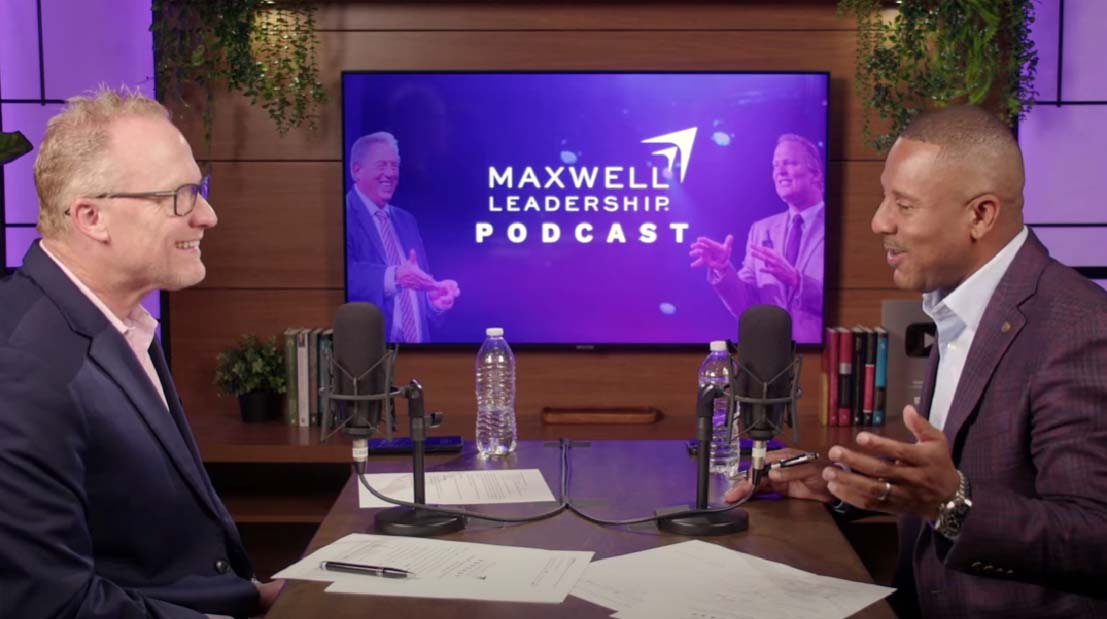
Welcome to the Maxwell Leadership Podcast. If you are the last person in the room to know something, in other words, everybody in the room knows you, knows the idea before you, or if you’re the first person. Today, Chris Goede and I are going to help you talk about, learn how to, and begin to see more and more and more, more before. Chris, we’ve heard John talk about this a couple of times.
Chris Goede:
I think this is the reason you and I are able to. To work here. This is simplicity at its best, right? More and more or less. Less. You’re going to hear that from John. I’m like, oh, well, there’s no wonder why we’re still sitting here. And we’ve heard it before because we can understand those words.
Mark Cole:
Yeah. And, and I remember the first time. It’s, it’s several years now, but I remember when John first started teaching this concept of how he sees more and more and more before, or he sees more and before is what he would say. And then he said, hey, but I’m going to take it to the next level. I’m going to go more and more and more before, which means there’s a natural state of leadership. I just see things before others and I see things more. But John today is going to get into the science of seeing more and before by going more, more and more before. Hey, podcast family, we recently just engaged you in an assessment, said, hey, talk to us, tell us what we can do.
Mark Cole:
By the way, they’re sending in questions more regularly now, which we love. You’re giving us comments, you’re giving us feedback. This assessment let us know what we all know. We want more John Maxwell. And so you’ll see today, we’re going to give you more access to John. In the coming episodes, we’re going to give you more access to John and John’s content. So grab a pen and a paper, by the way, if you want to watch this on YouTube, if you want to download the bonus resource, you can go to MaxwellPodcast.com/MoreAndBefore. John today is going to teach us two components of disciplining yourself to see more and more and more before.
Mark Cole:
Next episode will be part two, and John will give us three more. Three more points. Here we go. Here is John Maxwell.
John Maxwell:
You have never known a leader that had no vision. You’ve never heard at one time where a person says, you know why I love the leader that we have? That leader absolutely has no vision at all. My God. Doesn’t know where he’s going, doesn’t know what she’s doing. Kind of like Mr. Magoo of life. No, we follow many times the leader, because what he or she is seeing in the future, they’re seeing something. They’re seeing a picture.
John Maxwell:
A picture of the future that brings a passion today because that’s really what vision is. Vision’s what I would like to be tomorrow, but I’m passionate about it today. If there’s no passion today, it’s not a valid vision for tomorrow. So I see it clearly and I feel it burning within me. It’s something that I want to do. It’s somewhere I wanna go. It’s something that I want to accomplish in my life. And what I’ve discovered is this.
John Maxwell:
I’ve discovered that there’s one thing that all leaders have in common and only one. And I mean, it’s regardless of country culture, because I travel the world and I’m in all kind of settings. And there’s one. When somebody says, what’s the one common denominator of a leader? I’m gonna give it to you right now because there’s one. It always shows up on a leader’s life. And here’s what it is. Leaders, they see more than others see, and they see before others see. So when you see a leader, trust me on this, they see more.
John Maxwell:
They see a bigger picture than they see before. They not only see a bigger picture, but they see it quicker than anyone else. Let me explain it this way. If you’re around a table of eight of you and you’re talking about something in the leadership form and everybody else sees it before you see it, you are not the leader of the pack. Okay? You got a lot of developing to do. Because I can tell you, you get around a leader, they see more. They just see a bigger picture. You got this picture, they see this picture.
John Maxwell:
You get around the leader, they’ve already caught on. In fact, they’re already moving out of the room. They’re wanting to pursue the vision, and you’re trying to figure out what it is. One of the things about leaders is when they see it so quickly, they have an impatience about it. Let’s get going. Let’s get rolling. I mean, what are we talking about? What are we waiting for? So here’s the question. If a leader sees more than others sees and sees before others see, then I can develop myself until I can see more.
John Maxwell:
The question is, how do I begin to see more and more? How do I begin to see a bigger picture? And not only can I see more before, if I can Develop myself. I can also see more before. So I want to talk to you about how do you see more, more? How do I increase my more more? How do I increase my more before? Number one, I want you to know that there is more, more and more before out there. In other words, the first thing I wanna do is I wanna work with your thinking. Let’s talk about how you think, how I think. Because what I want you to know is in your life, there is more, more for you than what you have right now. And in your life, there is more before you than you ever had in your life. I want you, in other words, to think.
John Maxwell:
Think abundance, not scarcity. See, a lot of people, they don’t think more, more, they think less. Less. So I just want you to know that before you in front of you. And you may say, well, you know, I’m in kind of at a juncture in my life and I’m not even really quite sure where I’m going next. And it’s a little transition period. It’s okay. It’s okay.
John Maxwell:
Let me just say something to you. Here’s what I know. Here’s what I know about life. Here’s what I know about you. There’s more and more for you, and there’s more before you. And I want you to know that because I know that for sure. And I want you to think of two words right now. And these two words will just help clear all of this up for you.
John Maxwell:
The first word is creativity. And the second word is flexibility. Because the moment that you really not only understand, but you begin to embrace and live out these two words, you begin to enter into the more, more and more before world that I want for creativity. What creativity really says is this, that there is always an answer. You show me a creative person and I’m gonna tell you, at the core of their creativity is not some kind of genius or some kind of a way that they can think out of the box. We put a lot of talent to creativity, and it’s a high talent. But what I want you to understand about creative people is at the core of a creative person, you is this. They believe there is always an answer.
John Maxwell:
That’s what keeps them creative. Think about it. If you don’t think there’s an answer, how creative are you gonna be? How long are you gonna hang with that idea? How long are you gonna try to work it and percolate it and create it and make it something bigger? So creative people, they believe there is always an answer. So they already think if I really work hard and use my mind and I get creative. There’s something out there that I haven’t discovered there. Now look at the word flexibility. The word flexibility says there is more than one answer. I love this.
John Maxwell:
There’s more than one answer. And so when I start this life, I’ve got to understand that, wow, there’s not only an answer, but when I get the answer, that’s not the only answer. I was asked the other day, john, you seem to be constantly striving to improve yourself. How do you handle best? And I say, well, every day I try to do my best. And at the end of the day, if I did my best, I said, boy, I did my best, and I’m glad. I like best. But tomorrow, best is the foundation I build off of. Best can get better.
John Maxwell:
You see, best becomes a problem. When you think it’s best, then you want to mount it and have a trophy, have a celebration and take pictures. You see, what you gotta understand about best is best is best. If you’re giving your best right now. So we like best, but you gotta understand beyond best is something better than best. And so you don’t rest on the best. You don’t rest on the best because you understand you can improve it. You can always get a little bit better.
John Maxwell:
You can always excel a little bit more. You can always push it a little further. You can always climb a little bit higher. Best is one. And so when I run into people and they say, this is as good as it’s ever gonna get, I wanna walk in their life and say, my name’s John. And if it’s as good as it’s ever gonna get, I feel very sorry for you. No, you understand that best can get better and more can get more. And I want you just to understand.
John Maxwell:
Creativity says there’s always an answer. Flexibility says there’s more than one answer. So when I think I have found it, when I think I have succeeded, when I think that I have really grabbed this, what I want you to know is I’m not there yet. There is no finish line. The second thing I want to share with you is this. If you want more and more, and you want more before you have to develop a process to find more and more, there’s a way to do this. There’s a process that you have to go through to get more, more and more before. It’s one thing for me to talk to you about, have abundance, thinking, and have a passion for something bigger than what you are.
John Maxwell:
Okay? Okay. But that can get Kind of. That can get a little mystical. You’re saying I gotta get my hands on something. Do you have a system? Do you have a process? Yes, I do. Thank you very much. But here’s the process, because there is a process and this just really works. Five steps.
John Maxwell:
If you really want to get more, more and more before, here are the five. And you just. These are what I call the cycle to success. And here’s the way it works. Test, fail, learn, improve, reenter. You see, when you want more, more and more before, guess what you do? You test more, you test more. The person gets more and more, they test more, the person gets less, less. They quit testing, they quit trying, they quit throwing it out there.
John Maxwell:
And if you want to have more and more, you gotta fail more. This is the way this works. You test more and then you fail more. And then you, hey, you learn more and you improve more. And by the way, let me say something that improved that. Step four is a huge step. Learn something. Are you with me? And then when you get back up, guess what? It missed you and you’re on your way.
John Maxwell:
So you test, you fail, you learn, you improve, and then you re. Enter. I’ve practiced this. Listen to me very carefully. I don’t care how stinking good you are right now, you are not where you could be. There’s more and more. And there’s more before in front of you.
Maxwell Leadership App Ad:
Do you feel like you’re meant for more, but you’re not sure what next step to take? Whether you’re leading a team, building your business, or just trying to lead yourself. Well, you don’t need more noise. You need wisdom. Real, proven, practical wisdom. That’s why we created the Maxwell Leadership App. Inside you’ll get daily bite sized videos from John C. Maxwell and other world class thinkers designed to help you grow. Every day you’ll unlock curated playlists on personal growth, leadership, mindset, communication, confidence, and much more. All for just 9.99 a month. And here’s the best part. It’s growth on your terms, at your pace in your pocket, ready to go further and grow faster. Download the Maxwell Leadership app today. Go to MaxwellPodcast.com/App or click the link in the show notes. Try it free for seven days with the code Podcast seven. That’s podcast the number seven.
Mark Cole:
Chris.
Mark Cole:
This is kind of one of those cliffhangers. Sorry to do this to your podcast family because I’m ready for the other three. I don’t want to wait a week. Right?
Chris Goede:
Right.
Mark Cole:
Because he’s just got me in this mode. And it kind of left me on a cliffhanger, sit here saying, I want to teach more. And so John is going to teach us next week. But I’m happy and excited to talk through, dig through these two things with you.
Chris Goede:
Yeah. We said in the intro, we talked about the simplicity of the words. Yeah. But the profoundness behind what we’re going to talk about. And John’s thoughts has changed so many leaders, including you and I, and specifically you and the journey that you’ve been on and all the work that we’ve done in organizations. It was fascinating. I was reading the Gallup study that was talking about people are just hungry for their leaders to have direction, to have the vision. But only 22%, they said only 22% of them believe that their leaders have a vision and are passionate about it.
Chris Goede:
And so that means what John’s talking about right here with the more and more before anybody else is not happening in organizations. And we’re going to take a look today behind the curtain with you specifically because you’re moving right now from this president and CEO role to we’ve named a new president, first time ever. It’s something that you have had to let go emotionally years.
Mark Cole:
Yeah.
Chris Goede:
And now you’re going to, you’re going to be acting as our CEO going forward. Why is this topic so important? Take us behind the scenes. Just a little bit of maybe some mentoring that you, that John has had with you. And the passion, you know, John talks about having a passion for the vision that you have now sitting in that CEO seat by yourself, not the president and going, man, I’ve got to be thinking out in front.
Mark Cole:
Well, it was inspired with my friend. I’ve told this story, I think on the podcast before. It’s inspired by my friend Ed Bastian, who has grown up in the ranks of Delta Airlines and is now the CEO. And John and I were having dinner with him, lunch with him one day after he had quit being president and started becoming the CEO and asked the question, Ed, what’s the difference between being a president and CEO and just the CEO, no president. And he said, well, I’m now looking at where the business is going and not just going in the next month or two, but where it’s going in the next six to 12 months. And I’m not encumbered by the day to day operations. And I’m not saying Ed is not responsible or aware of the day to day operations, but that was a big distinction. And so for the last five years, I have not only taken the responsibility of ownership which comes with its weight.
Mark Cole:
I’ve come taken the continued, the weight of leadership, operational leadership of the organization. I’ve also taken this new role that’s new for me. What is the future look like? What’s five years, 10 years down the road look like? John’s always had that. John’s now ready to help me see more, more and more before in the vision area, where could we go? What’s been interesting, Chris, you’ve been a part of this. Our growth in every area of our business, every impact number, every KPI has doubled. What we did the previous 10 years as president and CEO and what it’s done in the last five years as president, CEO and owner. And yet there is this more, more and more before that. John and I are going, that’s not enough.
Mark Cole:
That’s not enough. You better free yourself up to be able to get behind the scenes and see or in front of the scenes really to see what else is out there and what’s more and more and.
Chris Goede:
More before and that as John says, what’s burning right inside of you. Before we dive in to the two principles that John gave us today, I want to look at the other side of it for you for just a minute. What’s been the hardest part for you as a leader? Knowing the day to day and then knowing you had to. What’s been the hardest part for you to think about allowing the opportunity of day to day be another leader and for you to go, oh, now it is solely my 100% KPI because we’re looking at you as the leader and saying, hey, six to 12 months ahead, this is where we need to be. What’s been the hardest part for you about that as a leader?
Mark Cole:
Well, I think so. Anybody that has been in a second chair with a brilliant leader and you guys know who you are out there, I’ve been in a second chair behind a not brilliant leader. Didn’t feel the same way.
Chris Goede:
Sure.
Mark Cole:
But when you’re, when you’re in a second chair and you’re working alongside a brilliant leader like I have been for 15 years in a second chair, the first thing that I’ll tell you is the hardest is thinking that I know how to do it, then being given the opportunity to do it and going, oh Lord, it’s kind of like one of my grandchildren now is ready for the bike without the training wheels. He’s five, six years old and he’s ready for the training wheel. He’s going, I got this, I got this. Look how good I am take the training wheels off Paul, and I give it to him. And after day one, he went, can we put the training wheels back on? And I feel a little bit like my grandson to say, for five years I got this vision thing. And then all of a sudden I go, john, can we put the training wheels back on? I think there’s some more stuff I need to learn. So the first thing is the intimidation of a brand and leadership mantle that you’re carrying, that we’re carrying, and realizing there’s more to this vision thing than meets the eye. When you’re playing at this level, that’s number one.
Mark Cole:
I think the second thing is, is giving up the thing I’m comfortable with. I’m pretty comfortable. I’ve got. I’ve got a pretty good track record of impact and influence and success and production and giving that up and going to something I’m not very good at. Come on, leaders. Anybody feel it? When you’re pretty good at something and that’s the thing you have to give to go to something you’re not that good at. I think that it’s a little intimidating. It’s a little, am I doing the right thing? It’s a little questioning.
Mark Cole:
And to be honest with you, it’s a little paralyzing a little bit as well.
Chris Goede:
Well, all of that, I think all of us would agree, is totally acceptable. Right. Especially when you’re. You’re gifted in one area, you become comfortable, not complacent. Comfortable.
Mark Cole:
Yeah.
Chris Goede:
In the regular and the routine to now, now the. Everybody’s like, hey, Mark, where are we going the next 612 months? Where is that? And the benefit that you have is you have the best still riding shotgun right with you right there. And so part of him working with you, these things that he shared with our listeners and those that are viewing, they weren’t new to us because you’ve been under his tutelage for so long. But I want to dive into these and I want to give some practical thoughts. I want your leadership to come out in what this looks like. I think all of these that he’s going to explain, not only these two, but when we get to next week with the next three, they are learned behaviors, because I think you would say you came into the organization without really maybe having these or understanding them. And through your journey of leadership and mentorship by John, they become part of who you are and you’re ready for that next because they’re learned behaviors. Why do I say that? I say that because there are leaders out There that are leading small organizations.
Chris Goede:
Maybe, maybe they’re leading the organization by themselves. Maybe they have a big team and they’re like, well, I can’t do that. Well, we’re hoping not only after today and hearing from Mark, but also next week that you’re going to have a roadmap to be able to do that because they’re learn, they’re learning behaviors. The first one we want to talk about, this one, I swear, this one, I learned this from John and I was like, man, it’s amazing. He lives this out, which is the, the scarcity versus the abundance mindset. I mean, there is no scarcity bone in John Maxwell. Right. And someone that maybe is leading from a scarcity, they overprotect, right.
Chris Goede:
They keep, keep things in a box. They stunt growth. Whereas, man, I’ve just seen him, seen him lead with and teach on abundance.
Mark Cole:
Yeah.
Chris Goede:
And that just creates so much innovation. So as you think about this, what was it or what is it that comes out of John’s thinking around abundance that helps you see more and more and before others see inside our organization?
Mark Cole:
It’s a discipline. You know, I used to think it was a gift. It’s a discipline. I did just on the day that we’re recording this podcast, I just did a whole teaching to a couple hundred our certified coaches in a mentorship program on the law of the lid. John wrote about the law of the LID and the 21 Laws of Leadership. In the Law of the lid, John contrasts a lifter of opportunity and a limiter. Someone that limits it, Somebody that puts a ceiling on it, somebody that lifts it, puts an escalator on it is his illustration. And in that concept of the law of the lid, John says that the discipline of lifting your lid lies in your perspective to scarcity or abundance.
Mark Cole:
What he’s really saying is if you will challenge yourself to think abundance, think abundance in your courage, think abundance in opportunity, think abundance in empowerment. And he lists out these things, then you will develop a more more and a more before perspective. But if you develop this limiting idea of entitlement, of scarcity, oh my, what I have is mine and I’ve got to keep it, and I can’t empower. If you train yourself to think, think in a scarcity mindset, you’re going to train yourself to see less. You’re going to train yourself to see the problems and not the opportunities. And while John, I think, was gifted with some great gifts inside of him, some great strengths that empower him to see opportunities, I also am aware More than I’ve ever been. There’s a learning to it. There’s a science to it.
Mark Cole:
There is a muscle to it that when you exercise it, you can begin to see more and more and more before.
Chris Goede:
And he has completely, time and time again stressed us out with this thinking in protecting his brand, protecting his mantle for you and this and that, he’s like, no, no, it’s okay. Like, if we’re going to add value to people and this is going to lift their lid, like, let’s go, let’s do it. Whatever that.
Mark Cole:
Watch this. Sorry to interrupt.
Chris Goede:
Good.
Mark Cole:
But just now, right before we did this podcast recording, you brought me a question that we had to answer that it is a big investment. A big investment. I know what John’s going to do. I know what his answer is going to be. And I told you that.
Chris Goede:
You did.
Mark Cole:
I get him on the phone. Here’s how he solved the problem. Yeah, Mark, if we did this, if we brought 10 more people over here, if we sold this right here, we can solve that. There’s the solve right there. What I love about John is I can now anticipate. Guys, this is so important. Leaders that want your team to begin to think abundance. It begins when you display or demonstrate abundance.
Mark Cole:
Got it? We’re sitting here going, we’ve never spent that before. We’ve never taken on that much responsibility before. That’s how you and I are looking at it. I knew what the answer was going to be. I didn’t know how he was going to get there. And in this moment in the studio just 15 minutes ago, I called John with a big opportunity with a ton of risk and a whole lot of cost, and he not only gives me the answer I knew he was going to give me, he gave me how he arrived at that answer. He began to solve it with an abundance thinking, what if we expand this? What if we do this? How many people can we get here? And he solves the problem from an abundance standpoint, not from a cost and saving standpoint. There was no scarcity in him just a moment ago.
Chris Goede:
He did it in less than five minutes. And what did he do? Back to your lesson this morning to hundreds of our team members. He’s lifting the lid on that experience. And by the way, every single person that will be invited to join that experience, the lid will be completely blown off your process.
Mark Cole:
Now, this was your point. And again, I’m so sorry to use something that’s so inside right here, but I think it’s illustrating out well. It is to Me and you.
Chris Goede:
Okay.
Mark Cole:
But immediately you went, yeah, John and the long tail on that right there for next year and the next year and the next year. Here’s what he did. He modeled to you and I going into that call. Oh, my. How we’re going to do this. He modeled in the call, how we were going to do it next year. And you picked up on it and said, this is how we’re going to do it on year two, three and four, five. Two.
Chris Goede:
Yeah, yeah. It’s. It’s just when you’re around it. And so let me just put a little bit of teaser, because I know what’s coming next week. We’re going to talk about questions. We’re going to talk about people. You surround yourself. You don’t want to miss next week, but Mark has given you an incredible teaser on the way that you can begin to see more and more.
Chris Goede:
And by the way, to Mark’s point, you don’t have to be the CEO to live this out. This is a learned skill. So let me transition in a couple more points that John talks here about that I want you to unpack, because this illustration of what you just modeled, we knew you knew the answer, and you asked great questions to get them there. But there’s always an answer with John. Always. And there’s always more than one answer, which is why he often says, hey, when we have a meeting, I’m going to bring an answer. But if we leave with the same answer, you’re not going to be invited back to that meeting because we did not see more and more than we did before we came in the meeting. This creativity and flexibility as a leader, some people get tied into.
Chris Goede:
This is my role. This is what the vision is of the company, this and that. And it’s scarcity. They get a little bit of constraint around that. And that is not how you and John play. Matter of fact, because we’re on the other side of that, a separate podcast will be without Mark, and we’ll tell you what it feels like to be on the other side of that.
Mark Cole:
Let me tell you, you’re sitting there saying, some people think like that. They’re sitting. I’m going, it’s me. Because next to John, y’ all have no idea.
Chris Goede:
Okay, so let me get us back on track right here before. I’m never invited back to another podcast. But this creativity and flexibility, like the way you two work together and. And solve problems and. And present more than one answer. Again, those leaders that are listening, this is a learned skill. When you look Back on your journey, leadership journey. How have you seen yourself? What was it that allowed you to continue to grow in that area as a leader, to be.
Chris Goede:
To have the adaptability, which is a massive trait to have as a leader in any situation around the vision of seeing more and more of what Maxwell Leadership and the mantle can actually be about going forward.
Mark Cole:
I think it starts Chris, and this is really important. Podcast flaming I’m looking you right in the eyes. If you’re watching YouTube, you need to know if you have a bent towards scarcity or abundance. It doesn’t matter right or wrong. Don’t try to be something that you’re not. Know you’re bent because it’s going to be important as you work with teams. So I would take you back 35 years ago and I would tell you I was an abundant. Let’s figure this thing out.
Mark Cole:
Let’s go sell our way out of anything. I was an abundant guy. I’ll figure this thing out. When I started working alongside John, who is off the chart abundant. He’s so abundant that sometimes we don’t have enough to pay for what he’s abundant is about. He’s just true. He’s just abundant. He’s over the top.
Mark Cole:
I figured out to work well with John and to serve John. Well about 18 years ago as kind of his business manager. I wasn’t even CEO yet. I figured out I needed to bring a more realistic scarcity mindset to really be a good partner with John. I became adaptive in how I naturally see things.
Chris Goede:
Okay, makes sense.
Mark Cole:
Very important. Again, gang, I’m going to tell you know naturally where you are because in some settings you’re going to have to become adaptive. For the last 10 years, 10 years from 2010 to 2020, I was adaptive to being more realistic or scarcity because that’s what John and I’s partnership needed. I needed to be the implementer in EOS language. John’s the visionary. Well, in the last five years, I’ve tried to get out of the adaptive back into the natural and it’s been extremely hard. Only in the last six months, really three months, when I saw a path forward to really unencumber myself.
Chris Goede:
That’s what I was going to ask from the adaptive. Yeah.
Mark Cole:
As I become back to man, we got this thing figured out. We got this thing figured out. But now I’m relearning how to do it at the next level. Back to more, more, more. Before, because I was in my adaptive state of realism or scarcity for so long. I’m Having to come back and relearn, become the student with John on how he gets to more, more and more before so quickly.
Chris Goede:
Well, and I want to say this too, when you were talking about, as you’re a leadership team, as an individual contributor inside organizations, you would come in and we could begin to see the shift in you knowing the change that was coming to give you the space to be able to think like that. You’d come into meetings and be like, hey, like, give me some ideas, like where are, what is, what could we be doing? And if the team didn’t have them, that’s frustrating to you because you have, you have graduated into a thinking of that because John has mentored and it’s a learned skill that you’ve been practicing for a long time. And now you step into another environment and it just shows up in spades because that’s what your daily thinking is like. And I think the point here, leaders is, number one, don’t get so, so stringent in what our vision is and where we’re going and what the cap is. Be a lid lifter in the way that you’re thinking about things and having creativity and flexibility to be able to take it to the next level. Which then John goes in and he talks about, you know, the best and don’t ever settle on the best. I was having a conversation actually just this morning on the way in the studio with one of our corporate facilitators and coaches. He’s also a Maxwell Certified Team member, Tony Lynch.
Chris Goede:
And we were talking about a culture exercise with an organization that we did that he did where he was like, he put on the board, he said, tell me about a good culture. And then he said, okay, that’s great. He said, now tell me what a great culture looks like. And I asked him, I said, hey, Tony, how hard was it to get them so interesting to think about the fact they just told you what a good culture was to get to a great culture. Like, what’d you have to do to facilitate that out? And we had a fantastic conversation.
Mark Cole:
That’s a great thought.
Chris Goede:
And Tony was like, oh, it’s pretty simple. Let me just give you an example, right? And he walked me through an example of, hey, we want to recognize Mark Cole for leading this way. Okay, that’s a good culture. Recognize great culture. Because I had to give him, flesh it out to me because I didn’t understand. He goes, a great culture would be honoring the values of the company while recognizing Mark Cole for what he did. And I was like, oh, you’re onto something. And I walked into the studio, we listened to John just a minute ago.
Chris Goede:
And this is exactly what John is talking about right here when he’s talking about, man, don’t rest on the fact that what you think is a good vision. So where you’re at in your leadership as CEO, you have a vision for max leadership, and you’ve had one. And it has evolved over time. We thought it was incredible. At certain stages, we’re like, that’s the best it’s ever going to get. And it just keeps climbing. It just keeps getting bigger. Your vision now for John’s mantle and Maxwell Leadership is continuing 10x what it was 18 months ago.
Chris Goede:
Fair enough, fair enough. How do you get there? What are the questions you ask yourself? What are the challenges inside? When you’re talking to Mark Cole behind the scenes, there’s no team members around. John’s not around to saying, man, how can that be better? What can we do differently? Because everyone deserves to be led. Well, what’s that inner conversation like with Mark Cole?
Mark Cole:
Well, let me. Let me again try to make it applicable to the non Mark out there or the non Chris out there. 1. I’ve already said this once. You’ve got to know your bent. Are you good at ideating? Are you good at envisioning? Are you good at more, more, more before? And if you’re not, don’t try to force yourself to be it. So know your role number two, know your time. So there’s a.
Mark Cole:
There’s a. I know what I’m good at. Know what the times is requiring of you and your leadership right now and learn from that. And then finally know what the organization’s need is. So know you’re bent. Know your time and know the need.
Chris Goede:
And align that and make sure that.
Mark Cole:
They’re in alignment right now. In this window of John Maxwell’s time, John continues. By the way, your assessment. Thank you for giving us the assessment. You said, give us more John. Give us more John. Let me tell you, he’s in his prime. I want to hear more of John real quick.
Chris Goede:
You know what’s crazy? He doesn’t even understand that you and I were on a call with him yesterday. He’s like, guys, I don’t understand. I want to introduce all these thought leaders. And we just have people telling us that they want more John.
Mark Cole:
This is in another product, not even podcasts.
Chris Goede:
Yeah, and he doesn’t even realize it.
Mark Cole:
He doesn’t. That’s been his genius for years, though. Chris. You know that that grounded humility that’s hard to describe. He’s sitting there and we’re in this time. The organization needs me to start exercising this muscle. I have a strength. I can be abundant.
Mark Cole:
It is my time, but it’s the organization’s need and match those three together. And what’s been happening for us is very magical and it’s a different thing. And boy, the joy, the peace, the sense of accomplishment, the sense of certainty that has come over all of our leadership team since we’ve moved into the organization’s need. We need to be here. John wants us here. The future demands that we get here so that we can continue the impact.
Chris Goede:
Yeah, I totally agree. The word certainty that you just said, I think that’s how I feel on the other side of that. And I think when you go through that process of knowing and keep pushing and getting better, you’re going to get to a place that your team, you will feel certain about that. By the way, it won’t last very long because you’ll continue to push to the next level, which we’re fully expecting from Mark. The second point principle John brings up and we’ll kind of wrap up at this at this point, but I want you to talk a little bit about this from again where we’re at. How as a leader do we have that vision? We’re passionate about it moving forward, which what John calls the cycle of success. You’re extremely familiar with it. Can you give us some practical applications or maybe just a thought or an idea when it comes to what you’re focused on as a CEO in this vision more and more before others, before we do.
Chris Goede:
What does that look like? I know I probably have been on the other side of some of these. Test fail, learn. We’re going to improve and re enter. But. But give us a little bit of insight on that from your seat.
Mark Cole:
Yeah, I’ll tell you an email I sent this morning and by the way, if you got it, sorry about that, but this morning I needed to announce to again hundreds of our coaches that in the, in the next month we’re going to be doing a program called Global Youth Initiative. Now, the Global Youth Initiative is a volunteer effort by our paid certified team members, people that are out there building a business. It is our give back to our communities. And over the course of the last several years, we have volunteered and trained 2.2 million students in the Global Youth Initiative. This is anti bullying. This is self respect. These are about four core concepts that we have taught in YMCAs and school assemblies. 2.2 million.
Mark Cole:
This morning they wanted me to announce that it’s coming up next month. I got my announcement ready, but the next thing I did is I grabbed my laptop, I quit studying about my lesson, and I pounded out an email to our four members of our content development team, to our unit leaders over that division, over the Global Youth initiative. And I said, by the end of October. So I’m going to announce that everybody’s participating, but in October, you’re going to ask yourself the question, is this the best we can do? Can this thing get better? Where could we improve? And by the October 31st, that’ll let you know when this was. By October 31st, I want a plan on how we’re going to improve in 2026. That’s what great leaders do. They see more and more and more. Before I was getting ready to announce, hey, we’ve got 2.2 million, let’s get it to 2.5 in October.
Mark Cole:
And I went, I’ll announce that. But in 2026, I expect a better plan. Six months ago, I’d have just been, how do we execute in October? How do we do in October? But over the last couple of months, by exercising myself, my leadership to think about the Future. I’m announcing 2025, but I’m thinking 2026.
Chris Goede:
Yeah.
Mark Cole:
And our team is now for 45 days. This is the first time I’ve ever given somebody a 45 day project. Most of the time it’s a four or five day project or four to five hours. Y’ all are that it was a 45 day project to go and participate and get it better. Hey, we’re gonna get. I’m so excited about next week and I’m gonna tell you, Chris, I’m ready. Let’s go. Next episode’s gonna be incredible.
Mark Cole:
Before I do that, many of you know this, we have the Maxwell Leadership app. And it’s an app that provides daily videos, daily ideas. Chris, you’re on it. You shoot some videos on there and John Maxwell’s on it. In fact, there’s a brilliant video on there right now from John Maxwell, Expecting problems and giving solutions. And I’m just going to tell you, it’s a brilliant four or five minute video. And we’re going to give you as a podcast listener, we’re going to give you a seven day free trial to try the Maxwell Leadership App out. You will just need to go in the show notes, there’s a link there and you can use the promotion code podcast7.
Mark Cole:
Podcast7. And that will get you that seven day free trial. We had a great question this week that I wanted to address and if you’ll give me just a minute Podcast listeners, this is a question from Steve, who listened to the podcast Discipline keeps you growing. Steve said, I’ve been meaning to ask while I understand the importance of discipline, drive, focus, goals, how do I accomplish that while fighting ADD and adhd? And I love this because one of my teammates called me on my drive into the office this morning and was asking the question about a child of theirs that is going through some ADD and ADHD questions and asking the question is there leadership opportunity there? We went into one of our team members, Brianna, who has ADHD and here’s what Brianna said. So I love this because it’s a great question. I love it because it’s a teammate giving the answer right? This is what Brianna said. She said get connected with a community of people who have adhd. There’s social media, there’s support groups and find out how they manage their systems or their symptoms.
Mark Cole:
John says much of his best thinking has been done by others and this is true for the ADHD community as well. Second thing Brianna said is take note of your attention distraction patterns and adjust your physical environment accordingly. No solution is too outlandish if it works. Finally, Brianna says at the end of the day, ADHD is a mental health condition. So please seek mental health professionals because they will help you, especially the ones that specialize in adhd. Steve, thank you for your question teammate. Brianna, thank you for your answer. By the way, that’s what we do here because everyone deserves to be led work.
Maxwell Leadership Certified Team Ad:
Hey podcast listeners, many of you listening right now would probably love the autonomy that comes with owning your own business or becoming a coach that helps other businesses succeed. Well, we have a phenomenal strategy where you are 100% in control of your own business, earning income on your own terms and have access to to the people, tools and resources you need to build a thriving leadership development business. When you become a Maxwell Leadership Certified Team Member, you join a global community of entrepreneurs led by our expert team of mentors and faculty including John C. Maxwell. You’ll also get one of the top leadership certifications in the world next to your name, giving you the boost you need to get started. Visit us online at MaxwellLeadership.com/JoinTheTeam to find out more.
Transcript created by Castmagic.



Be the first to comment on "A Leader Sees More and Before (Part 1)"