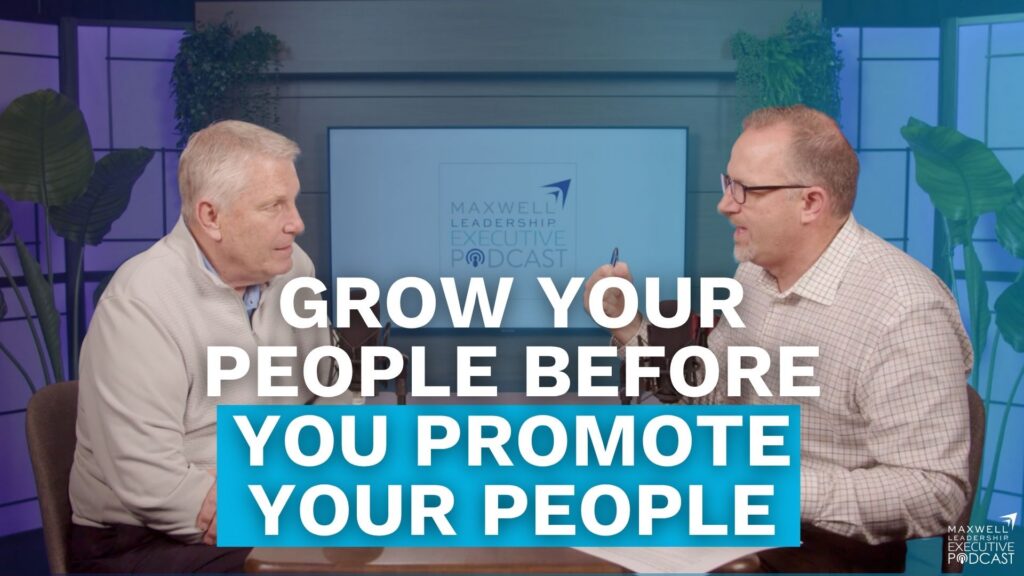
In this episode, Perry Holley and Chris Goede explore why organizations should focus on growing their people before promoting them. They discuss the pitfalls of promoting high performers without adequate leadership development and how this impacts team engagement and organizational performance. They share research-based strategies for identifying and preparing high-potential employees for leadership roles, stressing the importance of intentional development plans. Listeners will gain actionable insights on fostering a culture of growth, ensuring new leaders are equipped to succeed, and driving stronger results across their teams.
Perry Holley:
Welcome to the Maxwell Leadership Executive Podcast where our goal is to help you increase your reputation as a leader, increase your ability to influence others, and increase your ability to fully engage your team to deliver remarkable results. Hi, I’m Perry Holley, a Maxwell Leadership facilitator and coach.
Chris Goede:
And I’m Chris Goede, executive vice president, Maxwell Leadership. Welcome and thank you for joining us. I want to encourage you to go to MaxwellLeadership.com/ExecutivePodcast before we get started there. You’ll be able to download the learner’s guide. You’ll also be able to leave some information if you’re interested in some five levels leadership training. Everything that we base these conversations off of, or maybe even some executive leadership coaching, we would love to take that journey with you. Well, one of our values here at Maxwell Leadership is growth. Love growth.
Chris Goede:
And so I love the title. Perry came up with us for today. We’re going to talk about grow your people before you promote. Whoa.
Perry Holley:
Your people before being the operative word.
Chris Goede:
That’s right. That’s right. A lot of organization, you know, you think promotion is, I’m developing my people because I promoted them. And that, that absolutely does not. Does not do it. Matter of fact, when you do that. And we see this a lot, don’t we? We see this where leaders get in trouble and then we get a phone call and we’re like, we need to develop our leaders. And we say, absolutely.
Chris Goede:
We jump in and oh, by the way, we probably should have done this before we got that promotion. And so today we’re going to unpack. Perry and I love to read and do research in Harvard Business Review and Gallup. And so really, the content coming out today is the research from Corey Tatel and Andy Stewart about the Peter principle and why so many organizations unintentionally turn their best performers into struggling managers.
Perry Holley:
Yep. So the Peter principal here, you don’t. You don’t hear that much.
Chris Goede:
No, he caught me off guard when I reviewed.
Perry Holley:
I was growing up. It was, you know, just a little point of interest. It was kind of in the, I don’t know, 1969 somehow. Yeah. Before you were born. That’s right. Before you were born. When I was in college, that was it.
Perry Holley:
Was it Lawrence Peter and Raymond hall and they. It was just somebody that gets promoted and promoted until one day they’re no longer competent. So you get. You get promoted into a place where you’re not competent. But here’s how it plays out in the world. And what we see in our coaching business all the time is that you’re the best engineer, you’re the best salesperson, you’re the top nurse. You’re really a top individual contributor in whatever role you’re in. And your boss says, hey, we have an opening year, you’d like to promote you into leadership.
Perry Holley:
And now they’re a manager and suddenly they, the skills that made them successful are no longer skills that are required for this job. And they go from having done work, the one doing the work, to leading others who are doing the work. And it’s just, it causes large problems for organizations when they have unprepared leaders in there. This research really shows that out.
Chris Goede:
You know, John wrote a book called Leaders Shift and it’s the shifts that we need to make as leaders and leaders. Let me again just define really quick. Leaders is about influence. So we’re all leaders, but when you begin to move up different ranks and have different responsibilities, you begin to lead other people and develop them. That’s what John calls us in leadership. Going from the soloist to the conductor.
Perry Holley:
I love that.
Chris Goede:
Right. And he talks about in the book where you know you’re, you can be a lead violinist and the next day you walk in, they’re like, hey, you’re going to go ahead and lead the orchestra. Now I have no idea what that means. You do, you have a music background but you have no idea how to lead the orchestra. You know how to play the violin really well. And we see this a lot in, especially in the sales world where the number one individual right. Contributor is like, hey, you’re now the leader. And so what do they do? They can’t figure out leading.
Chris Goede:
So they’re going to try to super produce. They’re going to over produce and try to perform at a higher level to cover for the team instead of. And it just becomes a mess. And then they burn out, they leave, they lose that. And then that’s why we’re like, we should have been doing this ahead of time.
Perry Holley:
That’s how it happened to me. I got this dream job. I wanted to be an IBM salesman and did it for a few years, had some great success and got the numbers and was making money. And then they come in and say, hey, we’re going to promote you to first line manager. You’re now a IBM sales manager. I thought, wow, this is good. I finally made it. I’m finally the boss and I get out there.
Perry Holley:
Back in the day, they moved you to a new city.
Chris Goede:
I was going to say, where did you move to?
Perry Holley:
Yeah, yeah, you had to go from, from you were in one city. It was kind of like whitt this relocation because they would move you to a place where nobody knew your sins. You know, today it’s really tough because they don’t do that. You, you actually one day you’re on the team and, and on Monday you come in, you’re leading the team of the people you used to work with.
Chris Goede:
That’s.
Perry Holley:
We have a podcast on that, by the way, that we did years ago. But this idea that I became over, over a weekend became a manager and now I’m leading a team of 11 salespeople and, and I was a soloist, doing great. Now I’m leading the orchestra. I don’t know how to lead this orchestra. So what did I do? I became super solo, a super salesperson, got in everybody’s territory, upset everyone didn’t lead and it just caused a churn on the team. That really was a turning point in my life because I realized I didn’t have it. And so I needed to get trained. And IBM is a leadership training company and there were classes coming for me in my early days of being a manager, but maybe we should have done a little bit before I had that.
Perry Holley:
So Gallup looked at this research. The guys you mentioned were writing about this and they looked at frontline supervisors and managers and day to day operation people in all kinds of industries across the board. And they found that 65% of these frontline leaders got their role because they were good at their previous job and not because they were good with people, not because they had a leadership aptitude, just because they were high performers. And I think this happens a lot. Only 30% were placed into leadership because of actual supervisory skills about so a very small percentage tied into that. So kind of consistent with what we see, 100%.
Chris Goede:
And then we talk a lot about with organizations, we talk a lot about consistent language, consistent culture, consistent engagement level. And what Gal goes on to say in this report is that the, the engagement level of those that get promoted without being developed properly, then they become unengaged, they become disengaged. Thank you. Yeah. Where they are 31% is what the number says, is that that they’re bought in. I mean, 69% of the time they’re completely aloof inside the organization because they’re tied into the fact they weren’t developed and got into a place. Now the key about this though is that when we talk about driving engagement, every level of the organization, one of the things that we’re big on is that your direct leader, your direct Supervisor is responsible for your engagement level. So let’s say I’m reporting directly to you and you’re not engaged because you were promoted without being developed.
Chris Goede:
Well, if you’re not engaged, I’m not going to be engaged. Right. It’s just going to kind of rub off on that. And so what ends up happening is then 70% of the team of those leaders that weren’t developed are not even engaged. It just becomes a ripple effect. And then it has a huge impact on the culture of your organization. And it all has to go back to the managers and the leaders inside your company. It’s just cascading through them.
Perry Holley:
And we’re going to go here. As you think about how uncomfortable this may be for the person, it also has ramifications through the whole organization. I was kind of relating it to. We teach the law of the lid. John talks about the law of the LID and the 21 laws and about how that your ability to lead or influence will determine how effective you are in all of work, in all of life, really. But when you promote someone with a low leadership lid, you basically just capped the team. And John will teach this in the law of the lid that your team is not going to outgrow you, your team is not going to outperform you, your team is not going to go. You’re the lid on the team.
Perry Holley:
And so if you think I’m an executive in an organization, I’m going to promote someone with no leadership, a very low leadership lid, no leadership ability. But they were, they were top salesmen, right? Wow. I, I’m just. Now I’ve just handicapped the department that I put him in front of. And do I really want to do that?
Chris Goede:
Well, it. So when you do this, how, how many of you, you’re riding along, you’re listening, maybe you’re exercising, sitting there, taking notes and you go, man, I can remember working in an organization that felt like that low morale, that feeling. You’re like, what am I? I don’t want to get. Well, the thing is that it’s not just a feeling. It actually is something that they can measure. And it goes on to talk about the fact that even in this research with the National Bureau of Economic Research, it backs it up where it says 7.5% decline in sales performance. So the production now, engagement is down. Now all of a sudden the production is down when in this case, the top salesperson were promoted into the management role when they shouldn’t have been as an.
Chris Goede:
Or they, they, they should have maybe, but not the right time. Right. They weren’t developed properly. So not only did you then use lose your top producer, you also gained it very unprepared leader that are now leading other leaders that are not going to produce. And it just becomes a ripple effect. Okay, though, real quick, front goes on. Last statistic here. Frontline workers already have lower engagement anyways than.
Chris Goede:
Than some of the higher ones. And that’s at 26%. I was speaking the other day and I was talking a little bit about the engagement levels and just talking about how. Just breaks my heart to think about those statistics and organizations we’re privileged to work in a. We got our own problems. Okay. I always tell people, you got people
Perry Holley:
engagement, not one of them, but we are like, let’s. Yeah. Hey.
Chris Goede:
And so what’s John called? He goes high energy, low iq. That’s probably part of our problem. And I just go, man, what would it like to be work, get up every day and go to work when only 26% of people are engaged? That would be miserable.
Perry Holley:
That’s why the quiet quitting thing was such a big deal.
Chris Goede:
100%. Yeah.
Perry Holley:
Well, Gallup, just before we talk about maybe some practical things to do that these high engagement leaders, their teams had a much higher percent of engagement than the average leader. So people do what people see. So it’s that people are watching your leader and their engagement kind of follows the leader engagement. But when you mis. Select a leader based on, you know, just their individual contributor status, you’re affecting not just one role, but the whole team. So that that disengagement, like you’re saying, falls. That’s why I titled this today about grow your leaders before you promote your leaders. Because many of us do the opposite.
Perry Holley:
We promote first and then try to train later. I just saw a graphic this morning about how a sports team practice. They got practice, practice, practice, perform, practice, practice, practice, perform, business, perform, perform, perform, perform, perform. And then at the very end that one leadership training day. One leadership training day out here.
Chris Goede:
Yeah.
Perry Holley:
And so you didn’t.
Chris Goede:
That’s awesome.
Perry Holley:
I had a graphic for that. But. And we often barely train when it comes to doing that. But only 45% of frontline supervisors receive leadership training. In the last year, they said nearly one in four have never received any management or leadership training. Okay, that’s making me cry. Yeah, that’s, you know, kind of astonishing when you realize that manager influences 70% of the engagement you’re feeling is influenced by your manager.
Chris Goede:
Yeah.
Perry Holley:
Oh, by the leader. So. Wow.
Chris Goede:
Yeah. Gallup found two solutions okay, so to change these outcomes. So I love it. They gave us the data. Here’s a problem. Here’s a couple of solutions. Select leaders based on leadership talent. What? Yeah, like, imagine that.
Chris Goede:
Like, and here’s the thing. You can, you know it, you can see it, and you can see those that, that have some of that initial leadership talent. Second thing is to train and develop them before and early in their role. And developing is such a big thing. Perry and I talk a lot about the difference between training and developing. And that training comes from the IQ side a lot. The developing comes from the EQ side. But, man, are we training them before they get promoted and then even early in their new role.
Chris Goede:
As you go through this process, they say structured interviews and leadership assessments increased revenue per manager by 21% and profit in the company by 32%. And then if you’re a supervisor or a leader who actually received training in the past year, you were 79% more likely to be engaged, 19% less burnout, which is a huge issue right now. It’s one of the reasons why Perry jumped in with Valerie Burton. We wrote a resilience training piece. And then 11% less likely to look for another job. So that’s in our words, that’s retention, productivity, culture. All of that is tied to developing our leaders before we promote them.
Perry Holley:
Right.
Chris Goede:
And that’s why we’re talking about this today.
Perry Holley:
Well, I think about John Maxwell. Again, 21 laws tough, the law of process, that leadership doesn’t develop in a day, it develops day by day. And that you’re, you need to be constantly doing something to help get people on the track about studying leadership, maybe something small on a daily basis. Don’t treat the promotion as a reward that you’re really good in your job. So we’re going to promote you that there’s other rewards. Promotion needs to be for other reasons. You’re not. It’s responsibility. You’re giving them over of your people.
Chris Goede:
Right.
Perry Holley:
I also think about the law of the picture that people do what people see. If we place unprepared leaders in places of leadership over our teams, and that’s what you see. You’re getting this unprepared, unqualified leader. Not basically not any fault of theirs, but they don’t know how to lead, and that’s what you see, then it’s just going to perpetrate this through the organization. It just feeds on itself. So I think.
Chris Goede:
And then you’re sitting there going, well, if he or she, it’s not going to Take much for me. So I’m just going to go or be discouraged.
Perry Holley:
Your retention numbers you’re talking about, and now I’m losing talent because we got bad leadership. So let’s talk about what to do about it and we’ll wrap this up.
Chris Goede:
All right, so let’s talk about what leaders should be doing to prepare their high potential, high potentials for the next level. First we talked about we got to identify them, be on the lookout for them. Be, have it in your awareness and, and then be thinking about on your team who, who’s your number two guy or gal like Mark Cole, our CEO, you know, talks about it when we walk into a meeting, says, hey, if you were not here, who’s going to sit in your seat? If you don’t have an answer, that’s a problem. You’re not thinking about who that next person is.
Perry Holley:
Well, I hear a lot, I get this a lot. People, I mean most people say, yeah, duh, we should have a number two. How do you. I get a lot of people say, well, how do you identify? Are there, what is, what’s, what’s your experience on that? Identifying who’s up next?
Chris Goede:
We’ve talked a lot about this individual contributor, right? Like producing. We would hope that everybody on our team should be producing. They should be hitting their marks or, you know, maybe there’s some other things we need to work on. But one of the more than one several things for, for us is we look for are they coachable? Maybe even are they requesting coaching about their performance, about even if they’re hitting their marks, like, how can I do this better? Are they accountable? Do they take ownership of, of things when they, when they go wrong and maybe deflect ownership when they go right to the team, like what, what does that look like? Where’s their eq? Do they have initiative? Do we see them developing other people even not in a leadership. That’s what we talk about, influence. Hey, Perry, come along like I’m going to go show you how I did this. So the next time you’re talking to a client, you can do this, you start to see those things in a person. I think that’s something that you better pay attention to right away.
Perry Holley:
And I don’t think you should miss. Overlook the opportunities in the moment before they’re promoted to let them run a project and actually make them the leader of the project. Let them understand what that feels like. Make them make the calls on that. Get them some of that leadership responsibility. Running meetings for you, stepping in and you can Be there. But maybe you’re, you’re watching how they handle the, the group, coaching their peers or adding value to their peers. Like you said, handling conflict.
Perry Holley:
Something going on with the team. You asking them how they could do that. I had one leader, a senior leader at IBM, that he would come by my desk and say, hey, come go with me. I’m going to a big meeting. And I go like, I got plenty to do. I don’t need to go to your meeting. I got my own meeting.
Chris Goede:
Yeah.
Perry Holley:
And you know how I feel about media.
Chris Goede:
Not at all.
Perry Holley:
But, but he, I said, what was he. And I had to do what he said. But he would tell me, we’re going to go room, be a big table. Don’t sit there. There’ll be some chairs up against the wall. Sit there, take notes, keep your mouth shut, don’t say a word. And we’ll talk about it when we go back to our office. What was he doing? He was, and we talked about this a long time ago on this podcast.
Perry Holley:
But saying many of us in leadership think about developing the leaders on my team. We think, I don’t have, I don’t have time. When am I going to do that? I said, instead of adding leadership development to your calendar, add leadership development to the items that are on your calendar. So that’s what he was doing. He was saying, come go with me now. I can’t go to every meeting. But he knew this one would be a good me to sit and watch. How do we do things? How do the leadership talk to each other? How do they make decisions? And, and he was grooming me slowly by including me in items on his calendar that I could participate in and, and watch him to do that.
Perry Holley:
So I think we miss some of these easier, low hanging fruit to develop people.
Chris Goede:
Make it part of what you’re doing.
Perry Holley:
Yeah.
Chris Goede:
And, and bring them along where appropriate to. Perry said there’s lots of books out there. Lots of people study. Hey, what do I do in the first 90 days if I get hired by a company? What’s your 90 day plan? What does that look like? How do I. Well, we want to encourage the same thing here. It’s like once a leader hopefully has been developed but then been promoted, man, the first 90 days is a big, big deal for us. We talk about a level one. It’s kind that that’s where you lay the foundation of your leadership style and identity.
Chris Goede:
And what do you want this to look like in this role? And so our encouragement would be not only once they’re promoted to increase the development and probably even coaching. I know we get a lot of feedback about that. Because what leaders don’t want to go, I don’t know, they don’t want to look like they don’t know to the team. So as if they have a coach over here, it’s like, hey, Perry, so I have this meeting, I’m getting promoted. How should I run that? And so we would encourage you to increase that. We see a lot of success with that. And then throughout, you know, that first 90 days, making sure that you’re supporting them, because that’s going to determine those 90 days are crucial to what their leadership brand becomes inside the organization.
Perry Holley:
And just finally, before you let you wrap it up, don’t leave them to figure it out on their own. I think they got it, they don’t got it. And I don’t. I think also when we’re seeing a lot of this in our business that we used to do a lot of one day seminars, workshops, and we’re out.
Chris Goede:
Yeah.
Perry Holley:
Now people are building training plans with us. We do a workshop, we follow with some coaching, group coaching, then we have another seminar, you know, another workshop and then more coaching. And so they have a bit of a three to six month plan of indoctrinating people slowly into leadership, what leadership is. And then we have time for them through group coaching and individual coaching to apply it before the next time that we train. So you should be coaching your people. You should be coaching the good ones, the new ones and the old ones. You should be letting people know how they’re doing and growing them. Intentionally growing people, either after they’re promoted, if you have to, but definitely before they’re promoted to get them ready for that opportunity to conduct the orchestra.
Chris Goede:
I mentioned earlier I was working with a team and speaking to them and we talked about how nowadays that in the top three reasons people are staying or joining companies is the development plan for them, not the career trajectory path. Their development plan as a leader, as an individual was shown to them during the interview process. Top three, you and I would have, we would have never thought about that during our hiring process. And so it’s super important.
Perry Holley:
Well, it’s a level four thing. And you think what is the phrase we say at level four is that people, you know, when you’re level one, they follow because they have to. Level two, they follow because they want to. Level three, they follow you because of what you’re doing for the business. Level four, they follow you because of what you’re doing for them. Personally, this is a high level of influence because once somebody invests in you, you stick with them. You don’t want to leave them because they’ve taken an interest in you. They’re investing in you.
Perry Holley:
Wow. How many people have done that in my life?
Chris Goede:
Yeah.
Perry Holley:
Less than a handful. So I’m with you.
Chris Goede:
So I love that. Well, as I wrap up, before I throw it to you to close here for us, listen, your job is not to build a company or build a team. It’s build people that then become the company. I love that statement. If you grow the people, you’re going to grow the business. The culture numbers, the engagement levels have a direct impact on the EBITDA at the bottom of your business. I promise you. We see it all the time and we know it.
Chris Goede:
Even just going in coaching leaders, we can tell right away where their financials probably are based off of that. And so just some things that three questions like, well, maybe not to ask, but also maybe two ask, don’t ask. Well, okay, who’s been around here long enough? They deserve a promotion, Right? This is not like, oh, you’ve been here two years, you’ve been promoted.
Perry Holley:
Yeah.
Chris Goede:
Right. It’s also not different generations going, hey, I’ve been here 60 days, I’m ready to be promoted. No, we got to develop them. So there’s all kinds of sides of that. Maybe you ask is, who’s prepared to lead people? And. And are you watching that? Or maybe even a better one is who are we intentionally preparing right now to lead people? Because I think that as organizations that we work with, one of the things we see that separates the good from the great is that, yeah, you can discover and identify that. Yeah, that’s good. The great ones, they’re developing those and they’re ready when that opportunity comes.
Chris Goede:
So again, this is such a personal topic to us. Like, this is what we do. It’s one of our values. So, man, I appreciate you bringing it to us and letting us unpack a little bit today.
Perry Holley:
Problem for a lot of folks. Well, grateful for your insights on that. And as a reminder, you can get the learner guide for this episode. You can also learn more about our offerings and other podcasts in our podcast family. You can do all that at MaxwellLeadership.com/ExecutivePodcast. You can also leave us a comment or a question there. We love hearing from you. Very grateful you’d spend this time with us.
Perry Holley:
That’s all today from the Maxwell Leadership Executive Podcast.
Transcript created by Castmagic.