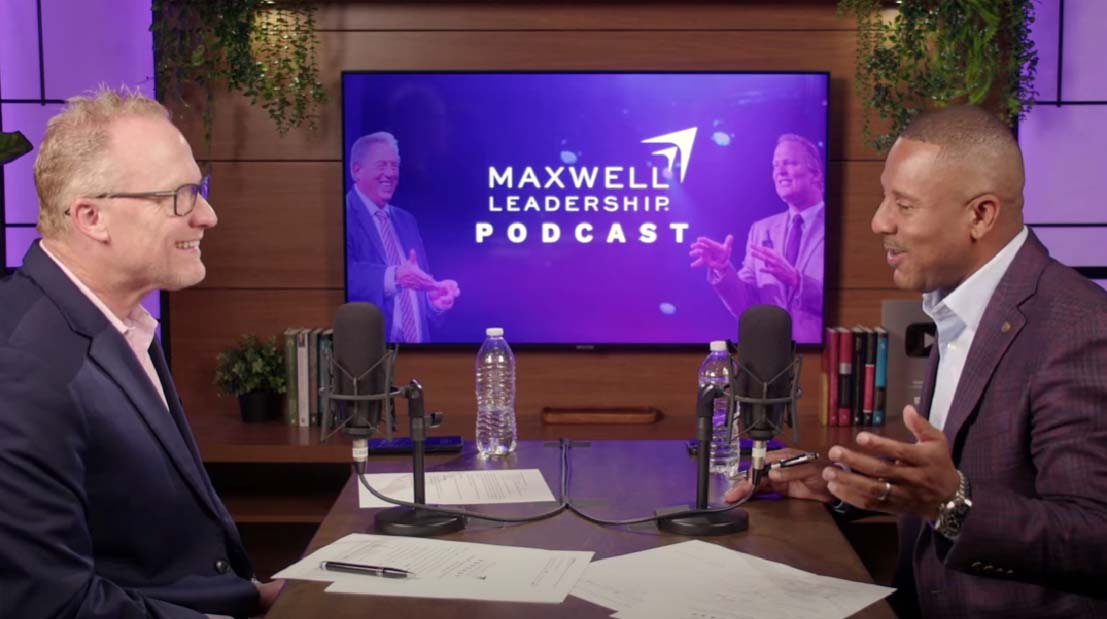
In this episode, Chris Goede and Perry Holley explore why culture consistently shapes organizational success more than strategy alone. They share practical examples of how leaders can close the gap between stated values and everyday behaviors, ensuring the team’s actions truly reflect the company’s core beliefs. They highlight specific steps leaders can take to build trust, promote accountability, and reinforce key behaviors that define a positive culture. The conversation offers actionable guidance for leaders eager to create a work environment where consistency, clarity, and real-time feedback drive exceptional results.
Perry Holley:
Welcome to the Maxwell Leadership Executive Podcast where our goal is to help you increase your reputation as a leader, increase your ability to influence others, and increase your ability to fully engage your team to deliver remarkable results. Hi, I’m Perry, Holly a Maxwell leadership facilitator and coach.
Chris Goede:
And I’m Chris Cody and executive vice president with Maxwell Leadership. Welcome and thank you for joining. We’re super excited. Again, I just want to let those that are listening, you need to go to YouTube and start following us. We’re in our brand new studio. The team’s done an incredible job.
Perry Holley:
Maxwell World Headquarters Studio.
Chris Goede:
That’s right. We have now taken over the entire floor in this office building. And so what a great environment for Perry and I just to talk about leadership, hopefully add value to you. I want to encourage you. One of the things that Perry hears a lot on coaching calls is that leaders take the learner guide that we create for every podcast and they hand it out to their team. They say, go listen to this podcast. Come back to our leadership meeting in first five minutes. Tell me what your number one takeaway is.
Chris Goede:
How can we apply that here in our organization? I want to encourage you to do that as well. Today, go to MaxwellLeadership.com/ExecutivePodcast and then you can fill out that form. Also, maybe you have a leadership challenge or a question. Perry’s always in favor of that because we are episode 403 and we are looking for additional content, but it’s never ending because we’re coaching and facilitating and we’re in organizations. And so you guys get to benefit from that. Well, today’s topic is probably a phrase you’ve heard before. Culture eats strategy for lunch. I think the original person that’s attributed this is Peter Drucker.
Chris Goede:
I know John talks about a version of it. A lot of people talk about that.
Perry Holley:
It’s a little vague on who said it.
Chris Goede:
A little vague when we start talking about culture, but really know what culture is, is the attitudes, behaviors and, and beliefs of, of your team, of your people, of, of that culture, of the organization. And that’s how you define it. Now, there is a, a gap between what leaders or organizations say their culture is versus how maybe their behaviors or how they act that out. And we need to talk about, well, how do we close that gap? Because I think that’s probably one of the most important things as a leader that you can be doing. And maybe you say, well, I can’t close the gap organizationally, but I bet you could do it internally with inside your Team and your leadership. And so if you start there, I think it may even become contagious. So we’re going to unpack that a little bit today.
Perry Holley:
Sure. And I have heard that statement many times, but I didn’t really get it until I heard John say that where you’re going, your strategy is not nearly as important as what you’re doing, which is your culture. And then it. And then it really struck me. So I started looking into it a little deeper and noticed that you can have the most brilliant strategy on the planet. But if your culture doesn’t support that strategy and people are, you’re going to have a difficult time. That strategy is going to have a difficult time surviving if people aren’t acting in a way. So what I did was I broke this discussion into three parts.
Perry Holley:
That would be, first of all, how do these behaviors really shape culture? And then secondly, what do leaders do to shape that behavior? And then how do we intentionally change your culture? I thought if we can move through that pretty quickly, we’ll have really something you can work with here to do that. So let’s start with how to behavior shapes your culture. I. I listed a number of ways there. Almost everywhere we go, you and I both core values being written on break room walls, coffee mugs and websites is not unusual, very common to say that everybody seems to have what they think their core values are. Having the. The behaviors to witness, judging the behavior. So I can tell what your core values are is really quite something different.
Perry Holley:
So that’s why I want to look at the behaviors first. But take us off with the first thing we need to be looking at.
Chris Goede:
One organization that comes to mind that you were just talking about, that we partnered with one of their values is first of all, let me set the stage we’re walking into. It’s a big manufacturing organization in the Midwest, phenomenal company and leaders. And so I walk into the area where they have this kind of cafeteria for all their staff and their team that can eat lunch there, dinner, whatnot. And on the wall in big painting, it says no gossip. And I was like, now this is a blue collar. I’m like, we got. Can we talk about that real quick? Like, I completely lost focus. And they go, what’s one of our core values? I go, oh, really? Really? I said, so you have it on the wall.
Chris Goede:
It’s core value. Have you ever had to let somebody go because of it? They go, yep. I’m like, what? And they gave me three examples and how the behavior of no gossip inside their organization you know, is measured, is talked about, and then how they take action on it. So I was like, okay, put it up on there. But it’s the first and maybe the only company that has no gossip in their values.
Perry Holley:
That’s a great one. I think I would have ever guessed that was a value, but I like it. One of the companies I was working with in California handed me a water bottle as a takeaway. And they had water bottles, each had a different color, but they had their values on it. The one they gave me, it said, can’t stop, won’t stop. I said, okay, I’m a big proponent of words are cheap. Show me. I said, so how does that show up? How do you see that? That’s a good question, though.
Perry Holley:
Anybody been fired for that? I like that question. I’m going to remember that one. But I said, how does that. What is the behavior that goes with can’t stop, won’t stop? They’re in the hospitality space. They work with restaurants and inns, and they. Whenever a guest. When they’re working with their team or with. With a guest solving a problem, solving an issue, we can’t stop, won’t stop.
Perry Holley:
I love it. You have permission, based on our culture here, to don’t stop to get it. So I thought, yeah, I like it.
Chris Goede:
Yeah. So. So part one, we’re unpacking how behaviors then shape your culture. So number one of part one is tolerance sets the standard. What. What you ignore today becomes normal tomorrow. And so I love the fact, you know, Perry talks a lot about standards and expectations. You know, what.
Chris Goede:
What are the standards that you have set, but more importantly, that are continued to be lived out. Right. Like that is. That is we. We don’t deviate from that. That is a standard expectation of how we. How we do things. And, you know, you didn’t write a policy about it.
Chris Goede:
You didn’t give a speech. You just. You tolerated something that was against that standard. And that toleration is a decision that you’re making that’s going to drive the behavior that affects your culture.
Perry Holley:
And people are watching what you let slide because you were too busy or it was too late or whatever the reasons were. People start to. And what are the real rules here? Because there’s. We think we know what we do. There’s some unwritten rules.
Chris Goede:
Yeah, unwritten rules we Talk about in360. Leader for the leader, but there are that for the culture and the organization as well.
Perry Holley:
Yeah, they’re taking notes for sure on what you let slide. Number two, rewards drive Repetition. And people repeat what gets recognized, not what’s written in the employee manual or not what’s written on the wall. So if you reward hustle over ethics, you’re going to get hustle over ethics. And if you always reward the person who’s the loudest, you’re going to get more of that. So what gets rewarded gets repeated. And I think you need to be careful about when you have these core values and you have these behaviors, be, be paying attention to what it is you’re recognizing on the behaviors.
Chris Goede:
Show me what you celebrate and we’ll show you what, what you believe. Number three, Pressure reveals truth. I often heard this as growing up of when you’re squeezed, you know, on the outside, what comes out on the inside is, is the truth. Right. So this is really about how you’re reacting and how your leaders are reacting when things go wrong and when there’s a crisis, when a project in turmoil fails, the reactions of your leader, leaders of your leadership define the emotional tone of what the team is going to begin to act like that. So if you lose it, there’s lack of consistency. You can expect that that behavior is going to be modeled. We say all the time, right? Leadership is a visual sport and it’s contagious.
Chris Goede:
And so then the team will, will show up that way as well. The other thing is they’re going to expect you to show up that way. And so then your team is going to stop taking risks, stop telling the truth, maybe even start leading up to you.
Perry Holley:
Well, I’ve coached a number of leaders who genuinely thought they had to speak up and they’ll say anything. People will always tell me the truth culture. And when I’m working with the team, I was shocked just, even, just a few weeks ago, I said, so tell me how you would say that to the executive team and the around the table. If somebody bold enough said, oh, I would never say that to the executive team. I went, what? And the heads are nodding around the table. I go, what? So the leader thinks they have a lead up, speak up culture. And the people are scared to say something. So yeah, behavior is going to really be a driver here.
Perry Holley:
Number four, communication shapes reality. You know, clarity is about building trust and confusion creates fear. And so thinking about when people don’t know what’s happening or they feel they’re going to feel that they’re going to tell themselves a story and they’re going to. Usually it’s the worst case scenario about what’s going on. So ambiguity is not a neutral. It’s going to cost you. So I’m thinking, are you shaping reality with your communication?
Chris Goede:
Yeah. Number five is consistency. It’s a word we talk about a lot on this podcast. Consistency builds belief. So how do you show up daily matters matters more than what we’ve talked about, what’s on the wall, what’s in the vision statement. And. And so they want to see repeated behavior, they want to see repeated communication, they want to see that consistency. John shares in the Law of Consistency, which is in the 15 invaluable laws of Growth, a great book if you’re on a personal growth journey.
Chris Goede:
Leaders who have good days and bad days where they show up differently based on their mood or their stress level, those leaders create an unpredictable environment. And unpredictable is culturally destructive. I think even building a business, it’s destructive. I think the more you can be predictable about your systems and processes and how you’re doing business, the more success you will have. It’s the same thing with your leadership. And so if they don’t know who’s showing up or which Perry or which Chris is showing up, no matter what situation, I can promise you you’re going to have an unpredictable culture.
Perry Holley:
So that was part one on behavior, shaping the culture. Let’s go to part two about what you as a leader can do to shape those behaviors. This might be a little practical here. Just. It may sound some of them really, but I’ve been watching and I’m also noticing myself quite a bit here was I think that one of the number one ways that you shape behavior is that you show up on time, accountability spreads, standards rise without really being announced, and you don’t have to send a memo about punctuality and other aspects of your culture. The team’s going to mirror what you do.
Chris Goede:
Was that for me? I know you started off by trying to be.
Perry Holley:
I was looking the other way. I was trying not to look across.
Chris Goede:
You looked at yourself. But, you know, let’s just be transparent. It is. And so all of us. Yeah, no doubt. It is all of us. Right. And so I’m not going to justify this by saying, well, I.
Chris Goede:
I try to maximize everything and try to get all these meetings. That’s just an excuse. Right? Here’s where it hit me. Yesterday we had a team meeting and my executive partner was on pto. And so I was very cognizant of my schedule and my time. And so it’s interesting that because of that, I was on time in the room, but the rest of the team wasn’t there. And so Then I was like, well, why is everybody not in the room? And I thought to myself, well, when’s the last time I showed up on time? No, because usually she would have everything set up for me, and everybody’d be there, and I’d come flying in on two wheels.
Perry Holley:
Right.
Chris Goede:
And so I am just transparently sharing with our audience that, yeah, man, like, how do you. How do you do a better job of that.
Perry Holley:
Yes.
Chris Goede:
And showing up on time, because then people can begin to expect that of you. Well, number two is leaders admit their mistakes. The three famous words we don’t want to say, I don’t know either. We don’t want to tell the team. We don’t know the answer, and we don’t want to admit our mistakes. So then what ends up happening? What ends up happening is that our team doesn’t want to do it either.
Perry Holley:
Well, you know, perfection or you’re trying to be too, too perfect. And then, yeah, it’s a very. It’s a downhill spiral.
Chris Goede:
And so set the example and go first and admit your mistakes.
Perry Holley:
Well, that vulnerability, we talk about it a lot, is. It really undermines a lot of the leadership behaviors, the willingness to say, I was wrong. Here’s what I learned. Boy, I could use some help. All these things build trust, and it. It. I’m finding it makes you authentic and real, and it kind of builds a culture. I think if you looked at vulnerability, look at your core values, and in the light of.
Perry Holley:
Through the lens of vulnerability, you almost find that it’s. It supports every single one of them was being real, being honest, being consistent, and. And letting. Letting other people know that you don’t have all the answers, but you need. You need them to do that.
Chris Goede:
And I’ve heard you tell people so many times, your people already know that. So just go ahead and tell them that you don’t know and you don’t have that answer.
Perry Holley:
Number three, leaders would stay calm. I just find thinking improves. Teams under pressure don’t actually think because they’re bracing for the emotional reaction that’s coming from the leader. This, to me, goes back to the word consistency of emotion and that. Can you be trusted with whatever is going on? Can you be trusted with bad news? Can you be trusted with difficult questions? Can you be. I trust it. If I challenge you in a meeting, if I disagree with you or you’re going to. Your emotions are always in flux, and I don’t know what to get.
Perry Holley:
So guess what I’m going to do? I’m going to salute and stay mute. I’m not doing anything.
Chris Goede:
Yeah, well, number four, leaders listen first. People want to. They want to feel heard, and so don’t. And here’s the other thing. We don’t want you just to hear them or to. To listen. We want you to be curious about what they’re talking about. And so we want to make sure that you do that.
Chris Goede:
When you do that, they’ll bring ideas to you. They’re going to flag problems. They’re actually going to probably invest in whatever you guys as an organization or a team are doing at a different level. And number five, leaders follow through. This drives me crazy and I hate it when I make this mistake. But, man, if you said you were going to do something like follow through and do it, and that’s where your trust begins to grow. We haven’t said this in a long time, but trust is a currency of all influence. And so if.
Chris Goede:
And I have a bad habit of doing this to where I will say, oh, yeah, I’ll get that for you. And I really should have deflected or I should have said, hey, I can’t do that right now. I can do that and set proper expectations instead of just saying yes. But I want my team to know that anything that they ask of me, either they know right in the moment I’m not going to be able to do it or that I am going to follow through and get it done for them.
Perry Holley:
So the idea on this section about people do what people see, you mentioned that they’re watching your behavior. So if you’ve got a set of core values and they need a set of behavior support those values, are you actually living those out? Are you the one that’s showing that? Let’s go and wrap this up with number three. This part, third part was. Part three was how to intentionally change your culture. So let’s say you’re listening and you think, well, I really would. And by the way, I remember learning this early on is you can’t not have a culture. You always have a culture. You either default to it or you design it intentionally.
Perry Holley:
And so if you think we’ve kind of defaulted and I want to design. Let’s give you a couple of ideas on that, which was, you know, I wrote this as statements declare, but actions demonstrate is that you can have all the words in the world, but as we just said, your actions are what’s going to be the demonstration. So you model the behavior before you expect it to see it from others. So I had a couple ideas that I’ve heard people say Is that we value transparency. Okay. How would that be evidenced here?
Chris Goede:
And so how’s that lived out?
Perry Holley:
How does that lived out? So you think, do you share the financials? Do you communicate? I love this that you do this. On our weekly team call, you start off with, here’s where we are. Whether it’s good news or bad news, whether it’s uphill or downhill, whether it’s a light shining or it’s in the dark. You’re very transparent about what’s going on and where we are. You might hear someone say, well, we prioritize accountability. Do you. Or do you avoid those hard conversations that we, you know, we talked about that earlier. I’ve heard this one a lot.
Perry Holley:
People come first. Do they? Or does the phrase get shelved the moment the numbers look a little shaky? Yeah, you think, oh, forget the people. We got to worry about the task. We encourage people taking ownership. Really? Are people allowed to make decisions, or does everything escalate to you to do that? We believe in teamwork. You know, this was, you know, I’ve seen lots of those mugs with teamwork on it. Teamwork makes a dream.
Chris Goede:
That’s right. One team, one dream.
Perry Holley:
Yet the reward structure is completely individual in. In nature. The person that makes the number gets celebrated. The team, you know, person to help three other people. No, they get nothing to do that. So without the behavior, these are just words. And so I think the very first step is have your words, have your statements around. What are your core value? But then really think about the actions.
Perry Holley:
What are the behaviors you’re looking for?
Chris Goede:
Yeah. Number two, in this third part of how to intentionally change your culture is make sure you have real time correction. Now, what do we mean by that? So you have to make sure that if someone is out of alignment, that you don’t allow it just to continue to happen. Because what’ll. What will happen is that will compound. It will. It will grow. And if it’s contradictory to your values and the culture that you desire, as Perry mentioned, either earlier, it’s going to happen one way or another.
Chris Goede:
So you need to make sure that you’re giving real time correction. This is just like leading people. We. We talk a lot about not having annual reviews only. And because by the time you get to the annual review, if you tell me something you did in January, I’m like, yeah, matter of fact, by the end of January, if you tell me something I did in the first week. Right. So the longer you wait, the more that that behavior is going to be normalized and it’s going to be allowed. And so you just want to make sure that in the moment it’s real time.
Chris Goede:
Hey, whoa, whoa, I heard you say this or hey, I heard there was some gossip going on, right, that we’re going to just make a note here in your file, right. Two more times and. And you’re gone.
Perry Holley:
That’s a really good point though. Is that you. So we want to design a culture. I need to make sure we’re clear on our core values. 3, 4, 5, not 12. What, who we are, what we stand for, what are the behaviors that are evidenced by each of those words or phrases. And am I demonstrating that another way here is then to reward the behaviors? So I need to pay attention. As your example just now was, I saw somebody not living by a value, their behavior was anti value.
Perry Holley:
I need to call that out probably one on one in a one on one conversation. But rewarding behaviors that support the values. Go back to my can’t stop, won’t stop. In a team meeting, the senior person said, I want to call out Chris for our core value of can’t stop, won’t stop. Chris, I saw you with a guest the other day and how you went to extraordinary efforts to get that guest what they needed. And I just want to say that’s an example of can’t stop, won’t stop. And so you reward that not just the outcome. We tend to record the we made the financials for the end.
Perry Holley:
No. What were the behaviors that led there? I, I catch people doing the behaviors that support the core values. People start to think that it’s real. I actually captured those once I started capturing those little stories in a PowerPoint and I used it as an onboarding. So anybody that onboard, we want to share our five core values and these are the behaviors. But let me give you a couple of examples of how I’ve seen those around here. And so people started repeating the stories
Chris Goede:
around there because you could define those behaviors, but even that there could be misinterpretation. And if you use an example, that’s a great idea.
Perry Holley:
Well, let me just hit on a very important thing is that let’s say it’s we have the core value of timeliness or no, it makes something, let’s say a good attitude you don’t get. Nobody gets to define that but you. The leadership team defines what that means because people will come up with what their view of an attitude is. If you can’t stop, won’t stop. Well, to me that means that no, you don’t get to decide. Yeah, the leadership team, when we decided on our core values, we decided on what it means. And then we reinforce, reward and coach on those behaviors to our definition, not to your definition of that. That’s a good catch on that.
Chris Goede:
The fourth one here is your culture is, is going to be tested under, under pressure. Okay. So when you didn’t make the numbers at the quarter, there’s conflict. Maybe a big client, you lost a big client, maybe, maybe the client’s unhappy, whatever that is. That’s when people are going to really find out what your culture is really about. And so remember, it’s easy to design it when things are going well. It’s not easy to design it when they’re going bad. So here’s what even Perry’s saying.
Chris Goede:
Hey, let’s design it on the front end. Let’s define it. Design it and define it so that we can actually live that out no matter if it is under pressure or if it’s good times.
Perry Holley:
My final thought on the last one here is that people will copy what you do, not what you say. And that every interaction that you have throughout your day, online, on the phone, in person, through a text or an email, those are culture building moments. And I just started really taking those seriously. Is that am I personally representing the core values and the culture that I want to see here? Am I an example of that? And are people following my lead?
Chris Goede:
Well, as we wrap up, we talked a lot about how behaviors shape your culture. How do leaders then shape the behavior and then how do we change the culture with all of that? Here’s what we want you to know. We just want you to start with something. We want you to walk away with, with an idea, with an understanding of something that is driving your culture of behavior. Just pick one of them and. And then we want you to improve it. We want you to lead, we want you to go first. We want it to be a non negotiable that you are going to, whatever it is, do this.
Chris Goede:
So let’s say it is, Chris, starting meetings on time and ending meetings on time, by the way, because we may really struggle on ending meetings if that is part of what our expectations are of our culture. And maybe it’s not. Then, then how do you tell your team about it? And then how do you live that out and then how do you do it consistently? Because remember, it’s not. Oh. In the month of August, Chris started every team meeting on time. That’s great. But 12 months from now, if we go, we started in meetings on time. And we’re still doing it.
Chris Goede:
That’s the behavior that’s driving the culture. So here’s our expectations. We talked about a lot of things, gave you a lot of examples, other, other companies, other organizations. But pick one thing. Pick one thing that you know is a behavior that can drive the culture that you want and then start living that out and then making sure that the rest of the team is aware of it as well.
Perry Holley:
Fantastic. Well, as a reminder, if you would like the Learner guide, which has all of these listed out for you in case you couldn’t keep up with that, you can get that as well as leave us a note. If you’d like to learn more about our offerings, the five levels of leadership, or about our coaching programs, we’d love for you to do all that at MaxwellLeadership.com/ExecutivePodcast. We’d also be welcome any comments or questions you may have there. We love hearing from you. Very grateful you spend this time with us. That’s all today from the Maxwell Leadership Executive Podcast.
Transcript created by Castmagic.