Are you simply focused, or are you fixated on your goals? The difference could define your level of success. In this week’s episode, John Maxwell concludes his lesson on the habits of successful people with four essential strategies that set them apart.
After his lesson, Mark Cole and Chris Robinson provide practical applications and coaching to help you turn John’s principles into results today!
Our BONUS resource for this episode is the What Successful People Know and Do (Part 2) Worksheet, which includes fill-in-the-blank notes from John’s teaching. You can download the worksheet by clicking “Download the Bonus Resource” below.
Mark Cole:
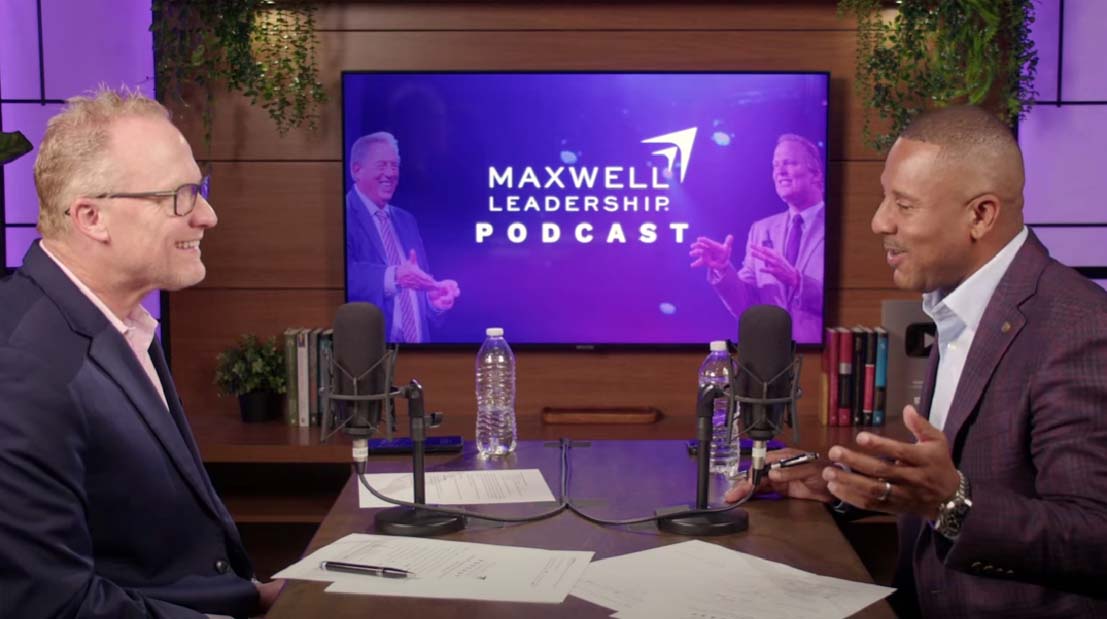
I think there really is something to say that if it’s not broke, don’t fix it. I really do believe there’s something to say, if it’s not broke, break it. Welcome to the Maxwell Leadership Podcast. I should say welcome back because I’m joined with Chris Robinson here in the studio, and I am excited to continue a conversation we started last episode about what successful people know and do. I think one of the things— I’m humbled, Chris, at the people, the successful people that we get to hang out with. If I’ve done anything over the last 26 years, it is heard the thinking, heard the processing, watched the actions of successful people. Yeah. It’s proximity to John.
Mark Cole:
It’s proximity to what we get to do. And I’m super excited because today, Chris and I are going to go into part 2. Those of you that missed last episode, go back because John started the conversation by talking about 6 things that he’s observed by being around successful people. Today, he’s going to finish with 4 more, and then Chris Robinson and I are going to come back. We’re going to put some application to it. We’re going to have some conversation. We’re going to challenge you to up your success game. Let’s go.
Mark Cole:
Anybody want to be successful? I do. Of course you do. That’s why you’re on the podcast. That’s why you’re listening to it. You want your leadership to be more successful, and we want it too, because we want the people around you to be impacted. So grab a pen and paper. In fact, if you would like to follow along with our fill-in-the-blank attachment, we’ve got a link for you that’s called MaxwellPodcast.com/SuccessfulLeader. You’ll be able to download the bonus resource.
Mark Cole:
You’ll also be able to check out some other things that we’ll put in the show notes there. Let’s go. Here’s John right in the middle of talking about what successful people know and do.
John Maxwell:
Number 7, focus your time and money. In other words, don’t let other people or things distract you. Stay focused. Here’s a rule of thumb. Here’s for your notes. A rule of thumb for organizing your overall work strategy. This will help you on focusing, prioritizing. Work where you’re strongest 80% of the time.
John Maxwell:
Work where you’re learning 15% of the time. And work where you’re weak 5% of the time. Number 8, don’t be afraid to innovate. Be different. In fact, following the herd is a sure way to mediocrity. So how do we become an innovator? Here’s a bunch of stuff. Get ready to write. Look for new opportunities everywhere.
John Maxwell:
Challenge preconceived beliefs, biases, and assumptions. Spot trends before everyone else does. Redefine goals continually. Develop and try ideas of your own. And watch for concepts that you can borrow and apply from other fields. Rely on intuition to assess risk and read people and deal with complex decisions. Think long-term and persist when others decide to quit. Find a way to do things when the odds are against you.
John Maxwell:
Seek both positive and negative feedback from employees, colleagues, and customers. Thrive on networking and build teams to carry out your products and projects. Don’t be afraid to innovate. Don’t be afraid to be different. Number 9, deal and communicate with people effectively. In other words, they are marvelous communicators and they’re very relational in communication. Recently I read a story that I wanna read to you that’s just a very short one, but it just, it does what I want it to do in this section here. Let me just read it to you, listen carefully.
John Maxwell:
An experienced nurse recounts this story. During my second month of nursing school, our professor gave us a pop quiz. I was a conscientious student and had breezed through the questions until I read the last one. What is the first name of the woman who cleans the school? Surely this is some kind of a joke. I had seen the cleaning woman several times. She was tall, dark-haired, in her 50s. But how would I know her name? I handed in my paper, leaving the last question blank. Before class ended, one student asked if the Last question would count toward our quiz grade.
John Maxwell:
Absolutely, said the professor. In your careers, you will meet many people. All are significant. They deserve your attention and care, even if all you do is smile and say hello. I’ve never forgotten that lesson. I also learned that her name was Dorothy. That’s a powerful statement on relationship and communication. And being able to communicate effectively with people.
John Maxwell:
John Craig said, no matter how much work you can do, no matter how engaging your personality may be, you will not advance far in business if you cannot work through others. Number 10, be honest and dependable, take responsibility. And I love this phrase beneath that, otherwise numbers 1 through 9 won’t matter. In other words, everything I’ve said so far isn’t going to matter at all if you and I don’t take responsibility. It is true, the time is always right to do what is right. When Bill Lear learned that 2 Lear aircraft had crashed under mysterious circumstances, he was devastated. He had developed the airplane to offer business travelers a fast, economical alternative to the airlines. At that time, 55 Learjets were privately owned, and Bill sent word To all the jet owners to ground their planes until he and his team could determine what had caused the 2 crashes.
John Maxwell:
Bill, a Christian, learned early in life that God expects courage and honesty of his children. And the thought that more lives might be lost was far more significant to him than the adverse publicity that the grounding of all Learjets might generate in the media. And as he researched the ill-fated flights of the 2 planes, the possibility of a specific technical problem began to emerge. Using his own plane, Bill personally experimented to recreate the same problem. He nearly lost control of the jet in the process, but he found that a defect in the plane’s mechanism did exist. All 53 planes were fitted with a new part, eliminating the danger. Bill spent 2 years rebuilding the business. Learjets were soon soaring again, carrying thousands of business people safely to their destination.
John Maxwell:
Bill Lear protected the lives of his customers while counting on God to protect the reputation of his corporation, and he has never regretted his decision. Great story of somebody taking responsibility. Now here’s what I want you to do. We’ve talked about 10 secrets to success that successful people know and do. And what I want you to do, if 1 is low and 10 is high, score yourself in these 10 areas that will bring you success. How you think is everything. From a 1 to a 10, how do you do there? Decide upon your true dreams and goals. How well are you doing? Take action.
John Maxwell:
Never stop learning. Are you a consistent grower? Be persistent and work hard. Learn to analyze the details. Focus your time and money. Number 8, don’t be afraid to innovate. Be different. Number 9, deal and communicate with people effectively. And 10, be honest and dependable.
John Maxwell:
In other words, take responsibility. And this last statement, don’t let someone else create your world, for when they do, they will always create it too small.
Ela Bijlani:
My father passed and I was in a really difficult time, really questioning What is life really about? One day we’re all going to be gone. What makes you think that you lived that life well? I was really looking for answers. I met a girl who told me about John Maxwell. The more I looked at the information that I found out, I realized, well, he’s really offering all the resources that I’m looking for right now, which was amazing. In 3 days, there was a conference. I was on a call with Kelly. I had this feeling that I just really needed to be there. I got in the car and I drove.
Ela Bijlani:
When I walked in and I saw the sign, Welcome Home, I thought, wow, that’s amazing. Kelly introduced me to Mark and she told him that, you know, I just found out about John Maxwell 3 days ago and here I am. I didn’t really know what I was getting myself into, but it felt so good.
Ela Bijlani:
Come right up here, Ella. This is all unscripted. She’s one of our Maxwell Leadership Certified new team members, John. She said, I really want to do more with my life. I want to begin coaching. I want to do something with my life. And John, Her friend said, well, you’ve got to talk to John Maxwell’s team and be on the Maxwell Leadership Team. She said, who’s John Maxwell? I think this is drop-dead funny.
Ela Bijlani:
She said, I have a saying that says, when the student is ready, the teacher appears, and I’m ready. Show me the way.
John Maxwell:
To Ela, where have you been?
Ela Bijlani:
I remember John’s school. question, where have you been? So I decided to take action to achieve my dream. Now I know it was the best decision I’ve made in my life because I get to do what I love to do most, which is helping others to achieve their goals and dreams. Now I know that it’s never too late to be what you might have been.
Maxwell Leadership Certified Team:
Your story is waiting to be told. Learn more at MaxwellLeadership.com/JoinTheTeam.
Mark Cole:
Hey, welcome back. Chris, again, I go to you just like I did last episode, and I go, man, I love how you think. We talked a lot about attitude last time. We talked a lot about the things John just reviewed in the content. But as we go focus right here, I can’t wait to talk a little bit about focus, ’cause Ben, you have played ball at many levels, and there is a focus that’s required when you’re gonna be successful at anything.
Chris Robinson:
Yeah, yeah, absolutely there is. I mean, but I think this is when I look at truly highly successful people, there’s focus. And I believe any average person can focus because that’s for a period of time. And we have to do this, and I love how John directs this, and to focus your time and money. And I got a question for you that in a moment, but when I look at this, I think the difference maker between those that are successful and those that are super successful, ’cause there’s a delineation there, is that those that are focused, the average person can do that ’cause it’s for a period of time. But those that are on that super side, those people go from focus to fixated.
Mark Cole:
Ooh, I love that.
Chris Robinson:
Okay, from focus to fixated. Now, fixation has no expiration date. Fixation says, I’m going to do it until it works. So if you think about it, when I think about, you know, reading biographies, watching biographies, you think about some of the common ones that you see. You think about like a Jimi Hendrix. Mm-hmm. He was fixated. He never put the guitar down.
Chris Robinson:
You think about a Magic Johnson. He grew up, he never put the basketball down. You think about a Steve Jobs. He never let the sun come up without innovation on his mind. Those people weren’t focused. Those people were fixated. And so, when we look at this, you gotta ask yourself, hey, am I just kind of focused on this because I need to do this for a period of time? Or am I truly being driven by something that I’m fixated on doing, whatever it is that you wanna do, until it happens?
Mark Cole:
Dude, that is so good. And I’m so glad you did that. I don’t think I’ve ever heard the difference between focus and highly focused people, which puts a fixated on it. I love that. That’s incredible. It takes me back. I’m not going to improve on that. Y’all got that? Pause the podcast and go apply that right there.
Mark Cole:
I am going to go back because of what you said there and pick up one of the things we talked in the last episode. We finished it with the difference between being persistent and giving up. Right. I think when John talks about persistence and never giving up, it’s when he has founded and grounded himself on something That is not giving up. And a position is not something to be grounded on. A job role or responsibility isn’t. A calling, a sense of purpose, you are persistent in those things. And so, I don’t know what the next word, you’ll have to get creative with another P word, but what is the difference between persistent and uber persistent? Because that right there is what we’re talking about.
Mark Cole:
There are some things you need to give up yesterday, last episode. I hope you’ve done it because of what you and I said. There’s other things that you never give up on it.
Chris Robinson:
Yeah, well, okay.
Mark Cole:
That’s that uber.
Chris Robinson:
That’s that excess. So that uber would be persistence with patience.
Mark Cole:
Ah, yeah.
Chris Robinson:
Okay, because here’s the thing is that we can be persistent in something and it may not be happening, but we’re never given the time of when it’s supposed to happen. So, we need to persist, but persisting with patience—
Mark Cole:
Is next level.
Chris Robinson:
That’s that next level. That’s that fixation. That’s saying, oh, I tried it. I learned a little. I did a little. I’m not there yet, but hey, if I just give this thing some more time,
Mark Cole:
Yeah.
Chris Robinson:
Man, I think it could happen. It’s just like growing a farm, you know what I’m saying? You water it, you plant it. There’s only so much you can do in that day. If you overwater it, you flood it, right? If you underwater it, it dies. And so it’s having that action of learn a little, doing a little, and then letting time have its way. And that’s where I think it’s the patience with the persistence would be that next level there.
Mark Cole:
That’s beautiful. That’s beautiful. Okay, we can get back and focus this time. Let’s focus this time. Yeah, let’s focus on this week and not last week. But I did love that in that way that you did focus and fixated. Boy, there are some things that we have to be focused on. There’s some things we have to be persistent with.
Mark Cole:
That is without— there are no exceptions. There are no excuses. It is only staying focused on that, being persistent with that.
Chris Robinson:
Yeah, I love that. So, talk to me about— but it’s time and money. And last week you also talked a little bit about how you kind of sort through your calendar. for relationships, but how do you focus or determine what gets your time and your money when it comes to your life?
Mark Cole:
Yeah, I love this question. I think it goes back to values. We talk a lot about values here at Maxwell Leadership. In fact, we teach our team their first IMC. We are people of value that value people and add value to them. Right. I mean, that is our mantra. That’s our identity statement.
Mark Cole:
That’s our stake in the ground, so to speak. A lot of value in that. A lot of values, values, values, values. And one of our values is valuing people. And we value valuing people. It’s just a lot of values. But I think really, really, your values should drive your time and your money. So take it back, go to your checkbook, see what you spent your discretionary money on, and you value that.
Mark Cole:
Go to your time, your discretionary time, and that’s what you value them. I had a friend, a very, very dear friend of mine, and I was talking about a relationship that was changing. And I was talking with one friend about another friend about the relationship dynamic changing. And that friend gave me some advice that I thought was really good. He said, you need to look 5 years down the road, what you want from that current relationship that’s changing, and you need to build a plan to get to the 5-year plan. And I went, what do you mean? He said, do you wanna still be able to call that person in 5 years from now? And I went, yeah. He said, do you want that person to be calling you 5 years from now? And I went, yeah. He said, do you want that person to need you for big decisions in their life in 5 years? No.
Mark Cole:
And he said, start changing the topics of your conversation now to get that relationship. So I didn’t want the relationship to end, but I didn’t want it to fall off a cliff. Excuse me, I didn’t want the relationship to fall off a cliff, but I didn’t want to keep spending a ton of time with that. And this advice that gave me, envision what you want and begin driving behaviors around that now. What he was saying is, what do you value about that connection? And what do you think will last in value about that connection? And now begin to build your calendar and your engagement around what you’re wanting from that. It’s the same thing in anything that we’re doing that we want to be successful in. That was a relationship that I want to be successful in, but I want to redefine relation— I want to redefine success in that relationship. Yeah.
Mark Cole:
Well, I think we have to do that with our job. I think we have to do that with our vision. What is it that we value? And begin to accelerate the time and the money you put into that because it is what will give you a return on that value.
Chris Robinson:
Yeah. And what you’re talking about here, for those of you that are listening, is just intentionality is what this is really boiling back down to. And when it comes to focusing your time, your money, your energy, all those things, reevaluating, hey, what is it that you really want? I mean, again, at a blank sheet of paper asking yourself, hey, what do I want? And then filling that out. And then now you can begin to be intentional Become more intentional about relationships, your time, your money, your energy, all those things that are there. Now, John goes on to talk about number 8 here, don’t be afraid to innovate. Now, innovation, we love ideas, we love creativity, but how do you know when it’s time to challenge what has already worked and really begin to push against, hey, this is already working, but is it time to innovate there? Talk to me about this. Can we kind of go back and forth about this inside of our world? We do. Quite a bit because of long-held traditions, symbols, cultures, all these different things.
Chris Robinson:
But how do you know when it’s time to challenge it?
Mark Cole:
Well, boy, I think there are a lot of factors, and I think getting advice before you do something— I think there really is something to say that if it’s not broke, don’t fix it. I really do believe there’s something to say, if it’s not broke, break it. And that’s what an innovator says, right? Says, if it’s not broke, break it. And then the conservative person says, if it’s not broke, let’s not mess with it, man, it’s really good. I think also there’s this concept of sacred cows that we’re talking about with this question. There’s things that become such a ritual, such a pillar of an organization that it takes outside voices to make sure that you’re not getting, stale, that you’re not getting stagnant. I think a couple of things that I want to give you or offer you to the question and offer to our podcast viewers and listeners is one, the concept of an outer circle. John, about 10 years ago, he felt himself getting old.
Mark Cole:
And let me tell you what that means. He kept going back to the same sources to get new ideas. Now, As a consumer, as a partner, as the leader of his company, it wasn’t broken. What he was doing, and specifically his filing system, things that he had filed for over 30 years of leadership, he had a filing system and it was big boxes and it was index cards and it was a beautiful thing to see. And I’ll never forget, it was in this time that John called me and he said, hey, I just did something that I can’t believe I did. I said, what’d you do? He said, Mark, I just threw out Tens of thousands of index cards that I’ve been sourcing and referencing and collecting over the last 30 years. And I went, you did what? And he said, I felt myself getting stale ’cause I keep going to the same sources and I throw ’em away. But John was so committed to reinventing himself, as he’s done multiple times, that he felt himself from a content standpoint relying on yesterday’s quotes, yesterday’s index cards.
Mark Cole:
The second thing that John did in that same timeframe is he established an outer circle. So back to this concept of an outer circle. An inner circle is somebody that keeps you grounded to your vision, to your mission, to your purpose in life. But an outer circle is someone, is people, a group of people that will challenge everything that you’re doing right now, the success and the unsuccess. Mm-hmm. And getting those people that will challenge the status quo, that will challenge yesterday’s index cards. And somebody told him, said, John, You know there’s better ways to file now, and you know there’s new sources to go get leadership thinking from. It was an outer circle member that had challenged him to rethink how he was aggregating, collecting, and sourcing filing.
Mark Cole:
It was that outer circle. I would ask all of us, who’s your outer circle? Mm-hmm. Who’s challenging the way that you’re thinking to think differently? Number 2, is it growing? For me, I’m such a growth junkie in everything, constantly challenging if I don’t have growth, because growth is the values of ours. So when something is not growing, trust me, at Maxwell Leadership, it’s being challenged. The third thing that I would say is when you feel like its best days were behind you.
Chris Robinson:
Okay.
Mark Cole:
John Maxwell writes a new book at least once a year. And every time he writes it, he goes, this is my best book ever. And as his CEO that still has not quite released the previous book that he wrote because the publisher’s not done with it, I’d go, oh no, he’s already talking about a book that he’s writing and we haven’t had a chance to sell the book that he just wrote. And he’s writing the best book, which means the best— the last one could be his second. Right. And who knows if it’s even second? I can’t even sell second. But here’s his point. If what you’re working on now is not your most favorite, if you’re not anticipating the best in front of you, it’s really time to figure out if you need to innovate.
Chris Robinson:
Wow, I love that. Love that. 3 solid points right there. Let’s go into number 10 here. And it’s talking about it’s always right to do what’s right. Okay, so tell me about a time when doing the right thing cost you something in the short term, but ultimately, It made the company stronger.
Mark Cole:
Yeah, so let me give you 2. We have multiple companies here that actually represent John’s intellectual property at Maxwell Leadership. So we have for-profits, we have nonprofits. I want to give you one on our for-profit side, and then I’ll finish it up with one on our nonprofit side. You and I get the privilege of of serving 61,000 coaches. We talked a lot about that last week if you want more information on that. But we get this incredible privilege and they’re brilliant people. And it’s not just business associates.
Mark Cole:
We’re partners. We’re on the same team. It’s not just people that are trying to build a business. We’re trying to carry a mission. And it’s a real special, unique thing, a sense of belonging. We, in fact, our slogan when you come to our annual, or we do it twice a year, our annual events. When you come, our slogan is Welcome Home. And when I meet a new person, I go, where have you been? Welcome home.
Mark Cole:
I mean, it’s just kind of the thing. And I can remember in COVID, so this goes back to a COVID story, you and I were just brand new leaders. We had just taken over ownership and leadership of the team less than a month.
Chris Robinson:
Yeah, 45 days.
Mark Cole:
45 days. And we were now the leaders. We had no capital. And there’s a big cost to the event. There’s a big revenue generation at the event. There’s a big next step moment at the event. All these things that are business critical. And COVID happens.
Mark Cole:
And, you know, now the story does not feel very, very big because the world shut down. Yeah. But before the world shut down, I was traveling in Israel and my family and my close associates were watching the world shut down and they were worried about me. They couldn’t enjoy my time away because they were worried, was I safe? Was it sick over there? Was people dying over there? Could I get home? The questions were incessant. And right in the middle of that, I had to make a $750,000 food decision. And I went to John and I said, John, I can’t buy this food decision because I don’t think I can ask people to travel in from all over the world and give their family the perplexities my family’s having about my travel. It wouldn’t be caring for our team. And John said, Mark, our values are more important than our dollars.
Mark Cole:
Our values are more important than our got to make business things happen. If you feel like that— again, this was before it shut down. After it shut down, it was like, no duh, you had to shut down. You didn’t have to shut down that day. And we didn’t have to shut down for that event. Right. And we shut down because our values. To this day, Yeah.
Mark Cole:
To this day, you and I are still carrying business burdens from that decision.
Chris Robinson:
That’s correct.
Mark Cole:
Still to this day. Would I do it again? A week earlier. I would’ve done it a little bit earlier. I wouldn’t have wrestled with it so much because it was the right thing to do for the family. And I wouldn’t say that a week earlier because what happened. I said it a week earlier because values and what you value is that important. And how it’s turned out, right? Because I just said we’re still wearing the burdens. We were able to impact people and not cause so much grief by getting people out of their country and not back into their country afterwards.
Mark Cole:
They’d have been stranded for months. One of our team members was.
Chris Robinson:
He was, yeah, yeah.
Mark Cole:
The second one is a nonprofit. We had some real business challenges some years back, some real financial challenges some years back. We had more revenue than we had, but we had made more commitments than the revenue matched. And we were opening up schools in Paraguay. And what I mean by that is we resource schools with this nonprofit. We resource schools, we teach values in the middle of the school day in public schools. And we were on our way to getting 50% of the Paraguay schools using our values content in the middle of school. And we ran out of money.
Mark Cole:
We could not launch more. So I had to call, I called the head of education in that country. Mm-hmm. And I said, I know you’ve got I know you got the teachers geared up for it. I know you got it. And there’s a way we could do this, but it would be stopping the ones that are already established with this to give these new ones that we made a commitment to. And our word is our commitment. And I could do it, even not miss my commitment, but I would stop the flow that’s happening in some of the other schools.
Mark Cole:
And I just can’t do that. And we’re not going to do that. We went and visited that president with several billionaires on a plane. We were in— Argentina, I think, and we dropped down into Paraguay and met the president. President came up to me and he said, I was the head of education then. He wasn’t the president then. He said, I was the head of education. He said, today I’m making a decision that every school in Paraguay is going to adopt this program and it’s going to become in the constitution as a part of our core curriculum.
Mark Cole:
And it goes back to you calling me and doing the right thing. Wow. You showed me that Just because of a commitment, which is good, just because of an opportunity, which is good, you would not forsake what you had already started. And I need you to know, we’ll now help you with that. And by the way, we’re gonna find some funding too. Right. And so that was a moment. It was hard to determine if that was the right thing, keep my word or be consistent with what we’re already doing.
Mark Cole:
And I could have gotten away with it to keep my word over here. We decided to apologize for making a a commitment with our word that we couldn’t live up to, and it paid off great dividends.
Chris Robinson:
Wow. Incredible. Incredible. Man, I tell you what, those are the 10. Those are the 10.
Mark Cole:
Those are the 10.
Chris Robinson:
And 2 parts here. And I tell you what, love this topic and I love getting to do this with you. Likewise, man. Thank you so much for always having me.
Mark Cole:
Likewise. And we love doing it because of you, podcast viewers, podcast listeners. I say this often. I don’t think I said it at the top of the program today, but We add value to leaders because you multiply value to others. You’re in the trenches. Many of you are thanklessly leading. In other words, gratitude is not being expressed to you about your leadership. I grew up in a pastor’s home, and man, I can remember the sacrifices of my family with very little gratitude, a lot of expectation, a lot of entitlement.
Mark Cole:
Well, that’s what you’re supposed to do. You’re supposed to take my call at 2:00 AM in the morning. That’s why we pay tithes. I heard that many times. And I think about all of you that are out there leading today and somebody hasn’t thanked you for the sacrifice, the waking up early, the listening to this podcast so that you’ll be better. And I just want to thank you. I just feel a heart of gratitude for you leading. I want you to be successful.
Mark Cole:
That’s what we’ve been talking about, but I want you to be appreciated. And so thank you. Thanks for listening to the podcast. Thanks for sharing this podcast to others. We do it. Because we want you to experience powerful, positive change. We want you to do it because we want you to lead well, because everyone deserves to be led well.