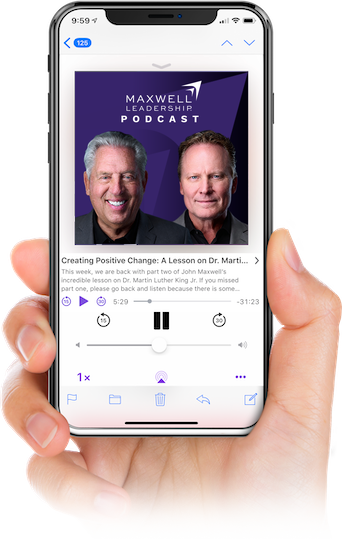
Don’t spend your leadership journey trying to avoid failure; you will end up thinking, planning, and dreaming too small. Instead, invest your time creating a framework to let failure work to your advantage. In this week’s episode, John Maxwell teaches four ways you can transform setbacks into powerful steppingstones for success!
After his lesson, Mark Cole and Chris Robinson share actionable strategies to help you turn John’s insights on failure into practical growth for yourself and your team.
Our BONUS resource for this episode is the Four Ways to Turn Failure Into Success Worksheet, which includes fill-in-the-blank notes from John’s teaching. You can download the worksheet by clicking “Download the Bonus Resource” below.
Take the next step in your growth journey and become a Maxwell Leadership Certified Team Member. Click here to speak with a Program Advisor today!
Mark Cole:
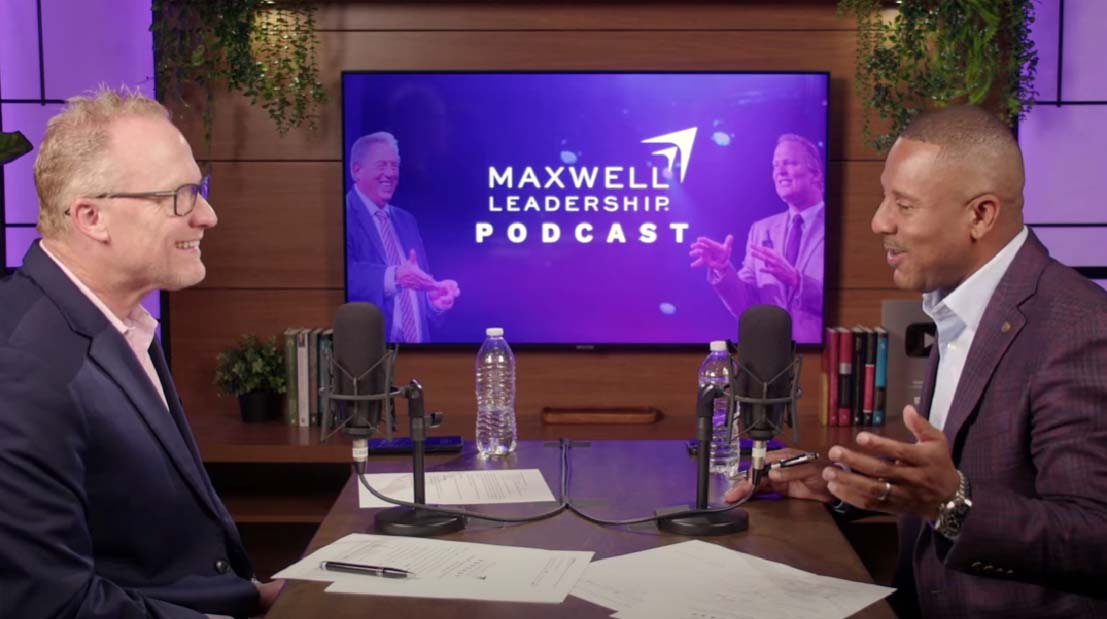
Welcome to the Maxwell Leadership Podcast. Our podcast is really committed, as you all know, to add value to you and to. So that you’ll go multiply value to others. We’re very passionate about it. But today we brought you to the Maxwell Leadership Podcast to talk about failure. In fact. In fact, Chris, hopefully it won’t stay quite about failure podcast. Stay with us, Stay with us.
Mark Cole:
John’s teaching today is brilliant. But, Chris, before we get to John, I want to ask you a question. What would you two. What would you do? What would you try? What would you want to go after if you knew you wouldn’t fail?
Chris Robinson:
If I knew I would. I’d be a professional athlete at something, okay? I. I do not care what sport it would be. It could go from curling to pickleball to javelin, you name it. If I knew I couldn’t fail, I would be a professional athlete at something.
Mark Cole:
Now I got to challenge this right here. I didn’t know what his answer would be. This was not scripted at all. But. But I gotta. I gotta tell you, I don’t believe for one minute that you would do curling because your South Florida blood couldn’t handle ice of any kind.
Chris Robinson:
You’re right about that. You’re right about that.
Mark Cole:
Everything but curling, right?
Chris Robinson:
I gotta go pro at something athletic.
Mark Cole:
So, by the way, Chris played baseball at a very high level. And Chris had the potential, if you had the time and didn’t have six kids at home had the potential to do some crazy good stuff with pickleball. So it’s in his blood. It’s not this I believe I can fly kind of thing. Chris has some really incredible athleticism. All right? Reason I ask that is because. What’s yours? What’s your question? What’s your answer to that question? Now, before you spend too much time on it, John’s going to tell you that that is not the right question because that’s what we’re talking about today. Four ways to turn failure into success.
Mark Cole:
Hey, if you would like to watch Chris and I, you would like to see his guns, his muscles that makes him think he can be a professional athlete, go over and join us on YouTube. You can find that link as well as a bonus resource we’ve created for today’s lesson. You’re going to be able to take down notes on the four things that John’s going to talk about. All of that, the YouTube link, and then the link to our bonus resource, as well as some other free things that we’ll put into there as the show goes along. All that you can find at MaxwellPodcast.com/Turn. I just like that. I just like turn. Turn.
Mark Cole:
Say something different. Do something different. That’s what today’s all about. Hey, grab a pen. Grab some paper. Maybe grab the bonus resource. Here is John to help you with four ways to turn your failure into success.
John Maxwell:
How to receive a return on failure. And I’m very excited about this lesson because I think this is a big mission. I hear people talk about how to get a return on your investment. I hear people talk about how to get a return on your time, but
John Maxwell:
I don’t hear anybody talk about how to get a return on your failure. And yet we all fail. We all miss, we all come up short. Now, I know you’re immediately. You’re already grabbing hold and do what you do so well. You’re taking notes and you’re leaning in. But let me just ask you a question. How many of you have failed at least one time? Let’s.
John Maxwell:
Yeah, yeah, we all fail. No one likes it. When I was young, I didn’t like failure at all. I felt that when I messed up, it looked bad on my leadership. And people would say, well, you know, you failed. You’re not a good leader. I was really privileged to have Robert Schuller as a mentor. And Bob and I were having dinner one day, and he said something to me that really helped me.
John Maxwell:
He said, let me give you a question so that when you fear failure, you can ask yourself, and it’ll help you get back into the arena of action. And the question he gave me that day was a real help to me for a period of time. And the question, he said, john, when you think of failure, ask yourself this question. What would I attempt to do if I knew I wouldn’t fail? And so, man, I wrote that down. Okay, what would I do if I knew that I wouldn’t fail? My. That’s huge. Okay? And for the next probably year, when I would look at something and I thought, there’s some risk in it and I’m not sure I’m gonna do it very well, I would ask myself the question, well, will I do it if I’m not gonna fail? And the answer was, yes, of course. So it would get me active.
John Maxwell:
And so it was a good question for about a year, but it really wasn’t a great question. And here’s why. It’s really not a true question. When I ask myself, what would I attempt if I knew I wouldn’t fail? That’s impossible. There’s nothing that you can attempt that doesn’t have a high possibility of some failure in it. So when I removed failure, it gave me courage to get started. But guess what? Soon as I got started, I failed or I messed up. And I thought, okay, it’s a trick question.
John Maxwell:
It’s not a good question. So I’m gonna give you a question today that will set the entire foundation for how to receive a return on failure that you should ask yourself. And if you ask yourself this question, it’s gonna keep you consistently in the arena of action, and it’s also gonna help you get a return on your failure. The question you should ask yourself is the question I ask myself all the time. What would I attempt if I knew I was going to fail, but I was gonna receive a return on that failure? In other words, what am I gonna do if I know that in this project that I’m entering into, I’m gonna have some misses, I’m gonna have some losses, but it’s okay, because in the process of failing, I’m gonna receive a positive return on my failure? Now, all of a sudden, that’s a realistic question. And I’m gonna give you the ways that you can receive a positive return on failure. And the reason I wanted to do this lesson was I wanted to prepare you mentally, emotionally, so that when you do have your misses and have your messes, that instead of it being a setback to you, it’ll be a stepping stone for you. And trust me, what I’m gonna give you today.
John Maxwell:
And if you’ll just follow these instructions, take good notes, and begin to integrate this into your life, you’re about to go to a new level of living, because failure will no longer dominate you. Failure will no longer intimidate you. Failure will no longer be your master. You will begin to become the master of failure. So how do I receive this incredible return on my failure? Here we go. So, number one, understand the difference between good misses and bad misses. And a good miss is good. So what I’m saying to you is there are times you don’t hit it.
John Maxwell:
You don’t hit the ball. There are sometimes you have good misses and good misses are good. And then there are times when you have bad misses. A good mission, a good miss didn’t get you there, But a good miss moved you forward. A good miss is failing forward. A bad miss is failing backward. So in your misses, you just gotta ask yourself, well, I know I missed, but did it get a little closer? Don’t miss this. In a good miss, we make adjustments.
John Maxwell:
Ooh, I Learned something. I’m gonna have to change this. In a bad mission, we make excuses. It’s easier to go from failure to success than it is from excuses to success. So in a good miss, in a good miss, we change for the better. And in a bad miss, we don’t change. Those are good misses. Those are bad misses.
John Maxwell:
The inability or unwillingness to make adjustments in failure will keep you from getting a return on your failure. But as long as you keep adjusting and not making excuses. And by the way, remember this, the best excuse is your worst excuse, because it sounds good and you believe it. Number two, the second thing on return, on failure, embrace hard. Just embrace hard. This is Mark Cole, our leaders. One of his favorite expressions is just. He said, just embrace hard.
John Maxwell:
There’s a book I would encourage you to get if you haven’t gotten it. It’s a classic book. It’s an older book. I read it many years ago. But it’s Scott Peck’s book, the Road Less Traveled. It’s a great book. And the first three words in the first paragraph on the first page of this book is worth the whole book. In fact, the first three words, they are the book.
John Maxwell:
Scott Peck opens up the book the Road Less Travel with these three words. Life is difficult. He said, this is one of the greatest truths that we can ever embrace that life is difficult. He said, what is interesting is the moment that we embrace that life is difficult. It no longer becomes difficult because we have accepted it as a fact. So therefore, we do not have unrealistic expectations of what life should give us. The moment we embrace that life is difficult, it’s no longer difficult. I just love this mindset, and I just love the way that he presents the fact that you have to embrace hard.
John Maxwell:
What do I do? What do I do with my arm? Everything worthwhile is what? It’s uphill. It’s all uphill. Everything that you do every day you get up, you should realize you gotta climb a hill. You have to swim upstream. You gotta lead your life. You can’t accept your life. And by the way, when I’m talking about swimming upstream, no one ever drifted to a desired location. So there’s no such thing as, I paid no attention to my life, and I just kinda took it easy and I ended up in a good place.
John Maxwell:
When you drift, you never get to your desired location. You have to understand that it takes a long time, that you have to pay a high price. And the moment that you embrace hard, the moment that we say, okay, it’s okay, it’s okay. It’s okay for it not to be easy, and it’s okay for me to have these. The moment we embrace hard, we begin to receive a return on failure. Because let me tell you before you embrace hard. If you embrace easy, failure is your enemy. If you embrace hard, failure is your ally.
John Maxwell:
You just gotta figure out what you want with it. Number three. To receive a return on failure, anticipate failure. Anticipation influences preparation. So when I anticipate failure, I begin to prepare my life for it. I have mental preparation because I anticipate failure, not because I’m negative, but because I’m attempting something big. If you wanna decrease something, attempt something. If you wanna decrease failure, attempt something small.
John Maxwell:
But you also decrease your fulfillment. Go big, go big or go home. And so my mental preparation is this. In the midst of difficulty, while I’m trying to attempt something big, I will keep moving. I will keep moving. In other words, I will not let failure stop me. I’ll keep moving. And the reason that I’ll keep moving is because it’s in the action and in the movement that you find the answers.
John Maxwell:
You don’t find the answers when you stop. You find the answers as you move. People that say, I’ve gotta know the answer before I do something will never do something. The answer is in the action. It’s what I call action attraction. The moment that you take action, you. You begin to attract people, resources, opportunities that come your way. So in the midst of adversity, the temptation is to stop, to freeze, to hold, to say, I’m not gonna do anything till I understand what’s no, no, I’m gonna keep moving.
John Maxwell:
The second mental preparation I have is that I will keep adjusting. I’ll keep adjusting that in the process of where I’m going. That wasn’t it. Okay, well, I gotta back up. I gotta make a U turn here. Oh, I’ve gotta move over here a little bit. I will adjust. I will adjust my way to victory.
John Maxwell:
Victory’s not automatic. Victory takes adjustments. So I will keep moving. I will keep adjusting. And I will keep believing. I will keep believing in my cause. I will keep believing in my mission. I will keep believing in my calling.
John Maxwell:
I will keep believing. Number four. If you want to receive a return on failure, encourage others with your failure. Encourage others with your failure. Wow. If I had one wish, you know, if a genie could come out of a bottle and give me one wish, what I would wish is, you could have seen me 50 years ago. I wish you could have seen me 50 years ago. I wish you could have heard me speak 50 years ago.
John Maxwell:
I wasn’t any good. I know you think I’m humble, but I’m not. I wasn’t any good. Now, the reason I wish you could have seen me then is because this is huge. This is absolutely huge. You gotta understand, you practice your way to success. It takes time. But I’m here to tell you.
John Maxwell:
I’m here to tell you those misses and those losses, if you’ll just be humble and you’ll say, okay, I got a lesson here. And you’ll learn that lesson. And when you miss, just remember your friend John said, it’s okay. I’ve missed more than you. I’ve lost more than you. I’ve failed more than you. I’ve been there and I’m still there. It’s not like I stopped failing 10 years ago.
John Maxwell:
I still have my losses and I still have my misses and understand that if we have the right response to failure, it will develop character in our lives.
Return on Failure book ad:
Want to know how to get ahead even when you lose? Successful people get ahead because they deal with failure in a positive way. Since they know they can’t avoid failure, they make the best of it and gain from it. In his new book, how to Get a Return on Failure, John Maxwell teaches readers how to turn misses into wins and losses into gains. He creates a simple roadmap anyone can follow and shows how changing your perspective on failure can transform your ability to grow, improve and move forward. We can’t avoid failure, but we can leverage it to create a better future for ourselves and others. Get your copy today at MaxwellPodcast.com/ROF.
Mark Cole:
hey, welcome back, everybody. I do hope over the last few minutes that John has just began to turn. Speaking of our link. To turn your perspective away from seeing failure is so final, failure is so just defining in the worst sense of the world. But I hope you see it now from a little bit of a different perspective. I know I do.
Mark Cole:
John’s first book, Chris, John’s most recent release, when I started his organization 26 years ago now, was Failing Forward. And so they gave me this big bundle of books, 13 books that they wanted me read just as soon as possible. And on the top was his newest book, which was Failing Forward. And those of you that know my story, Chris, certainly knows it very well. And I just had nothing to offer. I was in a place of failure. You know, it’s not a state of failure. It was a place of failure.
Mark Cole:
And reading that book and giving me a different perspective, I went back and relived that as I was listening to John today, truly this organization has given me a whole new. Hey, don’t see failure as final. See it as a step toward the right direction. Well, now we’re saying give me some failure because I need a return. Right. We kind of shifted, but, man, it’s good to be talking about this.
Chris Robinson:
There is a shift, but I mean, think about that. That was 26 years ago. You had a stack of books and I mean, John opens up with this very first question, you know, saying, hey, what would you do if you couldn’t fail? You know, and, you know, immediately when you ask me that question, we get into this state of almost disillusioned, like, come on, Chris, you know good and well you’re not going into some cold arena to curl.
Mark Cole:
Right.
Chris Robinson:
Like we go into the state of delusion. So John’s absolutely right, is that’s the wrong question. But now he shifts the question to what would you do if you knew that you would fail?
Mark Cole:
Now, isn’t that a great shift?
Chris Robinson:
It’s a great shift, but I think it’s a really hard shift to make.
Mark Cole:
Yeah, yeah, yeah.
Chris Robinson:
So how do you go? Because, I mean, I think that’s highly aspirational to make. Just be able to go, oh, all right. Yep. Now failure is okay. I knew, I know that I’m going to fail at this. I’m going to do it anyway, you know.
Mark Cole:
You know, Chris, I talked about my story just a minute ago as you asked that question. I go back into my story. You know, I failed. I failed a marriage, I failed a very important relationship. I just brought nothing, everything wrong to that. And then that led to leaving a job, leaving a family, leaving career, leaving all of this stuff, truly hitting rock bottom. And I often think of that from a perspective of, wow, that’s a failure. And it was and it is and it will ever be.
Mark Cole:
What I also look at at times when I’ve got a little bit of a different mindset is what are the things that I learned during that time? Now I was broke financially, so I’m going to lean on the. There was a lot of brokeness there, a lot of brokenness there, but I was broke financially, had nothing. I mean, borrowing money to get gas to show up at work. I mean, it was just. I was in a very, very tough, tough time. And when you go through that once, you know, I’ve now made million dollar investments, millions of dollars investments, putting everything I’ve got on the line for the existence of something for this company to continue. And I can tell you, it was nowhere near as hard to put everything on the line, because what’s the worst thing that could happen? Lose everything. Oh, I’ve done that.
Mark Cole:
Lose everything. Oh, I learned a lot when I lost everything. Is there a lesson in all that? And so when you truly go through the scenario of saying and you have lost everything, you’ve done that. When you’ve lost everything, the power of fearing losing everything loses some of its teeth. I’m not saying I still want to lose everything, okay? I don’t necessarily want to go back to counting potato chips, but I can and I could and I would if the stakes were high enough. And so I really do. For those of you that’s not had that colossal failure that I’ve had in every important ecosphere, every important environment, if I could give you one thing because you haven’t tasted it, to know it doesn’t define you. You haven’t tasted to know that you can overcome it, what I would tell you is, is try to mitigate the power of those lies.
Mark Cole:
That failure is final with the stories of someone else, so that you can feel the. The sense that I can overcome it even if the worst thing happens.
Chris Robinson:
Right? Yeah. Well, and I think again, as we talked about it was a progression up through a series of failures that you were able to realize that, hey, I can learn from this. And then the very beginning, you know, just like myself, we. We had lost everything. But in all actually looking back at it, we didn’t lose much at all. We didn’t have much to lose.
Mark Cole:
That’s true.
Chris Robinson:
And I think a lot of people get stuck. You know, when you’re struggling right now and you’re going through it and you’re going, well, I can lose everything. I got a friend right now that going through a tough time, and, you know, he didn’t want to invest in something for himself. I’m like, man, you got nothing to lose. Like, what’s the worst case scenario that’s going to happen? But you have to keep moving forward. And so I think it’s building up that stamina over time to be able to realize that, hey, I’ve got to continue to do some things. I got to continue to move forward in order to get this lesson out of it. Because it’s hard just on the surface to go, well, yeah, I’m just going to get a lesson.
Chris Robinson:
What am I going to do with this lesson?
Mark Cole:
Oh, well, let me say one of the things my mind was whirling as you were talking about that your friend, how you help your Friend, the more you have. What you said was, well, when you lost a lot at the beginning, you didn’t have a whole lot to lose, right? And that’s 100% right. I mean, what I would lose now if I lost everything is. Is from a financial standpoint is a whole lot more than what I lost then. I mean, a whole lot more.
Chris Robinson:
You lost lunch.
Mark Cole:
That’s right. That’s exactly. I lost a bag of potato chips. Okay?
Mark Cole:
So I think when you have much to lose, you have to ask, is the losing it? What’s got a hold on you are the power of the thing that you would lose has the power, has the affluence over you. See, right now, the idea of failing is much worse than failing because I’m seen as a successful God. The idea of losing my money is much greater because I have a lot to lose. Therefore, it’s not losing everything that has the power that has the control of me. It’s the power of those things in my life. And when I say I want this legacy that you and I are extending at all cost, when I listen and think about losing my house, my car, my whatever. My whatever, then the power of those things, that the idea of having those things has more power on me than those things. Because I guarantee you I want the aspirational vision and dream more than I want those things.
Mark Cole:
But the idea of losing those things has a power and a hold on me.
Chris Robinson:
That’s a whole nother topic. We can go right there, man. I digress. We go there. A whole episode right there on the power of that. Because that is rich. That’s rich. Let’s keep it moving.
Chris Robinson:
Let’s keep it moving because we’ve got to get through this content with these other ones. Because John talks about good misses versus bad misses. And I love this concept. A, you know, attitude guy, you know, good misses, bad misses, but he talks about, you know, good misses making that adjustment after you missed. All right, A bad one is going. A bad miss is. Well, I don’t. I didn’t make any adjustment.
Mark Cole:
Right.
Chris Robinson:
All right, I make excuses, but I don’t change anything or I’m not looking to change anything. So when you evaluate leaders inside the organization, all right, how do you practically discern the difference between someone who’s failing forward or someone who’s stuck in excuse making?
Mark Cole:
It’s such a good question. I’m gonna answer it. I’m gonna talk about how to discern that in leaders in our organization. Before I do that, I have to make sure I Can discern it in myself first. So if you’ll allow me, I’m gonna back up to go forward. I have a huge fear as a leader in number one, getting surprised. I hate surprises. Don’t throw me a surprise birthday party.
Mark Cole:
I don’t like it. It’ll take me half the night. Fact that I missed something because you got one over on me before, I can enjoy it. So I just don’t like surprises. Never have. Don’t like it. You probably do because you love gifts, right? I don’t. I don’t like them, but I don’t like surprises.
Mark Cole:
But you know what? I almost fear just as much. My greatest fear is I’m missing something. My second greatest fear is that I’m not taking responsibility for something. I have a high degree of leaders should take responsibility. High degree, unhealthy. Unhealthy perspective on that. I know it. It’s a strength.
Mark Cole:
It’s a weakness in that one right there. My greatest concern for my own personal leadership is, is that I’m giving you excuses when I should be only giving you reasons or that I’m not taking responsibility because I’m giving you excuses and calling it a reason. It’s knowing the paradox and the dichotomy between a reason that we didn’t succeed and an excuse that we didn’t succeed. And that fine line, Chris, scares me every single day because I do not want to be a leader. As John has talked about extensively in this less that makes excuses. Never ever, ever, ever do I want to make an excuse for a missed number or this kind of stuff. I don’t because I’ve watched too many leaders allow their state of failure to be final because they excused it scares me. But I believe a good leader always knows the reason they didn’t miss the numbers.
Mark Cole:
And so all the time, I have a reason of why something didn’t perform. And every time, I always ask this question, do you think I’m giving you a reason or an excuse? If I’ve asked John that question one time, I’ve asked it 1,000 times. Because I need to know from my leader if he sees my explanation as an excuse or a reason because it’s too fine of a line for me to understand. But I never want to come and say, hey, we failed. And that’d be the last thing I said. Hey, we didn’t make it. No, we didn’t make it because of this right here. Well, the because is where the fine line, the thin ice begins.
Mark Cole:
The because becomes the moment that the intersection of Reason, owning it, knowing why so you can do better and excusing it and saying it wasn’t my fault. And I have to have a barometer, and I don’t trust myself for the barometer. So when I am in a place of accountability and I am missing something, I miss performers or something like that. I get them to determine if I’m excusing it or explaining it.
Chris Robinson:
Oh, that’s good.
Mark Cole:
I don’t get to determine that, but I always have a reason. But I don’t get to determine if the reason is a. Is an explanation or an excuse.
Chris Robinson:
Wow.
Mark Cole:
Somebody else gets to understand that. Now with my team, yep, anytime that I have to point out a miss, I get concerned that the team didn’t miss it, that the teammate missed it. So the best teammates on my team are the ones that comes to me and said, here was what we said we were going to do. This is what we did, especially
Chris Robinson:
if
Mark Cole:
it’s a miss, if we didn’t get it. That teammate that’s aware because it starts with awareness and a teammate that is aware and then confident in theirselves enough to say, it was low, I missed it now gives me a greater sense that they’re not making an excuse for silence in a moment of a mess. Makes me question leadership. Stating I missed it makes me question ownership. So not dealing with it questions leadership, not saying it questions ownership, but then not having a reason on why it, why it happened and why it won’t happen again makes me question growth or learning. And so when somebody comes to me and says, hey, here’s what we said we were do, and this is where we did it. Okay, that’s, that’s. I got it.
Mark Cole:
You’re leading because you, you’ll have the tough. You’ll. You’ll force the first, the tough conversations. You’ll own the first, the. The difficult conversation, and you’ll be first to the difficult conversation. Then the person that says, hey, and it’s lower, I’m just going to go ahead and tell you, we missed it. I missed it, I missed it. Now that I said, they own this, they own this.
Mark Cole:
And then the reason and let me determine if the reason is an excuse or an explanation lets me know that they’re hungry for better. Those are the three attributes I’m ready for.
Chris Robinson:
Yeah. So the reason do you end there or then is are you really looking for the adjustment after that?
Mark Cole:
I’m looking for the adjustment because of that. See, a lot of people go, hey, we missed it because the climate changed. The Financial metrics changed and all that stuff. And I go, okay, but when I go, hey, the financial market changed and we didn’t adjust to it. Oh, okay, you’re giving me a reason, but you’re still owning it. See, the financial market change can’t handle that. The fact that I didn’t adjust to the financial market changes, you can handle that one. So when people give me the adjustment, I then can start seeing, are they giving me a reason or an excuse? Are they giving me an explanation or excuse? Because if they go, hey, man, I’m going to tell you, we had one of our nonprofits, I’ll give you one of the examples.
Mark Cole:
I hope they’re podcast listeners, but maybe they’re not listening to this episode. They came in, we missed our numbers at the end of the year. And they went, yeah, we missed our numbers because we planned for a million dollar commitment that we had at the end of the year. That was one of them response. And they came and said, hey, Mark, we missed our numbers by $800,000. And we missed it because we had counted on a million dollars and that donor just did not live up to their commitment. When, okay, and I’m waiting. Nothing.
Mark Cole:
And I went, well, that’s an excuse. I mean, if the. When you saw that the million dollars wasn’t coming in, why didn’t you go find a different million dollars? They’re giving me an excuse of why they didn’t hit their numbers. Next leader came in, same scenario. In fact, it was two leaders kind of owning the same problem. They came in and said, hey, let me tell you this, we missed it by $800,000. And the reason is because we let ourselves rest on one donor to hit our number. And we didn’t go and create a facet to where a donor that was unproven would drive our projections.
Mark Cole:
And we didn’t go in and give ourselves multiple options just in case they didn’t. And we started questioning this in November and we didn’t adapt. We just kept making the phone call to the same person, hoping for a different result, and we didn’t do it. And I went, oh, my gosh, they just gave me the same reason, but they were not making an excuse. They were giving me what we could have done different to go make it happen. Does that make sense?
Chris Robinson:
It does.
Mark Cole:
Good illustration. Hey, by the way, if y’ all are both listening, I love you both, but do the second one.
Chris Robinson:
I love it, I love it. There we go. Let’s talk about embracing hard. You know, as a leadershaper in our culture, you know, how do you help the team. All right. Who move from expecting easy because we all want to get to this place where man just gets a little bit easier. You know, I wish today would just be a little bit lighter. You know, I got to be guilty.
Chris Robinson:
Some days I wake up going, man, hope today is a little bit lighter than yesterday, because it’s heavy. But how do you move the expectation from expecting easy to embracing hard, especially when the results are not showing up yet?
Mark Cole:
Oh, man. Speaking of another podcast for a whole episode on just this right here. This is such a good question and such an art. There’s not a science here, there’s an art, depending on a lot of factors that we won’t get into at the high level, top of the wave answer that we’re giving here. I think that one, we’ve got to debunk the idea that leadership gets easier, that John tries to debunk that myth that leadership eventually gets easier with a couple of things that he says often. One is, everything worthwhile is uphill all the way. And the all the way is every time when he says that, I say, could you leave that out? I’m okay with uphill climb for a little bit, but can we have a plateau? Can we have a moment of coasting? Can I run out of gas and still keep moving? I mean, something, something. And he just uses that all the way.
Mark Cole:
He also says that there’s no two good consecutive days in a leader’s life. Right. Which means that I’m having a really good day today, which means tomorrow’s gonna stink. Okay? And I agree with him. I mean, I’ve lived enough in leadership, so have you. There are days that I go, can there not be two consecutive bad days? Can we have a moment? Can I have. Because it doesn’t seem to ring true on that side. There can’t be two consecutive good days, but there’s a lot of consecutive bad days.
Mark Cole:
So this does not work in reverse here. Here’s what I think, though, to the question. I think it comes in a mindset that says, I’m in it. I’m in it for the good. I’m in it for the bad. Valerie Burton, whom you and I both just love tremendously, she talks on the subject of resilience. There is something to say about this concept of a lot of the things that John says, embracing hard understanding, good myths, bad myths. There is really something to this concept of resilience, and it starts in a baseball player.
Mark Cole:
We talked about being a professional at something you Learned as a baseball player that.300 is a good batting average. Did you ever hit.300, by the way? What’d you hit? Bracket?
Chris Robinson:
It depends on the season. Depends on the season.
Mark Cole:
Give me the best season.
Chris Robinson:
I don’t remember the best season.
Mark Cole:
Was it 400?
Chris Robinson:
Yeah. I would have had to have a.400 season. Did you really, David? Now batting.516.
Mark Cole:
You’re kidding me.
Chris Robinson:
No. Okay.
Mark Cole:
Batting a straight shot with the Robinsons. I can’t use this illustration. Most professional baseball players feel really good about a.300 batting average season, which really means they’re really excited that one out of three times they got a hit, which means they’re really excited that two out of three times they got an out. Okay? And I go, man, you want to talk about resilience? I’m standing in the batter’s box, and chances are two thirds of the time I’m not going to get a hit. And I’m excited about it. And they come out, and then at the end of the season when you put it all together and they say, I batted.325 this year against some of the best pitchers in the entire world,
Chris Robinson:
they go, no, that’s different. That’s good.
Mark Cole:
That’s exactly right. Well, I think leadership’s the same way. You got to understand, you need to be trying something so hard that some batting average under a thousand is actually very exciting. Most leaders are unhappy if they’re not batting a thousand every single day in every situation and everything. And you have set yourself up for failure in appreciating the mess. Great leaders, they swing. They strike out Hank Aaron, all the great strikeout, strikeout, strikeout. But they walk back to the deal.
Mark Cole:
Not going, dad, I failed again. They’re back going, man, if he tips his head that way this next time, oh, I’ll look for that sinker. He’s not going to get me. He’s going to come back and he’s going to give me that little tail. If you’re not appreciating the failure, you’ll never catch the failure. The tail. Let me try that again. If you’re not appreciating the failure, you’ll never catch the tail.
Mark Cole:
That tells you how not to do it the next time.
Chris Robinson:
Wow.
Mark Cole:
And so that’s what John means with this good miss methodology, that good miss mindset. You got to walk out of a failure, and you got to go, I’m ready for it. Which then allows you the next time to try something so big that you go, okay, I’m probably going to Fail on this. But I’m ready. It’s a one, two. The one is you got to start mining, start getting something powerful out of a mess to get excited to try something so big that you think you’re gonna miss.
Chris Robinson:
Wow. Awesome. Outstanding, man. We are out of time. But I’ll tell you what, this content, this subject, man, we can go so deep so far and just grateful to always do this with you.
Mark Cole:
Thank you. Yeah. You know what, Chris? Winston Churchill said, success is not final. Failure is not fatal. It is the courage to continue that counts. I think that’s an incredible quote by Winston Churchill. I’ve been trying for the last few weeks. I’ve been trying to give you something that would make our teaching stick, something that would help you.
Mark Cole:
And so just happens that last month, just three weeks ago, we released John’s book on how to get a return on failure. And in that book, John talks about much of what he said here and a whole lot more. I’m gonna really challenge you. This week’s challenge is just really simple. Go get a copy of John’s book how to get a return on failure. If you’ve already got a copy, let me take it one step further. Go create a discussion guide, a discussion time with your children, your grandchildren in your life and change their perspective on how they look at fail make a difference. Hey, Sunil listens to our podcast.
Mark Cole:
In fact, listen to the episode how to surround yourself with great People part one. We’ll put that in our show notes. But here’s what the question Sunil ask us. How can I upscale my inner circle and surround myself with great people? How can I upscale my inner circle and surround myself with great people? And so now I don’t want to make this a science any more than I wanted to make Chris’s last question a science. It really is an art. You’ve got to every day be looking for winners in your life. And by the way, they’re already there. And then empowering them and giving them permission to speak into your life.
Mark Cole:
And when you attract better talent than you with an openness and a hunger to learn from them, they’ll stick around you longer. So start asking some questions, true, honest questions to Neil of the people around you and watch what happens. You’ll up level the people that stay with you. You’ll uplevel your own leadership, which then creates a virtuous cycle. You’ll start surrounding yourself with even better people. Thanks for asking that question, Sunil. All of you that send in a question or make a comment, we greatly appreciate you. We do this because we want to help you.
Mark Cole:
We do this because we want to add value to you. And we do this because every one of us deserve to be led well.
Transcript created by Castmagic.