Growth isn’t automatic, but it can be guaranteed. In this week’s episode, the first in a two-part series, John reveals his personal blueprint for guaranteed growth and the three simple disciplines that set extraordinary leaders apart.
After his lesson, Mark Cole and Chris Robinson offer strategies to help you turn intentional growth into a daily habit, no matter where you’re starting.
Our BONUS resource for this episode is the Growth Guarantee (Part 1) Worksheet, which includes fill-in-the-blank notes from John’s teaching. You can download the worksheet by clicking “Download the Bonus Resource” below.
Mark Cole:
Often I’ve fallen into a trap. Well, I committed that I’m going to read this. I’m going to stick through it and hope I find something. Rather than like John, he goes, man, if I’m not finding anything one chapter in, 2 chapters in, set it aside. Welcome to the Maxwell Leadership Podcast. I’m so glad you’re here today because number one, we’re going to add value to you with a prerequisite. We want you to multiply value that you’re given to other people. The second thing I’m so excited about is John is starting today On a 2-part guarantee for your growth.
Mark Cole:
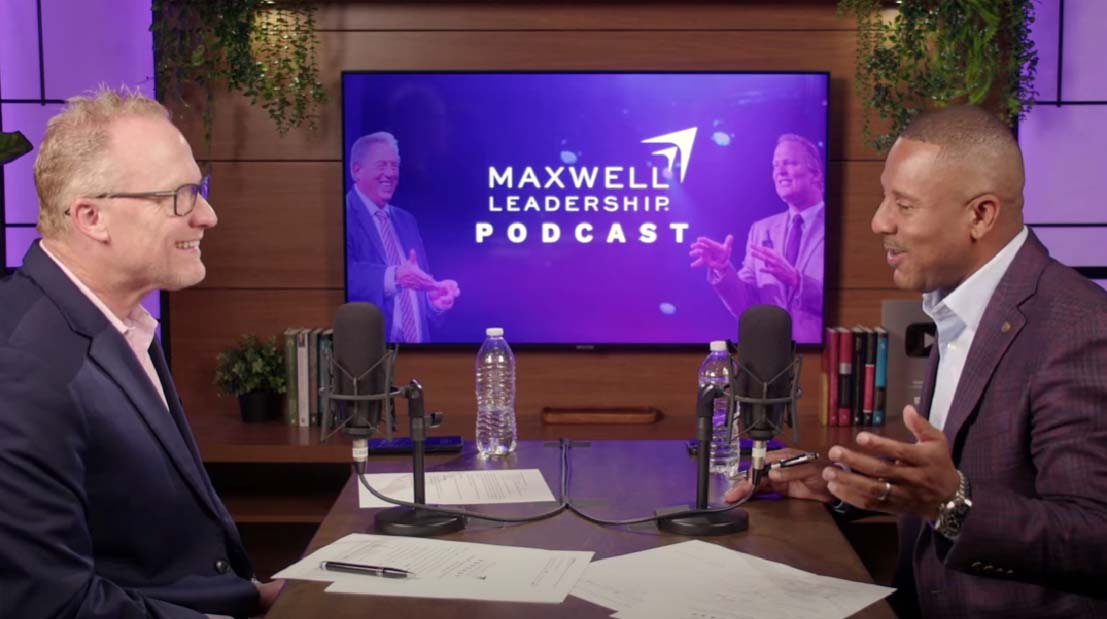
Now, Chris, you’re in the studio with me today. I was sitting here thinking about guarantees and money-back guarantees. I promise you, if you’ll act, whatever. And I was sitting here going, what have I done? There was this company, this has happened 2 or 3 years ago. This company reached out to me and said, we guarantee you to give you advice that if you invest in our recommended stocks, you will guaranteed get money back.
Chris Robinson:
Right. I bought.
Mark Cole:
Yeah. Have you ever done anything like that?
Chris Robinson:
You said guarantee on stocks?
Mark Cole:
Yeah.
Chris Robinson:
Oh yeah, I got it.
Mark Cole:
What’s the—
Chris Robinson:
I can’t get in there. Okay, now watch this.
Mark Cole:
Here’s the problem. I just realized I’ve been working that guarantee for 2 years. I’ve never invested in anything they recommended.
Chris Robinson:
Me neither.
Mark Cole:
So does that mean their guarantee worked or it didn’t work?
Chris Robinson:
Right, I don’t think I was stuck with the guarantee, but I’m on the same system. Either way, it got me. And I’m paying this every single month. I look at every single month. I was like, I need to go look at their stocks. I don’t. And so honestly, I don’t know the login. I don’t know.
Chris Robinson:
I just know what the bill is.
Mark Cole:
This is the podcast confessions of being bit, baited, and absolutely taken for a guarantee. This guarantee is not like that, but it is like it in one way. You have to do something. And so in today’s podcast, John does this episode and the next one. It does offer a guarantee for your growth. But it’s going to require something of you, just like the people that I’m paying for their guarantee and I’ve not done anything with it.
Chris Robinson:
You got to do something with it.
Mark Cole:
That’s not today. So here’s the first thing you do. Go to MaxwellPodcast.com/Guarantee, and there you’re going to get the bonus resource that you’ll be able to download, follow along with John. We’ll also put some other different content value-add pieces there at that link. So go to MaxwellPodcast.com/Guarantee. Click the YouTube link, come over and watch the podcast today live. We would love to have you. Now, make a 2-week commitment.
Mark Cole:
That’s the first guarantee. You’ve got to make 2 weeks commitment into this podcast because John’s going to talk about the Growth Guarantee. And here he is today with part 1.
John Maxwell:
Over the years, I’ve developed a highly disciplined growth practices. I’m gonna give them to you right now. Number 1, I read daily to grow my personal life. That’s no big deal. Everybody else, they, they read also. And I, I consider reading like drinking water. You’ve got to have water to continue to live. So reading is like drinking water.
John Maxwell:
But here’s what— here’s the difference between you and me.
John Maxwell:
This is not a reading exercise for me. It’s a growing exercise. And so therefore, I concentrate on reading the things that’ll give me the return. And so I read daily, but I don’t read what you read. I read the things that are going to give me a return. One of the things I get is what I— the little thing on my iPad called Flipboard. It’s just very simple. And I took about 2 hours one day and picked the subjects that I wanted to read from news media outlets from around the world.
John Maxwell:
And I get it, and every evening around 11 o’clock at night, I wind down by going through Flipboard and I spend about 30 minutes. And in that 30-minute time, I pull out things that are just gonna be helpful or life-changing for me, or they’re gonna be in the areas of communication, leadership, equipping, attitude, relationship, Relationships, or faith. Those are my 6 areas. So listen to me very carefully. I read, you read, there’s one difference. I read for return, you read for pleasure. Now let me just say this. I think there’s nothing wrong with reading for pleasure.
John Maxwell:
In fact, I think it’s a wonderful thing. I would not in any way take away your reading for pleasure. I just want you to know, while you read for pleasure, I read for return.
Chris Robinson:
Amen.
John Maxwell:
In the end, there’s a world of difference. Now, I also must admit, the things I read that give me the return give me great pleasure, okay? I love communication, I love leadership, I love equipping, I love attitudes development stuff. I learn, but I just don’t read what other people read. I’m not going to, don’t need to. Does it have a return? So I read daily to grow in my personal life. Number 2, I listen daily to broaden my perspective. I listen daily because I, I, I’ve never learned anything while I was talking. And so I listen daily to broaden my perspective.
John Maxwell:
Other people’s perspective have things to teach me and things that I can learn. And the more I know about your perspective, the more well-rounded I am on the same subject. I wanna know your perspective about leadership. I wanna know your perspective about communication. I wanna know your perspective about relationships. But can I tell you something? I don’t wanna know anything about your perspective about sports or about entertainment or any of that other stuff that absolutely has no return. It’s okay. I’m not saying not for you to do it.
John Maxwell:
I’m just saying I’m teaching you, if you really wanna grow, I mean, you don’t have to. Everybody’s got a choice. But if you wanna grow, I read where the return is, I listen where the return is. Number 3, I think daily to evaluate What I learn. I think wide, which is perspective. I just talked about that. I think deep, which is sustained thinking. Sustained thinking will change your life because you may be very smart and you’ll think about something for an hour.
John Maxwell:
I’ll think about it for 3 hours. And research tells you that the longer you think about something, The deeper your thinking goes. In fact, if you take 10 people in a room and they spend 1 hour on that thinking, remove 5 of them out but leave 5 back, and the 5 that are left behind, they get 1 more hour on the thinking. In the end of the second hour, the thinking of those 5 will be much better than the thinking of the third. Why? Were the last 5 smarter than the first 5? Not at all. It’s the fact that they were willing to stay with the thinking longer. So I have ways to keep Thoughts before me where I could just at least think so that I can go deep. So these are my practices.
John Maxwell:
I read daily to grow in my personal life. I listen daily to broaden my perspective. I think daily to evaluate the things that I am learning. And number 4, I file daily. And I file daily to preserve what I am learning. It’s just that simple. Because if I don’t file it, I’ll lose it. And I don’t want to lose it.
John Maxwell:
I worked too hard to get it. The number one time waster in people’s life are looking for things that they lost. Do you know why you lost them? You didn’t have a plan to put them in the right place in the first place. And so therefore, since you don’t have a place to put them, you can’t find them. And what I do with thoughts is, which is to me, ideas and thoughts are just about the most important thing in the world, much more important than money. I make sure that when I think that thought and I work that thought, sustain that thought, I make sure that I file that thought. Now, those are my growth practices on daily, from a daily practice. Now I’ve given you 3 conditions that will guarantee your growth.
John Maxwell:
Your growth must be intentional, it must be useful, And it must be continued.
Rise ad:
Life doesn’t ask if you’re ready before it knocks you down. Whether it’s a rejection, a diagnosis, a door that closes without warning, discouragement isn’t random. It’s strategic. It targets exactly what matters most: your identity, your calling, and your future. Kelvin Henry knows that weight firsthand. A fast-growing cancer diagnosis, open-heart surgery, and a car accident that shattered both his legs. As a Maxwell Leadership Certified Coach and former Fortune 25 senior manager, Kelvin turned decades of setbacks into a path anyone can follow. In his new book, Rise: A Framework to Overcome Discouragement at Its Roots to Come Back with Purpose, he shares the RISE framework.
Rise ad:
4 repeatable stages that carry you from recognizing reality to executing your next right step so you can rise again and again and again. If something in your life is calling for a comeback, this book will show you the way. Get your copy at the link in the show notes.
Mark Cole:
All right, Chris, welcome back. I don’t know if you listened to John’s podcast teaching today or if you went and canceled your subscription. I’m not sure what you did.
Chris Robinson:
I’m going to cancel it. I’m going to cancel it.
Mark Cole:
I’m still laughing about the guarantee. Hey, boy, I love what John did here as it relates to talk about how he personally now for years, 50, 60 years now has committed intentionally to growth. And so I want to unpack this with you, Chris, because truly, again, on some of the guarantees that we’ve been given, we haven’t operated on. But this one, I’ve watched you do the exact same thing. Boy, your growth. Year over year, I get to ride shotgun with you, and your growth year over year is because you do some of these exact same things that John does.
Chris Robinson:
Yeah, absolutely. Well, I see the same in you. I mean, you are one of the most studious when it comes to personal growth and development, and I don’t know anybody that takes it as seriously as you do when it comes to planning for your year, when it comes to just how can I grow and get better? You model that. So again, proximity has empowered me to do it. It’s one thing for us to read about it, but then for me to have the ability to see it through John, see it through you and other leaders in our organization, it’s just, it’s absolutely amazing.
Mark Cole:
Well, and you’ve got some questions you thought and prepared for, but before we go there, I want to look you podcast friends in the eyes, especially if you’re visualizing this and watching it on YouTube. You’re sitting by a guy that literally pulled every bit of his savings out to join the team that he now runs. He’s now the president. He’s the leader of that team. You’re looking at a guy that came to this environment with nothing that now gets the responsibility of owning the future and stewarding the present. And I say that because I don’t know what your dream is. I don’t know what your aspiration is, but here’s what I know. Your opportunity is greater than you can imagine.
John Maxwell:
Yeah.
Mark Cole:
Exhibit A, Exhibit B. The difference maker in your dreams and aspirations and my dreams and aspirations lies in the guarantee that John’s given you here today. And you’ve got John saying that, you’ve got Robinson saying that, you got Cole saying that, and I’m just going to challenge you. Don’t let this message, this lesson, this 2-part series be too simplified for you. It is that simple. It’s not easy, but it is that simple. And that’s what we wish to extend to you today in these questions and in this discussion.
Chris Robinson:
Yeah. Well, let’s dive into it because at the end, John closes out that you have to be intentional, Growth must be useful and growth must be continual. Where do you think people fool themselves in thinking they’re really growing when they’re not, when you look at those 3 categories?
Mark Cole:
I think to me, it’s the usefulness. We’re going to talk about this a little bit later, but John says he reads to grow. He does not read, or he reads for a return. He does not read for pleasure. I think it’s finding useful ways to what you grow. It’s very funny. We’re going to laugh about this the whole episode, evidently. But I really, 2, 3 years ago, I bought into that guarantee that I was going to make money with this monthly investment, and I’ve never done anything with it.
Mark Cole:
In other words, it wasn’t useful. And I think that since I bought it, and I think that since I’m not canceling it, that’s going to make a difference for me, but it’s not useful.
Chris Robinson:
Right.
Mark Cole:
And I think, well, the guarantee says that it’s guaranteed. Well, I pay the money. That must be a guarantee. I read it every once in a while. Like you, I do read it. You can read it every once in a while, but until you put something into action, it’s not really applied learning until it’s useful. And so if you look at, I think there’s a lot of intentional people. I think there’s a lot of people that’s continual, but they don’t make sure that what they’re learning is useful.
Mark Cole:
And I think that’s the hidden step.
Chris Robinson:
Right. Yeah, I really do. And again, that comes down to relevance and we’ll talk more about it next week, but even just in the layered learning to make sure that it’s in alignment with where you want to go. Now, John, he talks about when he comes out the gate talking about reading at the very beginning. I want to pause for just a moment because he says, reading? That’s no big deal. Wait a minute. Reading is a gigantic deal.
Mark Cole:
Yes, it is.
Chris Robinson:
Okay, let me—
Mark Cole:
To a lot of us, that’s for sure.
Chris Robinson:
It’s a gigantic deal. And I don’t want you to miss this right here because it’s just like the person that works out every single day that says, oh, 10 pushups is no big deal. But if I don’t do any pushups at all, And I got to do 10 pushups? That’s a big deal. Well, let’s say it accurately.
Mark Cole:
10 pushups is not a big deal to him. 10 pushups is a big deal to me. But that is your point, right? It’s not a big deal to John because he’s been doing it 50-plus years every day.
Chris Robinson:
Right.
Mark Cole:
But to those that’s not doing it, let Chris and I challenge you to realize it is a big deal, but it’s still important.
Chris Robinson:
Yeah, it is a very, very big deal. And I think a lot of people miss it because that was one of the instructions that I got from a billionaire years ago when I I asked the question, what’s one thing that would make the greatest difference in my life? He said, read. Now, before I can say anything stupid, he answered it for me. He said, read, because he was illiterate at the age of 27, and by the age of 75, he was a billionaire.
Rise ad:
Wow.
Chris Robinson:
He says, I attribute my billions of dollars to reading over 5,000 books in my lifetime. He says, Chris, read. So I said, ooh, I need to read. I need to read. So we talk about this, getting a return on investment. How do you think people should decide what deserves their attention intention right now?
Mark Cole:
Well, I think for me, when I first started intentionality, and for me it was 26 years ago, I was challenged with a very similar question that John was, and that is, what’s your growth plan? And that goes into intentional. And I went, I don’t have one, but I’ll get one because that sounds like something I could do. And for some of us listening today, some of us viewing today, Let me tell you this, get started. Don’t wait for it to be perfect. Don’t wait for it to be something that’s going to give you a return because getting started will give you a return. To answer your question now, how to make it more of a return or how to get a greater level of results from it, I think it goes to asking yourself the question, where do you want to grow? And how do you want to use that growth in your purpose? Now, those are 2 big words. Where do you want to grow? Where sounds like really a haphazard, easy answer, and I don’t think it is. I think the answer to that question is deep within us.
Mark Cole:
The how is also equally deep, and why is equally deep. But I didn’t have that for 3 years. I just had, I’m going to start growing. And for me, the journey is what revealed the hoped-for destination. Most people I find are paralyzed waiting for the destination to materialize so they’ll make sure that they’re going in the right direction. And I challenge people as it relates to growth and getting a return on growth, get started. And in the getting started, clarity will come.
Chris Robinson:
Yeah, it does come because I can recall even after having lunch with him, I began reading ferociously. I mean, I was reading a book a month. I thought I was like, I’m a super reader. Then I realized that people were reading a book a week, a book a day, and I said, oh my goodness, I have to grow. But what happened was I started asking different questions. I started asking people how they read, but then I began to filter what I was reading, and that’s when I seen the real shift.
Mark Cole:
Yeah.
Chris Robinson:
And so I looked at it and go, hey, I need to really only read books or ask the question, what are you reading? on a specific topic. So I would filter to either my purpose or my passion or my problem that I’m trying to solve. So even today, I stay within those 2 categories.
Mark Cole:
Your passion and your problem you’re trying to solve. That’s so good. That’s really good, actually. You know, when John was talking a little bit earlier, people that read to grow or people that read to get a return, John is very intentional with this. I’ve watched him on a plane start a book, and 20 minutes in, close the book and say, well, I don’t have anything useful in that one.
Chris Robinson:
Right.
Mark Cole:
In other words, here’s a litmus test for those of you that are reading. Do you read the book to completion even if it’s not impacting you? Or do you set it down and pick up another book to see if it can be useful to you? And often I’ve fallen into a trap. Well, I committed that I’m going to read this. I’m going to stick through it and hope I find something rather than like John. He goes, man, if I’m not finding anything 1 chapter in, 2 chapters in, Set it aside. Let me find something else. And I think that’s really important to ask ourselves this litmus question. Am I reading to completion or am I reading to accomplishment or to activation?
Chris Robinson:
Yeah, absolutely. And I’ve picked that up from John going, hey, I’ll buy a book and read a chapter and leave it alone. And here’s the thing, we have this commitment to like, well, it doesn’t count if I don’t read the whole book. You’re not in school anymore.
Mark Cole:
Yeah, exactly.
Chris Robinson:
Nobody’s giving you a grade. This is life. Get what you need to get and get I’m going to get out of the book. So give me a routine then, Mark. So for somebody listening today, what would a realistic 30-minute daily routine growth system look like for them?
Mark Cole:
Well, again, identify where you want to grow and then make the commitment and do it every day. And at the end of the 30 minutes, if you really technically only have 30 minutes, only read input content for 25 and spend 5 minutes putting a plan of action in place. For instance, this year in 2026, a plan to grow in artificial intelligence, in AI. I am going to grow. So every day I’m spending 30 minutes of AI every day prompting, trying a different prompt, working with yesterday’s prompt to improve today’s reaction. And I’m just constantly digging into AI because I don’t want to get left behind, but it’s where I am growing.
Rise ad:
Yeah.
Mark Cole:
Now, I still am consuming content, books, digital content, but where I want to grow this year is in AI. It starts with where you want to grow, and it ends with how you grew. How did I grow today in AI? And every single day I answer that question. There are days that I said, man, I didn’t discover anything new. So tomorrow I’m trying something altogether different because I don’t like too many days in a row like that right there.
Chris Robinson:
I love it. I love it. And that’s the easy way to get started. So 25 minutes reading or listening, and then 5-minute plan of action. What are you going to do with it? So you’ve watched John firsthand when it comes down to sustained thinking. Give me a time when you’ve seen John in sustained thinking and where you’ve seen the benefit of that.
Mark Cole:
This is one of the things I admire about John as it relates to content is how he makes everything so simple. He’s gotten critiqued a lot. Some people criticize, some people celebrate, but he’s got critiqued a lot about how simple he is. Man, I read your books, John, and it’s stuff I already knew. Okay, he loves that. He says, good, what’d you do with it?
Chris Robinson:
Right.
Mark Cole:
Well, now that’s a different conversation. However, John is nowhere near as simple as he appears on the surface, which I said that just like that very intentionally. John will take something very complex and he’ll simplify it so that the most amount of people can get a handle on the concept and then put complexity to it in application. But he distills a principle down, a handle down. Everything rises and falls on leadership, the leadership lid. An organization can only go as far as the lid on them, the leadership lid on them. He takes these complex concepts and simplifies them both for mass appeal, but also for different application depending on the leader and the level of the leader. Why I love that about John is because everybody, people at various differing levels of leadership can listen to the same message and get massive meat, massive application out of John.
Mark Cole:
John is incredibly relevant that way. But it’s also highly intriguing to people that lead at sophisticated levels because once they start applying it, they realize how deep his concepts are.
Chris Robinson:
Mm-hmm.
Mark Cole:
How did he do that? Layered learning, sustained thinking. So he’ll take a concept. I remember the time that he was talking through Success Stabilizers, which is a book that he’s going to be writing soon. And he said, Mark, I feel like that there are things that leaders that are sustainable do when they have success that other leaders that are flash in the pans don’t do. That I think we could figure out. And I think it’s with how they stabilize success. And I remember when he first said that, I was like, okay, that sounds good. By the time now that he has put that in Handles, it is so thought, rethought, simplified, amplified, put complexity around it again.
Mark Cole:
And it’s what we call layered thinking. And he does his layered thinking. He does his sustained thinking. both individually and then in groups. This year, his biggest thought— he has a thought of the year that he wrestles with all year long. This year is how to be— John and many of us are people of faith, so those of you that are not, it’s okay. But John wants to be the richest person in heaven. And so this year, all year long, in any environment, I’ve been now with him in Oh, a dozen different leaders that he says, hey, talk to me about what you think when I say this right here.
Mark Cole:
How do you become the richest person in heaven? And then he just listens. Well, that’s sustained thinking. He is spending one solid year on that concept of how do I take the journey of being the richest person post-life than I am during life?
Chris Robinson:
Wow.
Mark Cole:
It’s a beautiful thought.
Chris Robinson:
Wow. And I love how it’s Intentional but casual, ’cause I think a lot of people will say, okay, they’ll complicate this.
Mark Cole:
Yep.
Chris Robinson:
Right? And they’ll go, oh, wait a minute, I don’t have time to ask this question every day, or I don’t have time to think about this every day. But even just keeping it before him, whether it’s on his iPad or whether it’s a notepad or an index card from time to time, but continuing to ask that question conversation after conversation after conversation just to keep that dialogue going. That’s a really simple way to just stay engaged and wrestle with that for a period of time.
Mark Cole:
And I think our ability to have sustained thinking, Chris, comes in who we surround ourselves with. And so sustained thinking left alone becomes redundant thinking.
Chris Robinson:
Right.
Mark Cole:
But sustained thinking moved around with different other thought leaders or thought provokers or thought givers, that then makes the sustaining of your thinking much deeper and richer. I know a lot of people that will take a concept and think about it for months, maybe even years, but they never get it out to where it can be massaged and talked about and thought through in different circles. And John is brilliant at bringing different people in at different seasons to sustain his thinking.
Chris Robinson:
Now, I love that. What you just said there, sustained thinking left alone creates redundancy in thinking, but I think it also fortifies people thinking in their belief That’s good. So you can see the people that they’ve had this sustained thinking so long with some idea, thought, or concept that they are completely blind to see any other thought or idea that can improve it, enhance it, or change it to make it better. Oh man, that’s good.
John Maxwell:
That is so good.
Chris Robinson:
Okay. So let’s take this personal. Let’s make this personal here as we get wrapped up here. But if someone says, hey, I want this next 12 months to be the greatest year, Okay. We don’t have to wait till the end of the year to start the greatest year. The greatest year can start now. What would be 3 things you challenge them to start doing tomorrow?
Mark Cole:
I think one is reading content or take content in. So we’re in a world, you’re right, that reading is very hard. Get a content intake commitment. How are you going to intake different thought and different concepts starting tomorrow?
Chris Robinson:
Mm-hmm.
Mark Cole:
Is it YouTubing? Is it reading nonfiction books? What is it? And by the way, read it for a return. As John says, read it for growth, but find something. The second thing is, is find a community to work it out. In other words, you just read it. Now get some people to speak into it. And then the final thing that I would tell you is find experiences to put it into practice. practice. Because when you can read it, take it in, when you can process it, live it in community, when you can apply it, that becomes the recipe of return.
Mark Cole:
That becomes a formula of getting that deeper thinking or that greater return of application that John is talking about. We’ll talk next week, in next week’s episode, we’ll go a little bit deeper in how you can expand your growth and how you can begin driving it. And you as podcast friends, you’re going to appreciate the second episode of this for 2 reasons. One, you’ve had this week now, right now, you have this week to process what you’re learning. Next week, you have the ability to come back and begin to expand it or to apply it. So I’m very excited about that, Chris. Thank you. Go cancel that subscription that you and I both need to.
Mark Cole:
Hey, for those of you that really do want Yeah. If you want to get some growth practices and some growth promises into your life, we have a product called Every Day with Purpose, and it’s a brilliant product. I love it. But what I love the most about it is it’s every day and it creates this rhythm, this rigor of growth and intentionality that will make a difference. You’ll see in the show notes, we’re giving you a 75% discount on that. We’re wanting to jumpstart you and gift that to you. Also, you’ll see in the show notes at MaxwellPodcast.com/Guarantee. You’ll see an episode that we’ve referenced called It’s Not About You: Leadership, Communication, and Putting Others First.
Mark Cole:
And that is a resource I challenge you during the week before you get to part 2, listen to that as well. It’ll help you. Go do well, be well, most importantly, lead well, because everyone deserves to be led well.