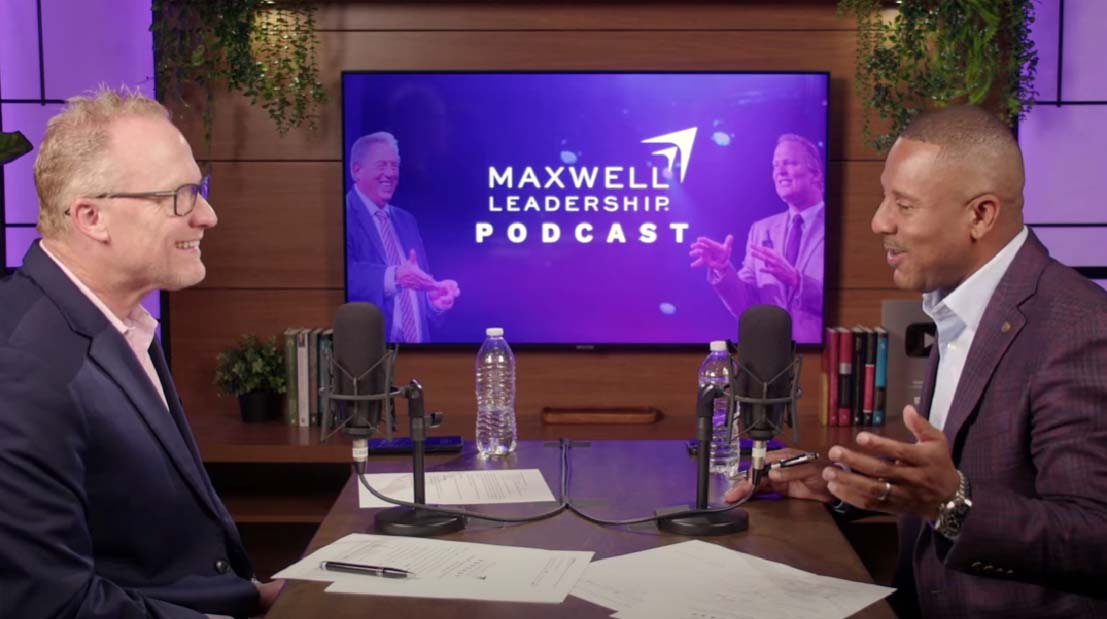
Find out exactly what John Maxwell means when he says, “You have to give up to go up.” In this week’s episode, John reveals fifteen time-tested strategies to help you get more done in less time and take back control of your effectiveness as a leader!
After his lesson, Mark Cole and Belay CEO Tricia Sciortino deliver actionable steps and real-world strategies so you can immediately start maximizing your productivity with John’s principles.
Our BONUS resource for this episode is the How to Get More Done in Less Time Worksheet, which includes fill-in-the-blank notes from John’s teaching. You can download the worksheet by clicking “Download the Bonus Resource” below.
Leaders, stop trying to do it all yourself. The best leaders know their limits, operate out of their strengths, and set others up for success. Find freedom with BELAY — pairing you with vetted U.S. virtual assistants so you can focus on what matters.
To help you get started, BELAY is offering Maxwell Leadership listeners a free download of their resource, The Financial Blind Spot Checklist. Just text MAXWELL to 55123 for FREE access.
Belay ad:
You know that feeling when you look at your financials and something just seems off? You can’t quite name it, but you know the numbers aren’t telling the whole story. Most leaders I talk to have been there, and here’s the thing: it’s not a you problem, it’s a visibility problem. Billay matches busy leaders with tailored financial solutions so you can stop guessing and start leading with confidence. Their vetted financial experts can handle everything from day-to-day bookkeeping to CFO-level guidance and forecasting for your business. And it’s fully customized to your unique needs. No long-term contracts, no offshore teams, no next available assignment. They personally match you to the right solution for your business. And if it’s not right, they rematch you at no added cost.
Belay ad:
Right now, BELAY has a free resource built specifically for leaders like you, the Financial Blind Spot Checklist. It helps you see exactly where your gaps are before they become costly mistakes. Text Maxwell to 55123 to download it for free. That’s Maxwell to 55123.
Mark Cole:
I talk to entrepreneurs all the time and they say, what’s the most important decision I’ll make? And I said, getting somebody on your team to take off things that you should not be doing. That is my single quickest and most relevant answer. Hey, welcome back to the Maxwell Leadership Podcast. We have done over 430 episodes, and I promise you, I am getting ready to start what will be one of my favorite podcast episodes that we’ve done out of 430. And I’ll tell you why. We have created a podcast where John Maxwell, one of the greatest sought-after leadership experts, delivers content every single week. And so every single week we have a content aspect to this podcast, but then we made a decision 430+ episodes ago that we would give every podcast episode application. And I’ve gotten to sit in this chair and give application over 430 times to John Maxwell’s content, but never before have I been able to show and demonstrate application to the content than I will be able to today.
Mark Cole:
And that is because I am joined by Tricia Shortino, She is the CEO of BELAY. Now, many of you are wanting to pause the podcast right now and go ahead and say, what is BELAY? Who is Tricia? And why is Mark so excited? And you can do that, but come back to the podcast because not only is she going to show you how to apply John’s lesson today, she is truly one of the most interesting CEOs that I get to interact with. We’re a client of BELAY. They serve us and our human resource needs. They’re incredible. They give us time back that we didn’t have. But also, every time I spend time with you, Tricia, every time I go, I need more leadership conversations. Quit putting a microphone in front of me and let me get a notepad in front of me because I want to lead like Tricia when I grow up.
Mark Cole:
And I say that tongue in cheek, but I say that sincerely because what she has done as the first employee Of BELAY. She goes way back, maybe none of your business, but she goes way back because you got to be careful how you talk about age around here. But she goes way back over 10 years or more than that. She has been a senior leader for 10 years, 3 years as COO. The last 7 years since January 1st, 2020, she has been the CEO. And today, They now have over $100 million of revenue. But here’s what’s even more important. Tricia and her team have placed over 15,000 teammates into 15,000 organizations in the last 15 years.
Mark Cole:
And I’m staggered by that, Tricia. I’m staggered by that stat. I’m staggered by your leadership. And I’m super excited that we’re going to get to hear from you in just a little bit. But thank you for being here.
Tricia Sciortino:
Thank you for the warm welcome, Mark. It is an honor to be having this conversation with you today.
Mark Cole:
Well, likewise. And that’s because the team put this content in front of me that John did recently saying how to get more done in less time, how to get more done in less time. Now, leaders, let me ask you a question. Every one of you podcast listeners will answer yes to what I’m getting ready to ask you. How many of you want to get more done? That’s a leadership question. And that is a leadership response.
Mark Cole:
You said yes.
Mark Cole:
Some of you gave some emphatic words before yes. Yes, yes, yes. We want to get more done. But let me put a little cherry on the top. How many want to get more done?
Mark Cole:
3 words, in less time. And John is going to give you 15 things right here that will help you get more done. But Trish is going to come back and give you application like you have never heard in any podcast before. So grab a pen, grab a paper if you want to So to download the bonus resource, if you want to see some other things that we’re just giving you free, you can go to MaxwellPodcast.com/Effective. You can see the Zoom link there. You can see that Tricia and I coordinated black today. Black is the new cool. And so you can check out the podcast on YouTube at MaxwellPodcast.com/Effective.
Mark Cole:
Grab a pen. Here is John Maxwell.
John Maxwell:
Okay, let’s get down to business. Let’s talk about how to be productive in our life. The dividing line between success and failure can be expressed in 5 words: I did not have time. So many times in our life we fail to be what we could be or should be because we say, well, I, I just didn’t have time. And, and because of that, I want to talk about how we can really squeeze the best out of our time and out of our day. So 15 things that’ll help you to really be more effective in your time management and your day. Number 1, never begin the day until it is finished on paper. You and I, if we’re going to be very effective, we’ve got to know where we’re going.
John Maxwell:
We’ve got to write it down. We’ve got to start there. The good news is that every minute spent in planning saves as many as 10 minutes in execution. It takes only about 10 to 12 minutes for you to plan your day, but this small investment of time will save you up to 2 hours, 100 to 120 minutes in wasted time and diffused effort throughout the day. Many years ago, I realized in the area of making the best out of my time that either I was going to have to control my time or somebody else would control it for me. That I was either going to have to control my calendar or somebody was going to control it for me. That I was either going to be on my agenda or, to be honest with you, I was going to be on someone else’s agenda because somebody was going to come in And have an agenda for me. So the issue is never, were you busy today? But the question is, did I have an effective day? And the effective day comes from me taking and getting control of the calendar, me getting control of my day, me in the very beginning, you in the very beginning, looking at what we have to accomplish and beginning to prioritize it.
John Maxwell:
Number 2, learn to say no. And I love the quote I have here. Don’t let your mouth overload your back. Now, this is a weak area for me. This is a huge weak area in my life. In fact, I am so weak in this area that I’ve always had to have ways and people to help me through that process. I’ve had to have gatekeepers, and I’ve had to look at my weaknesses here and say, okay, how am I going to be able to overcome just trying to help everybody and try to meet every need and try to Try to take care of everybody that I possibly can. Let’s go to number 3.
John Maxwell:
Apply the 80/20 principle in everything. There’s never enough time to do everything, but there is always enough time to do the most important thing. The 80/20 rule is one of the most helpful of all concepts of time and life management. It is also called the Pareto principle after its founder, an Italian economist, Ferretto Pareto, who first wrote about it in 1895. Pareto noticed that people in his society seemed to divide naturally into what he called the vital few, the top 20% in terms of money and influence, and the trivial many, the bottom 80%. He later discovered that virtually all economic activity was subject to the principle as well. For example, the principle says that 20% of your activities will account for 80% of your results. 20% of your customers will account for 80% of your sales.
John Maxwell:
20% of your products or services will account for 80% of your profits, 20% of your task will account for 80% of the value of what you do, and so on. This means that— here’s the important sentence— that if you have a list of 10 items that you do, 2 of those items will turn out to be worth 5 or 10 times or more than the other 8 items put together. Now, when I began to understand the 20/80 principle, the 80/20 principle, doesn’t matter how you say it, and began to understand that the most important aspect of effectiveness was not working hard or being diligent or being faithful, but understanding how to prioritize your life. This began to really help me. Let’s go to number 4. Number 4, spend your greatest amount of time with the smallest amount of people. But you got to figure out who your inner circle is. Going back to 21 Irrefutable Laws of Leadership, those who are closest to you will determine the level of your success.
John Maxwell:
Who are your— hey, go back to the 80/20 principle. Who are your top 20%? Whoever the top 20% of the people are would be in your group, those are the ones you ought to be spending— you ought to be spending 80% of your time with your top 20% and 20% of your time with your other 80%. Simple enough. Number 5, identify your limiting factor. If you’re really going to get the most possibly done in the least amount of time, identify your limiting factor. And we’ve got to identify what that is. Whatever you have to do, there is always a limiting factor that determines how quickly and well you get it done. What you got to do is you got to look at what you’re trying to accomplish, what are your priorities, what’s going to give you the great return, and then you got to sit there and say, okay, What holds me back? Number 6, know what you want to accomplish.
John Maxwell:
If you want to get more done in less time, know what you want to accomplish. Clarity is the most important concept in personal productivity. I have people all the time come to me and say, John, I’d like to hire some leaders on my staff. The first question I ask them is, what’s a leader look like? What are you looking for? Because you see, if you don’t know what you’re looking for, you don’t know if you got it. And clarity is the key to helping us in personal productivity and everything that we do. The moment that you and I get clarity on something, we begin to be much more effective than if we don’t have it. Number 7, understand that spending your time is not a metaphor. I love the phrase spending your time.
John Maxwell:
You don’t really pay for things with money. You pay for them with time. In 5 years, I’ll have enough put away to buy the vacation house we want. Then I’ll slow down. That means the house will cost you 5 years, 1/12 of your adult life. Translate the dollar value of the house, car, or anything else into time, and then see if it is still worth it. Sometimes you can’t do what you want and have what you want at once because each requires a different expenditure of time. Let’s go to number 8.
John Maxwell:
To make a day count, make each minute count. What I’ve discovered is most people get ahead during the time that others waste. I heard a good teaching on this by a fellow named John Erskine one time, and he was talking about the fact that when he was a kid, he took piano lessons.
John Maxwell:
And so his piano teacher was asking him about practice, and he said, well, I sit down and practice 15, 20 minutes, maybe 30 minutes at a time. And his teacher said, no, you really don’t need to do that. You ought to practice 3 to 5 minutes at a time. You ought to sit down and practice 3 to 5 minutes and then get up and do some other things and just go back and forth. Go back to the piano 4 or 5 times a day, but practice only 3 to 5 minutes. And then John Erickson was saying, what he taught me was Life doesn’t divide itself and give you big blocks of time normally. And what he was teaching him was to take great use of small amounts of time and let it compound to make a big difference. Number 9, realize that lost time is never found again.
John Maxwell:
Time is created by us for things we want to do. It often requires conscious planning to create those chunks of time that we can devote totally to one another. Understand that we’ve got to get the very most out of each day that we possibly can. It’s a great thought. Number 10, have a positive mental attitude. Optimism is the most important quality you can develop for personal, professional success, and happiness. Optimistic people seem to be more effective in almost every area of their life. It turns out that optimists have 4 special behaviors, all learned, through practice and repetition.
John Maxwell:
First, optimists look for the good in every situation. No matter what goes wrong, they always look for something good or beneficial. Second, optimists always seek the valuable lesson in every setback or every difficulty. They believe that difficulties come not to obstruct but to instruct. Third, optimists always look for the solution to every problem. And fourth, optimists think and talk continually about their goals. They think about what they want and how to get it. They’re always looking forward rather than backward.
John Maxwell:
Number 11, let your long-term perspective determine your short-term priorities. Future intent influences and often determines present actions. Successful people have a clear future orientation. They think 5, 10, 20 years out in the future. They analyze their choices and behaviors in the present to make sure that what they are doing today is consistent with the long-term future that they desire. Let’s go, number 12. I love this. Ask yourself, why am I on the payroll? This is one of the most important questions you can ever ask and answer over and over again throughout your career.
John Maxwell:
As it happens, most people are not sure exactly Why they are on the payroll. But if you’re not crystal clear about why you are on the payroll and what results you have been hired to accomplish, it’s very hard for you to perform at your best, get paid more, or get promoted faster. Number 13, create large chunks of time. Now, we’ve already talked about maximizing the minutes in your day. We’ve already talked about the piano practice and 3 and 5 minutes and grabbing this. We’ve already talked— Now, create large chunks of time. Now, you notice I didn’t say create small chunks of time. Small chunks of time are created for you.
John Maxwell:
Can I tell you something? The average person has between 25 and 30 chunks of time every day that are small. They’re already created for you. Hey, a missed appointment. I mean, they just happen. You don’t need to create those. Those will happen. You don’t create those. What you do is you take advantage of those.
John Maxwell:
But you do have to create large chunks of time because life doesn’t come in large chunks of time for us. Most of the really important work you do requires large chunks of unbroken time to complete. Your ability to carve out and use these blocks of high-value, highly productive time is central to your ability to make a significant contribution to your work and to your life. The large chunks of time, you have to put your important things that you do in it because that’s going to give you The highest return. Are you with me? That’s what you’ve gotta see. The high return comes in the large chunks of time. Number 14, put pressure on yourself. I love this one.
John Maxwell:
Brian Tracy said, this is so true, only 2% do excellent work without supervision. So all of my life, I have put pressure on myself. Your self-esteem, the core of your personality, is defined by the reputation you have with yourself. You build up or you pull down your reputation with yourself with everything you do or fail to do. I’ve always said the highest bar of expectation for me is not someone else, because the successful people, they wouldn’t think of somebody else setting a bar higher for them than what they set for for themselves. Now here’s what I’ve discovered. If you won’t put pressure on yourself, someone else will. So you got to ask yourself, am I going to be the person I should be or am I going to be the person somebody else wants me to be? Leaders all are self-disciplined.
John Maxwell:
Leaders all put pressure on themselves. They have no problem saying, I’ll go first. It’s okay. I’ll declare— hey, I’ll declare the vision. I’ll be the first to sacrifice. I’ll be the first to take action here. Because they understand the visual Boldness of the example, which brings me to number 15, be self-disciplined. Albert Hubbard defines self-discipline as the ability to make yourself do what you should do when you should do it, and I love this, whether you feel like it or not.
John Maxwell:
Most people who sit around waiting for their ship to come in often find it is hardship. Those things that come to a man who waits seldom turn out to be the things he waited for. The hardest work in the world is that which should have been done yesterday. Hard work is usually an accumulation of easy things that should have been done last week. I would encourage you on your own now to take those 15 things that will help you to be more effective in your time management in your day, and again, go back and evaluate If you do it like I do it, you’re going to find that there are some you really excel in. There are going to be some of you you don’t excel in. But I would really encourage you that if you can effectively work those, it’ll be absolutely amazing how effective that you’ll be.
Mark Cole:
Hey, so welcome back, everybody. I know, I know what John just shared with you is going to help you, but I’ve got to get out of the way speaking of more time in less time. And I’ve got to get you introduced to Tricia. Tricia, before we talk a little about belay, before we talk a little bit about your leadership, you were telling me, John did a good job with 15 of those, but I think there’s one more to add. So I’d love for you to just talk to us a little bit about the 16th way to get more done in less time.
Tricia Sciortino:
I think 16 is the practical application of 1 through 15, which by the way, every single one of them resonates with me. But I think the underturn to all All of it is delegation. So, in order for number 11 to happen, let your long-term perspective determine your short-term goals. In order for that to happen, you have to have chunks of time on your calendar, which is number 13. And in order for you to have chunks of time on your calendar, you have to learn to say no, which goes back up to number 1 and the core of this whole thing. And in order to say no, you have to have the resources to deliver the work to. You have to be able to delegate work to others. So that you can have capacity to do the 20% of the things you know you’re supposed to do, not the other 80%.
Tricia Sciortino:
And so, delegation becomes the underlying needle mover for all those things to be possible. And so, delegation is a tricky one for a lot of people. There are many different schools of thought. There are many ways to delegate. There are many systems we’ve helped leaders walk through to help them delegate better. And so, I’m excited to talk about how can we use delegation To help us move us through these 15 things and actually deliver what we promise.
Mark Cole:
Well, and we’re going to talk more about belay, but I do have to be fair to my podcast listeners and our viewers and tell literally tens of thousands of you, hundreds of thousands of you, that one of the best things we did at Maxwell Leadership was to create more time in our executives. I can’t remember how many of your 15,000 people that you’ve been able to, or 15,000 companies you’ve been able to help, that we have here at Maxwell Leadership. But gang, I’m just going to tell you what BELAY does, what Tricia has created is truly application on this. And we are a proud client of BELAY. And we have BELAY people on our team at all times. And we’re so thankful for it. The other thing that I want to say kind of as we get going, is, Tricia, your leadership and what you have done to now be the CEO of a company where you started and was a part of the first dollar generated, and now you’ve grown it over $100 million with what you do is staggering. So I’m going to come back to your personal story in just a moment because I want our listeners to know what you have accomplished as a leader.
Mark Cole:
But give us just a little bit of what BELAY does, your methodology, how you help companies like mine to be more productive? So just give us kind of, I want a 30-second, a minute elevator speech. So don’t go easy on me because I owe it to my podcast listeners to give them application to what John just talked about.
Tricia Sciortino:
Yes. So BELAY is your resource if you are overwhelmed and busy and you’re out of time. We provide fractional support for all of your business administration, operations, and financial teams. So what that means is we provide fractional support with assistants, executive assistants, sales assistants, operations assistants, starting as low as 10 hours a week, going up to 30, almost full-time if needed. We do the same in many different types of assistant levels. So you can leverage an assistant in all different areas of your business or for yourself as an executive. We also do the same for your financials. So, we offer bookkeeping, payroll, fractional controller work, fractional CFO work, and fully outsourced accounting teams to our clients.
Tricia Sciortino:
So, we’re taking care of all of the backend of your business so that you have time to think strategically, to think ahead, to focus on what only you should do.
Mark Cole:
It’s a phenomenal thought. I work with leaders all the time and their capacity is the question they struggle with all the time. I don’t have the capacity. I don’t have the bandwidth. I want you to know that what you have created is a product that we all need. I talk to entrepreneurs all the time and they say, what’s the most important decision I’ll make? And I said, getting somebody on your team to take off things that you should not be doing. That is my single quickest and most relevant answer. And so we’re going to talk about BELAY, but I had to get that out on the front end here.
Mark Cole:
But I want to talk about you. Because again, I get intrigued every time we have a conversation. And so you not only was the first employee to helping generate the first dollar that became the COO and then the CEO, you’ve also grown it every step of the way. But you did it by speaking of knowing how to say no. You did it when you already had a very successful job. You were a successful executive and you knew to say no to that because you wanted to go home, You wanted to get some priorities in your life corrected, and then you still rose to the top again. Talk to me a little bit about how the power of saying no to that corporate allure actually gave you what was important to you and then took you back to where you went with your values in tow.
Tricia Sciortino:
Yes. In my early career, I was rising in the corporate ladder. I wound up in a high-profile role before I had children when I was a younger version of me. And I was working 60, 70 hours a week, going into the nights, weekends. Then, I had a family. And I decided at that time that I needed to take a step back from my career because I wanted to be a great mom. I wanted to be present. My work, I loved it.
Tricia Sciortino:
It fulfilled me. My cup was full at the end of every workday. But I was missing very important things. I needed to be and wanted to be with my family. So, I just walked in the door one day and said, I’m leaving. And so, I took a giant step back. I did that for a couple of months and realized that there was another solution. Could we start fractional, work remote so that I would have the opportunity to be present because I’d be home and also grow my career as it made sense for my family? So, that’s when I found BELAY.
Tricia Sciortino:
I stepped back. I started fractionally. I started as a first employee, very part-time. And as the company grew, I was able to grow my career remotely, fractionally at home so I could raise my girls and also grow my career and have great impact. So, it was very much I was receiving both opportunities. I was able to be A present mom, I was able to be a great leader. And so, pretty quickly, I got into leadership under the context that time could fit in a bucket. Your time is a container.
Tricia Sciortino:
I was willing to give 40 hours of a container of time to my work and my career. The challenge would be over the coming years, could that remain true as we grew? Could I remain growing in my career, elevated to COO and CEO, and still devote 40 hours so that my family did not receive the leftovers at the end of the day. And so, that’s what I’ve been fighting against. And that’s where all the nos come in. So, when everything was going to be a spillover and take me over 40 hours, I ran everything through my no lens. If it was yes, we always knew it was yes. But the nos were sometimes, it was not me. So, I would delegate.
Tricia Sciortino:
That’s a great idea. We should do that. I would like this person to lead it or this person to do it. It’s just not me. It is a not now. That is a great idea. But it does not fit with our current availability, bandwidth, or whatever our big bets are in the organization right now. Let’s revisit next quarter.
Tricia Sciortino:
Or it’s a flat no. It doesn’t align with our priorities. It doesn’t align with our business growth. It doesn’t align with mission, vision, values. It’s no. So, running everything through the no lens doesn’t always mean you never do something. Sometimes, it means somebody else does it. You delegate or you defer to a later time.
Tricia Sciortino:
And I think if you run a lot of corporate decisions and functions and tactical decisions through that lens, you wind up in a place where you’re able to do the things that are most important. You don’t personally take things on you shouldn’t. And you give opportunities for others to lead projects inside your organization or 10/90/10 things. You kind of cast 10% of a vision. Let somebody run 90% of something. And then, you come in at the final end and give it an okay. You allow others the opportunity to grow. And so, by practicing Really believing in my container of 40 hours, it created boundaries that I’ve lived and died by to this day.
Tricia Sciortino:
And proof on the other side is we’ve grown, we’ve continued to grow, and I’m still a 9-to-5 CEO.
Mark Cole:
It’s amazing. It’s amazing to me. Okay. So, I got to double-click on something that you’re saying right there that really coincides with what John’s sharing today on how to get more done in less time. So you work with leaders all the time. In fact, you fulfill the need in us leaders that want to get done more with less time, but it takes an ability to say no. I love your not me, not now, no, no. That’s how I deal with opportunities.
Mark Cole:
Not me, not now, and no, no. It’s a double no. I love that concept. Okay. But you also possess something else as a leader. You do this for leaders, but you possess something. You were willing to take a dip to get that no-no in place. And so, you’re very successful up here.
Mark Cole:
You have an appetite to be successful. By the way, you have an ability to be successful too, if you hadn’t noticed yet. You’re back on top, but you had to give up. You had to take a dip. You had to get back. You had to say no to probably an opportunity that you were loving, you were enjoying, it was filling your cup. Talk to me about why most leaders won’t say the no, no. Is it because of the dip, what they’re going to have to go through to get back to where they really want to be?
Tricia Sciortino:
You know, saying no and taking that step back is probably based in a whole lot of fear is what I would say. There’s a lot of scared in, I’m going to take this step back from this big career, this big thing I’m doing. and hope that on the other side, things work out for me. You know, at the time, I remember telling my family like, hey, I’m leaving this job and I’m going to restart. And half of them thought I was crazy.
Mark Cole:
Yeah.
Tricia Sciortino:
You know, to do such a thing. But I think that it’s very important that when we know something’s not right for us, that we take a risk, take a step back, reconcile what we’re feeling. Your feelings and your gut and your intuition are really telling you things and a lot of us don’t listen to it. What is it telling me? I took a step back. I found what was meant for me, what was meant for my path for the future. And I don’t believe in luck. I really believe that if I had not taken the step back, I would not have wound up where I am today. But it was the most important thing I did.
Tricia Sciortino:
But I think people have to get over the fear of doing that. I think also what goes into doing that is people feel like it’s too late or they’re stuck. So, many people are like, I’m already 45. I’m not restarting now. And I’m like, no, I did it when I was 40. You can restart at 40, 50, at any age. You can restart over again. Take a step back.
Tricia Sciortino:
to hope to boomerang forward and reset your priorities. I think that’s a big one. And I think it’s, you just have to believe in yourself. And so, part of me stands on a principle that I was confident and I believed in my abilities. I just knew I could find a different application for them that would land me in a place that was equally as rewarding. But I had to believe in myself to do so.
Mark Cole:
Yeah. I think part of the path forward, we were talking a little bit about this right before we listened to John’s lesson and then got into studio and started the podcast about how you personally as a leader look at this 80/20 rule that John talked about here. And John said, his words were, apply the 80/20 principle to everything. And so you were talking a little bit about how you had done that. You guys have went through some acquisitions lately. How are you as a leader applying 80/20 currently?
Tricia Sciortino:
Every day. So, 80/20 is how, gosh, any leader needs to think through how they’re leveraging their day. We have gone through a season where we have acquired a couple of companies over the last couple of years we were talking about, Marc. So, we’ve acquired organizations. And so, there’s a lot that comes into that. There’s a lot of things and tactical merging of organizations is huge. And you may feel this even without acquisitions. There’s so much to be done.
Tricia Sciortino:
But what I must always do as the leader is ensure that I do not become buried in the tactical day-to-day in and outs of the organization. And I have to stay focused on the culture, the movement, the vision, the why constantly. And even this week, this week I sent a survey out to our entire organization. I said, hey, how’s communication? What do you need more of? What do you need less of? What are you unclear on? Clarity, like John talks about, is so important. And I received that feedback. And listen, transparently, there was some feedback that was hard to read. There was some feedback where like, hey, I can do a better job providing clarity for my team. And if I am buried in this 80% of stuff that somebody else can be doing, I can’t be focused on the 20% that is most impactful.
Tricia Sciortino:
And that is lead my team clearly into the future and ensure our clients have an amazing experience. So, that has to replicate down to every single person inside the organization, even to our frontline team members providing services. I mean, they have got to be focused on the most impactful work they can do and making sure it’s given the most amount of time possible.
Mark Cole:
Brilliant. Brilliant. John also talked about identify your limiting factor. Okay? So identify your limiting factor. You have gotten 15,000 people like me, CEOs or entrepreneurs, which I’m sure is a big client base of yours, just one-man, 5-man bands that are trying to figure things out.
Mark Cole:
You’ve gotten 15,000 companies to make the decision because of some limiting factor. What do you think is the biggest felt need that BELAY is providing that makes CEOs like me say yes?
Tricia Sciortino:
We’re giving you time back and we’re giving you peace of mind. Those are the 2 biggest things. So, one is so connected to the other. So, like every client we’ve served comes with the same problem. I’m out of time. I’m out of knowledge. I’m out of bandwidth. I’m at a breaking point.
Tricia Sciortino:
Please come in and save me. And so, we define the resource. We bring them through discovery. We help them uncover the pain points. And then, we put together a solution for them that we feel like will solve that pain point and immediately take many hours of work off of a leader’s plate. So, that’s number one. But also, focused on the quality of what we deliver so that you also have peace of mind. You can rest your head on the pillow at the end of the day knowing the work that’s being done on your behalf is being done to the highest quality and it is given a whole lot of care.
Tricia Sciortino:
And to us, the peace of mind measurement is the most impactful one. We love to know that we are able to give people a peace of mind solution by also giving them time back and giving them quality service.
Mark Cole:
What I love about your leadership is you’ve taken BELAY, who was known for executive support, executive administration, administrative support, and you have expanded that. It’s so much bigger and growing like crazy with additional supports that now is people that are thinking opportunistically. They’re not just taking capacity. They’re not just thinking peace of mind. They’re also thinking opportunity. I can scale my business if I partner with BELAY. Talk to me about how you tap into the opportunistic thinking of leaders to get them to source or resource an opportunity rather than a problem?
Tricia Sciortino:
Yeah. I like to say hiring is a growth strategy. Hiring is a growth strategy because every time you hire, even if it’s a part-time assistant, you have just offloaded work so that you can grow your company. If you look at your calendar, do you have blocks of time to think of strategy? Do you have blocks of time that you’re spending on client building, your organization, whether that’s marketing funnels, sales work you need to be doing, networking? You know, how are you growing your clients, your business, if you are in the weeds of doing expense reporting, answering every single email, and buried in Slack messages? You’re not. And so, the opportunity is the opportunity lost By not delegating that work to somebody else. And so hiring team members is an opportunity to grow your organization. And I would even be so bold to say, when you don’t, you stifle the growth of your organization.
Mark Cole:
Wow. Wow.
Mark Cole:
We’re not going to have enough time. Okay. I’ve got to get to your thoughts as a leader of a very large organization. I’ve got to get to your thoughts about culture. But let me lay some groundwork on culture. Number one, everybody listening to this podcast cares about culture. You’re either a benefactor of the culture that you’re a part of, or either you are drained by the culture you’re a part of. Culture matters.
Mark Cole:
Now, here’s why I want to talk to you about culture as a CEO. I love companies where clients of ours is people like Chick-fil-A. We have a client called Hendrick Automotive Sports, but also Hendrick Automotive Group. which has a lot of car dealerships here in the Southeast. And their culture is what I love calling them a multi-year client. I love Chick-fil-A. You go, the food quality’s the same no matter what outlet you’re in, but the attitude and the people are so the same. They just have gotten culture figured out.
Mark Cole:
Well, here’s why I love BELAY and here’s why I want you to talk about it. We’ve got multiple people. We’re not just one of 15,000. We are a multiple user of Bellet. And every time that I get really struck, Tricia, is you’ve got people that are virtual. You got people— I don’t know if you’ve actually been in person with some of the people that serve on our team. We haven’t been in person with some of them. And yet I get the same feel by every one of them.
Mark Cole:
It’s the same quality. It tastes like the same chicken sandwich. It feels like us. Number one, it’s our culture. They come in and represent us well. What is your thoughts on culture and how are you growing a company from $0 to $100 million, growing it from no companies partnered with to 15,000 clients, all virtual, all on the team because they want a level of flexibility. Yet when they’re serving me in the hours they’re serving me, they all feel the same and they’re all delivering. Talk to me about how you do this, Tricia.
Mark Cole:
I got to know.
Tricia Sciortino:
Yes. Culture, it was the reason we started this organization 16 years ago. We were leaving corporate bureaucracy. We were leaving places that we felt stifled. And when BELAY was founded, we were like, we will create a place where people want to show up to work because they will be treated as adults. They will be cared for. They will be communicated vulnerably. And authentically.
Tricia Sciortino:
And so, that was the foundation of how we started this business when we were very small. We have been growing to scale that over 16 years. And we have had our trials and our tribulations. But we know that when people show up to work to a place where they enjoy who they’re with, they enjoy the job, they feel supported, encouraged, and cared for, they will do a great job and represent you well. And so, we’ve built an organization around that thesis. Our vision, actually, BELAY’s vision statement is to help you achieve your vision. And we mean that for our clients, but we mean it for our team members. Our team members have a vision.
Tricia Sciortino:
Our EAs have a vision for their life. Our fractional CFOs have a vision. Maybe it’s they want to work fractionally so they can be home with their family. Maybe it’s they want to earn income to support a vacation fund. Whatever the reason is, we are here to allow others to achieve their vision. And we take that stance in everything we do. How we’ve been able to model it over the years is by being very intentional about communicating that. And so, just like anything else, and John says this all the time, you cannot say it once.
Tricia Sciortino:
You can’t have a core value that’s a plaque on a wall. You have to live it. You have to integrate it. You have to breathe it. And so, we have— I have one today. We have an all-team call. 300 people will get on a Zoom. And I will cast vision.
Tricia Sciortino:
And we will share client stories. We will share impact and power. We will update the entire organization on the good, the bad, and the ugly. The team wants to hear when things aren’t working, just as they want to be celebrated. And we share humbly. We share honestly and we don’t keep secrets. So, I think if you can model that behavior and hire people in leadership roles that model that on your behalf, it trickles down so that somebody like you, Marc, who’s a client who trusts us, you feel that too because we hold it as a standard for everybody they get— we get to work with.
Mark Cole:
Yeah. Well, do me a favor with your 300 teammates today. Tell them that I was I’m just proud to tell thousands of people that there is a Belay way and they’re living it out daily. So tell them from me, thank you, because it’s refreshing. I know what I’m going to get when I call Belay. And that is a gift. I know what I’m going to get when I drive through the drive-through at Chick-fil-A. I know what I’m going to get when I open a can of Coca-Cola.
Mark Cole:
I’m calling out all the Georgia brands today. But I know what I’m going to get and I know what I’m going to get when I get Blay. Okay. I want to finish where we started as far as a leadership conversation, but I don’t want to finish. So we just got to do another one. I’m just going to have to have you come back. You came back with the 16th point of delegation. And yet I believe that good delegation is an art that most leaders don’t understand.
Mark Cole:
And so talk to me about how you Have learned as CEO in a growing company and a company that’s acquiring? How have you practiced and what have you found to be most effective about delegation?
Tricia Sciortino:
Yeah, delegation is a mindset trick for most people. Delegation for me was very much giving away control. And I think that’s how a lot of people think about it in the beginning. I was a control freak. I’m a recovering control freak, I’d like to say, that I had the sentiment that I can do it best. I created it. I’m the leader of this. Therefore, I should own it into perpetuity.
Tricia Sciortino:
Well, that only gets you so far before you are owning everything and you’re working 80 hours a week like I was talking about. Delegation is the practice with which you trust others to do work that you used to do. And you’re going to extend trust. You’re going to delegate work to others. But you’re going to do it a very specific way. You’re going to tell them exactly what it is you want them to do. You want to give them an exact expectation of how you want the outcome to be. And then, you’re going to give them expectations around timeframes, timelines, and some general guidelines based on your preferences.
Tricia Sciortino:
And then, you’re going to let it go. And that is the most effective way. You’re teaching others to— you’re extending trust. You’re giving them rules, regulations, SOPs, if you will, on how things could be done. And you’re letting them go do it. You’re going to let people fail in the beginning. The first time people may do something for you, they may not get it right. Although I will say half the time, they will exceed your expectation and do it better than you ever did.
Tricia Sciortino:
The first few times I delegated something, I was like, well, if they get it 80%, 80% is good. That’s what they all say. If they can do something 80% as good as you can, you should delegate it. That’s a rule we’ve all heard. Sometimes, they do it 120% better than you ever did it. So, extending trust. So, you have got to be willing to let go of control.
Tricia Sciortino:
Let others do work. Extend a whole lot of trust. And then have an amazing feedback loop at the end of the entire process so that you can give feedback when it doesn’t meet an expectation to get to the point where it’s perfection and you never have to touch it again.
Mark Cole:
So you and I both have seen leaders, because we’ve seen a lot, that they have something that’s really important to them. I mean, it’s key, it’s critical, and then they excuse not getting to it because they say, I did not have enough time. Question for you, is that actually true or is it a delegation problem in disguise?
Tricia Sciortino:
That is definitely a delegation issue in disguise or a control issue, which goes back to delegation. If I think something’s so important, I have got to do it. Well, if you didn’t do it, something would’ve broken by now, right? You can’t keep deferring something that’s so important. Important. If it is so important you must do it, you must do it. And the truth is, most of it’s just not. So, we delegate it onto others. Let them own it and give them the opportunity to surprise you.
Tricia Sciortino:
There have been so many things that I held onto for so long because I thought it was so important. In the beginning, every single client that came in, I would decide who was going to be their account manager, who was going to lead them through our process. But I was the CEO deciding this because it was so important. Now, I could teach somebody else how to do that. You know, just let it go. Now, I look back and I’m like, that was so silly. You know, that thing that I thought was so important, gosh, I have smart leaders who work here who are fully capable to do this.
Mark Cole:
Wow. All right, podcast listeners, viewers, I want you to ask yourself the same question. What’s important to you that you’re not getting to that is a delegation problem in disguise? We’re talking to Tricia Shortino. Tricia, thank you. You have gifted us with brilliant leadership thinking, but you’ve gifted us with one of the best application points to a lesson John’s done that we’ve ever had. I knew it was going to be exciting. I want to give you one last opportunity. Just tell me what you love the most about your BELAY team.
Mark Cole:
You’re going to go meet with them in a few minutes. And so what is the thing they’re excited? And then finish that up with telling us how to get to BELAY and become a proud partner with you like Maxwell Leadership is.
Tricia Sciortino:
Yeah. This BELAY team, they are here to show up and serve, and it’s an honor. So my team is constantly asking, please share stories of how we’re serving clients. We want to know. We are here to serve the client. We are here to deliver and exceed expectations. Actually, one of our core values is to be exceptional. And they show up and they’re exceptional every day.
Tricia Sciortino:
And it’s an honor to be leading a team of people who really care deeply about just doing the best they can. And so I love to brag on my team.
Mark Cole:
That’s awesome. How do we get in touch with you?
Tricia Sciortino:
Yeah. So, you can either text Maxwell to 55123 and we’ll help you get in touch with us. So, M-A-X-W-E-L-L to 55123. And we will schedule a call with you to just unpack what it is we do and how we do it. Or you can just go to BelaySolutions.com and go to our Get Started page. And we will schedule time with you to see how we can serve you and your organization grow because you need to hire.
Mark Cole:
And that is the truth. And by the way, we’ll put that, Jake, we’ll put that in the podcast show notes as well. We’ll make sure that you get access to it. I picked up my phone because some of you need to be doing the exact same thing. You need to be picking up your phone. You need to be going to BELAY now because you now have a way to have an answer to the question we all started with. That’s how we get more done in less time. Tricia, thank you.
Mark Cole:
Podcast family, thank you. We do all of this, we delegate, we partner with people like Belay because everyone deserves to be led well and we want you to lead well.