Discover one of the great leadership paradoxes: the surprising growth that comes from serving others. In this week’s episode, John Maxwell teaches how putting others first unlocks unexpected personal development and deeper self-understanding.
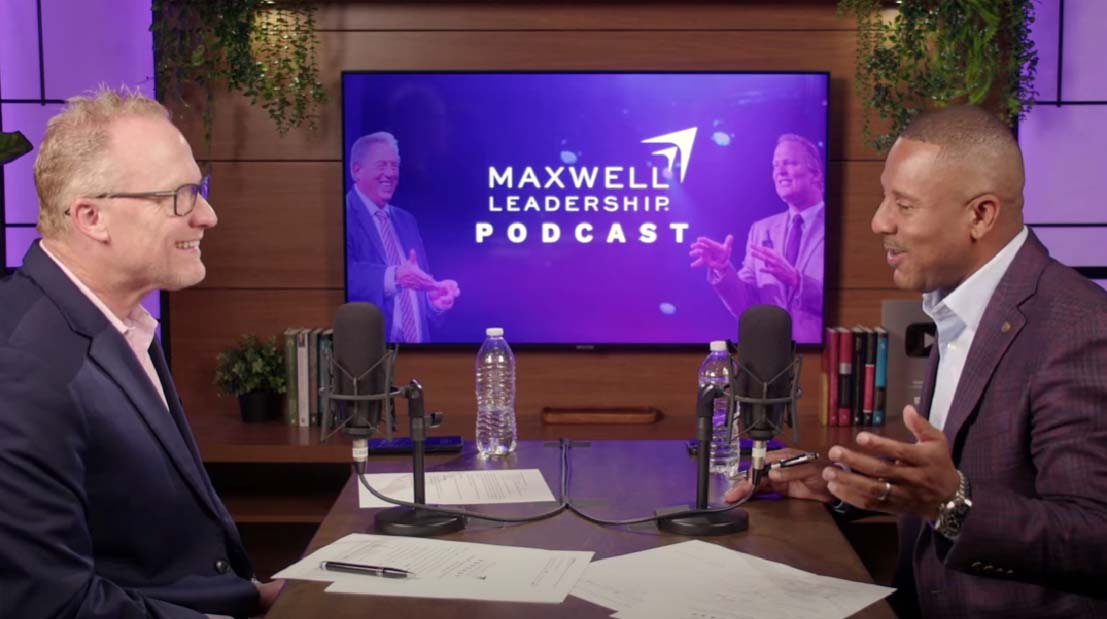
After his lesson, Mark Cole and Chris Robinson dive into real-world ways to apply these transformative insights, offering strategies to help you lead with greater impact starting today.
Our BONUS resource for this episode is the How Serving Others Unlocks Self-Discovery Worksheet, which includes fill-in-the-blank notes from John’s teaching. You can download the worksheet by clicking “Download the Bonus Resource” below.
Mark Cole:
Welcome to today’s episode of the Maxwell Leadership Podcast. Today, John Maxwell is going to talk to us about serving others to unlock self-discovery. Now, I love Chris Robinson. I love always when you’re here. It’s always fun. It’s always leadership and it’s always a chance to just add value to others, which is kind of our favorite thing. I was thinking as John’s teaching today, and you’re getting ready to hear this, Chris and I just listened to it right before this intro. And John talks about somebody that really unlocked his self-discovery, which is Zig Ziglar, right? And so you’ll hear John talk about the first time he heard Zig was in Dayton, Ohio.
Mark Cole:
How many of our podcast listeners out there, how many of you viewers, you can remember hearing Zig Ziglar live?
Mark Cole:
And so today, because so much of my self-discovery has been because of people like John Maxwell, people like you, Chris Robinson, but also Zig Ziglar. And so tell me, how did Zig Ziglar unlock your self-discovery and give me a Zig story?
Chris Robinson:
Yeah. So I’ve got one Zig Ziglar story that I will always remember. And so I was invited by a friend of mine to go to a conference. It was in Dallas, Texas. And I told him, hey, I can’t afford to get down there. I just didn’t have the money at the time. I mean, I was broke. And he says, well, hey, he goes, I’ll take care of the hotel room.
Chris Robinson:
I’ve got a suite. You can sleep on the couch, and I’ll take care of your ticket. Just get down there. And I said, okay, I’ll get down there. And so I go down there broke. I mean, not two pennies to rub together. I’m sleeping on my buddy’s couch, but I’m going in and I’m listening to speakers. I’m listening to speakers, and Zig Ziglar gets up and he speaks.
Chris Robinson:
And then, you know, afterwards, throughout the day, I’m kind of hanging around. Another speaker is speaking. I get up and I go to the bathroom. Well, I’m walking to the bathroom and right in front of me is Zig. And I’m going, I hope he’s not going to the bathroom. Well, sure enough, he goes to the bathroom and I stop right there and I say to his handler, I’ll wait. Because I wanted to give him his space. I want to go in there and you know how people are in the bathroom.
Chris Robinson:
People will talk to you in the bathroom. They will. And he says, oh no, go ahead. So I go into the bathroom. It’s me and Zig in the bathroom. Okay, and we’re done with the urinals and we’re washing our hands and he looks at me and says, “Young man, I don’t know why you’re here,” he goes, “but let me tell you this.” He says, “Never in a million years did I think writing one little book would take me all around the world.” He says, “I don’t know what you’re here for, young man,” he goes, “but whatever it is, pursue it with all your heart and I’ll see you at the top.” Oh my. And we walk out the bathroom. I never, that was about, 18 months before he passed away.
Chris Robinson:
And that was my only moment with Zig Ziglar.
Mark Cole:
What a moment. What a moment. I got to hear him a few times, got to visit with him with John, and he loved John. John loved him. So there’s a lot of Zig memories here. But I heard John first time in Atlanta, Georgia. Same kind of story. I met him kind of toward the backstage kind of thing.
Mark Cole:
It wasn’t a VIP experience because I didn’t have I didn’t have the ability to do VIP either, but I saw him in the hall. And here’s what he said, and this will mean something to you in just a moment. He says, “Oh, my wife’s people.” Now, if you remember the way he talked about his wife, the redhead, and back before all the gray that has now overtaken my head, I was redhead and pretty bright red hair. And he went, “My wife’s people.” And it was kind of this moment. And that was big for me because I grew up a little nervous or not liking my red hair. And I’ve told that story on the podcast before, but I became one of Zig’s wife’s people. And I was like, yes, I’ve made it. I may not be at the top like Chris Robinson, but I’m one of the wife’s people.
Mark Cole:
I told her that story after Zig passed away. It’s a fun story. Hey, here’s what we want to do today. We want to unlock your self-discovery. We want leaders, we want you to unlock other people’s self-discovery like John Maxwell, like Zig Ziglar has done for Chris. Now, Chris, isn’t it funny you wrote your first book last year? Zig Ziglar is seeing you at the top, buddy. Grab a pen, grab a piece of paper. We’re going to have a great time today adding value to you, expecting you to multiply value to others by unlocking self-discovery.
Mark Cole:
If you would like to download our bonus resource, if you would like to check out different things that’s applicable to today’s episode, you can go to MaxwellPodcast.com/Others. If you’ve never watched us on YouTube, our YouTube channel is in the show notes as well. You can come in and enjoy being in the studio. With Chris and I. By the way, I do want to see you self-discover and become incredible. And so listen to John, come back and join Chris and I, and we will unpack today’s lesson. Here is John Maxwell.
John Maxwell:
Serving others teaches you about yourself. When I serve you, I not only add value to you, but I began to learn about myself. I did a series of teachings some time ago on what I called servanthood surprises. And the basic thesis of that teaching was the fact that when I began to serve other people, I was surprised, taken aback to be honest with you, at some of the incredible things that I learned about me. It wasn’t about me because I was serving you, but while I was serving you, I began to understand myself. I began to see myself in a way that I don’t think I would have ever experienced if it wasn’t for the fact that I was committed on focusing on you. Isn’t it interesting when we focus on others, because it’s all about others, we learn about ourselves. Now, let me just start off by saying that I didn’t really understand as a young leader servanthood at all.
John Maxwell:
In fact, if you would’ve come up to me in my middle 20s and said, okay, what does leadership mean to you? I would’ve said with a great deal of excitement, leadership to me means that I have this vision and I share it with others and they buy into this vision and they get on my leadership train and I build this great organization. Back then, leadership wasn’t about me serving anybody. In fact, this doesn’t sound very good, but I think it’s quite truthful. Leadership for me was about people coming and serving me, and who could I get to help me with my dream and my vision? And I was always looking around recruiting people and come on to my team, but it was all about me. But when I was 26 in Dayton, Ohio, for the first time, now it wasn’t the last time, I heard many, many times Zig Ziglar speak, but for the first time, sitting on the front row in that Dayton arena with probably 10,000 to 12,000 people there, I heard Zig say that if you would help other people get what they want, that in the end, they would help you get what you want. And that was the day that I realized, you talk about learning about yourself, that was the day that I realized that I had this servanthood thing completely misunderstood. I thought I led so that people could serve me. It kind of goes back to the statement that it’s wonderful when the people believe in the leader, but it’s more wonderful when the leader believes in the people.
John Maxwell:
Well, in my idea of leadership in the beginning, it was wonderful when the people served the leader. And yet Zig that day taught me, and I made this incredible paradigm shift. Yeah, it’s wonderful when the people serve the leader, but it’s even more wonderful when the leader serves the people. Now, when I heard Zig and Dayton that day, I began to reflect on myself and realize that I needed to make a U-turn, that I was basically here on the other opposite end of the spectrum. I would say, join my team and serve me. And all of a sudden Zig says, no, no, no, you just help people get what they want. You start with serving others and putting them first. And what happened to me in this paradigm shift about leadership, I had to ask myself a motive question.
John Maxwell:
And the motive question was very simple. Why do I want to be a leader? To this day, when people come up to me and they share with me that they want to lead, I say, well, that’s a very good thing to do, but let me ask you a question. Why do you wanna be a leader? And I want to listen to their answer. Because many, many times we want to become a leader because we feel that there are benefits for us, and it’s too much about us and it’s too little about others. So I took Zig’s advice. I began to learn how to serve people. I began to ask people, what would be the best way that I can add value to you? And I began to focus on just helping people be successful. And that changed my life.
John Maxwell:
Until I serve people, I really don’t value them. That there’s something about putting other people first that makes them a priority in your life. And with that priority in your life, you begin to truly value that person. You’ve heard me say before that if you’re hurting, I’ll help you, and if you’re broken, I’ll fix you. But if I see you as valuable, I’ll serve you. And for many years, I saw people as hurting, so I helped them, and I saw them broken, so I fixed them. But to be honest with you, when I did those things, it made me look good. I wasn’t doing it to make me look good, but honestly, the people would say, “Oh, John, if you wouldn’t have come, where would I be today?” I almost had like a messiah sense to myself.
John Maxwell:
Well, here I am, and wow, you’re broken, I’ll fix you. Oh my, you’re hurting, I’ll help you, okay? But you see, everything changes. That table completely turns. I no longer have the upper hand when I see you as valuable. Because now, because I see you as a person of value, I’ll serve you. So serving others has taught me to really value people. When you begin to serve others, you begin to understand their importance on the team. And you understand how that you begin to need each other.
John Maxwell:
I have a statement that has been quoted many, many times. I’ll bet you’ve maybe even quoted it once or twice. Teamwork makes the dream work. In my book on the 17 Laws of Teamwork, I talk about the Law of Mount Everest. And the Law of Mount Everest just simply says, as the challenge escalates, the need for teamwork elevates. In other words, if you have a Mount Everest experience in front of you, you can’t accomplish it by yourself. You need others. And what I discovered is when I began to serve others, I began to value the gifts of others and their contribution and how they were helping me climb a Mount Everest in my life.
John Maxwell:
And it would be impossible without them on my team and without me being on their team for us to do this together. So it just has taught me to greatly value teamwork.
Maxwell Leadership Certified Team:
Hey, podcast listeners, many of you listening right now would probably love the autonomy that comes with owning your own business. Or becoming a coach that helps other businesses succeed? Well, we have a phenomenal strategy where you are 100% in control of your own business, earning income on your own terms, and have access to the people, tools, and resources you need to build a thriving leadership development business. When you become a Maxwell Leadership Certified Team Member, you join a global community of entrepreneurs led by our expert team of mentors and faculty, including John C. Maxwell. You’ll also get one of the top leadership certifications in the world next to your name, giving you the boost you need to get started. Visit us online at MaxwellLeadership.com/JoinTheTeam to find out more.
Mark Cole:
Hey, welcome back everybody. Chris, I always love being in studio with you, learning, leading together, and it’s fun. Thanks for sharing that Zig Ziglar story with us before. We have all John Maxwell stories like that too. John talked to us right there about our responsibility, putting people first, our reason, which is our motive, and our need. Which is teamwork. And so what I want to do is he really gave me 3 things I need to be constantly self-discovering there, my responsibility, my reason for leading, my need from leading. And so I can’t wait to unpack this.
Mark Cole:
I just really struck me as John was talking there, he’s given me 3 things that I need to constantly be self-discovering.
Chris Robinson:
Yeah. Let’s start off with the responsibility. And I think in that first responsibility is that going back to that quote, if you help enough people get what they want, eventually get what you want. But I remember watching you. I’ve seen you do this a couple times, and I think that you have a real passion for leaders that have been put out or dejected or feel less than because of circumstances or situations. But I’ve seen you work with leaders that are exhausted, they’re frustrated, and honestly questioning whether they should lead again. And yet you come alongside them. Now, you didn’t correct them, you served them.
Chris Robinson:
So as you reflect on moments like that, what has serving others in that capacity really revealed about yourself?
Mark Cole:
Well, I think one, and you didn’t characterize that as a good thing or a bad thing. I take it as a very good thing, a very noble thing, but I’m going to tell you why. Because for all of us, it may not be a noble thing for you. In fact, John Maxwell tells me often, and it’s not always a compliment, Boy, you put up with leaders a lot longer than I do. And he’s not always given me a pat on the butt. He’s given me a kick on the butt, kick in the butt. You touched something there. I want to put that out as a full disclosure because I do, but it’s because of my life journey.
Mark Cole:
You see, I was a leader that went through a very difficult time and I was pushed out. I was a leader that wanted needed a second chance and in some ways didn’t get that second chance. Now, in other ways, I’ve gotten a crazy good second chance and it’s been quite the ride, but I was a leader that needed understanding when my frailty, my humanity showed up and I didn’t get that. Did I deserve it? No, but I wanted it. Should I have gotten it? Lord, no. I should have gotten exactly what I got, but I wanted it. And so I always have this spot in my heart that has paid off a lot of times. It’s also been a lot of times that I waited too long to make some difficult decisions.
Mark Cole:
That’s the paradox of this conversation. But because of my leadership journey, because of what I didn’t get at a time that I wanted it, I’ve always felt this authentic compassion for people that are wore out, people that need somebody to talk to, people that are struggling in an area that is impeding their leadership.— excuse me, it is impeding their ability to lead, not their leadership. They’re still a good leader. They just have a challenge in their life that is impacting their ability to lead, but not their leadership. And so I have that. And again, there’s been a lot of times that having that patience that I don’t have in many other areas— patience is not what my wife and my kids tell me I’m really good at, but in this environment, In this particular description of what you’ve done, I’ve really realized my responsibility is not to look at you based on what I am getting from you. It’s what I’m depositing into you. That’s a true leadership posture.
Mark Cole:
That’s my first responsibility is what I’m depositing, not what I’m withdrawing. And because there was a time to where I needed a deposit in my leadership and all I got was a withdrawal, which was a bounced check, by the way, there was nothing in there. It’s really given me sense of that responsibility. Yeah.
Chris Robinson:
And I like the way you talked about knowing the difference between needing a deposit and making a withdrawal. When we’re talking about deposits, what we’re really talking about is what John talks about next, which is the motive. And so talk to me, John posed the question that’s really uncomfortable, a leadership question. Why do I want to be a leader? Now, my aspirations were very low starting out. Maybe somebody out there’s listening had the same aspirations that I did. As a 21-year-old kid trying to progress inside of an organization, I wanted 3 things. I wanted money, I wanted a title, and I wanted to be the boss. That was it.
Chris Robinson:
I mean, I cannot, as I think back on it, how shallow, how on the leadership scale of leadership, those are the least of these that are on there. But how do you help leaders diagnose their motive and if it’s going to be helpful or hurtful for them? In their pursuit.
Mark Cole:
John has 3 questions. So I love this. I did not know you were going to ask this, but as soon as you asked it, I knew how I wanted to answer it because John has these 3 purpose questions that we’ve heard him talk about. What makes you sing? What makes you cry? What makes you dream? Makes you sing, cry, dream, sing, cry, dream. And it’s a great motive. Excuse me. It’s a great purpose question where you can find that the thing that gives you purpose is the thing that makes you cry. The thing that gives you purpose is the things that you sing about, you dream about.
Mark Cole:
Love it. I think it’s true in leadership too. Why do I lead? What breaks my heart about leading? When I see X person do this, it breaks my heart. I’ll tell you what mine is. It’s demeaning people. It’s using people for their own benefit. It kills me, man. And to be honest with you, it does make me cry.
Mark Cole:
Now, before I cry, I get a little ticked off. I was trying to figure out which word I could use right here on the podcast because it makes me mad. Honestly makes me mad. When people use their position to demoralize, to demean people. But it does make me cry. I don’t like that. What makes me sing is when a leader puts aside their agenda and finds the greatness in others. One of the things I love the most about your leadership, Chris, I love this, is you give people experiences they would never be able to get.
Mark Cole:
You do it at IMC. You bring them backstage. You do all this stuff. Every time you do it, I go, “That’s the Chris I love.” You give people a chance to realize the value that’s within them. What I dream about is a world where leaders are so selfless that we don’t even know their name, we just know their impact. And so I think when I’m trying to help assess a leader’s passion to lead, I ask them, “What makes you sing?” What makes you dream? Often, to play off what you do, it is money. It is the ability to get paid to be a good leader. I don’t ever discourage that.
Mark Cole:
In fact, I think your characterization of the reasons you led at the very beginning are not shallow. I think leaving them shallow is problematic. But go dig deeper into that. Why you want to be the boss? Probably because there was something told you a long time ago you couldn’t be a boss and you went, no, no, no, I’m going to show people that they can overcome the lies that’s to them. I guarantee you there’s a— I know you. There’s a deeper why below your shallow answers that you just characterize. So I would come to you 30 years ago and you would tell me those 3 reasons. I’d go, wow, what about money gives you a sense of success? What is it? What is it about being the boss? What is it that telling people the position— was that the second one? What is it about position that gives you value? And I would go into that and I guarantee you underneath there, there’s significant—
Chris Robinson:
oh yeah, there’s a childhood answer.
Mark Cole:
I’ve ever seen in my life. There’s a significant thing there that was placed in you somewhere around the cry, dream, and sing comments that would make me go deeper. Because I do believe this, the motive behind people that really want to take on the task of leadership may be couched in a shallow package, but it’s a deep purpose. And if we can tap into that deep purpose and give that shallow wrapper deep meaning, we will get behind a motive that’ll drive them through the tough times. Because John Maxwell says this, for all of you that’s wanting to lead and you feel like it’s shallow, like Chris just said, let me tell you this. There’s no two good days in a leader’s life. Don’t pick it. Don’t pick it.
Mark Cole:
That’s kind of like John Maxwell said, I’m leadership sad. And I said, don’t do that. We’ve got a really good gig going here. We’ve got a good podcast here for me telling people don’t pick leadership. Don’t pick leadership for a shallow reason.
Chris Robinson:
It’s not worth it. I love it. I love it. So we talked about motive, man. And if I really do think about those, immediately answers came to me of childhood incidents or being overlooked or told that I couldn’t have this or that and seeing things that other families had that we didn’t have. So all those things did flash before my eyes, but I think those were the early ways to articulate how I would overcome those. I didn’t understand it at that time. And as we’re talking about this right now, those were the infancy words and aspirations.
Chris Robinson:
Which are deep.
Mark Cole:
Right. See, I say this. Let’s stay here for just a minute.
Chris Robinson:
We got time. We got time. Let’s do it.
Mark Cole:
So I tell people all the time, laughingly, I laugh about my joke. I laugh about my story. I’m the baby of 5. I was 5 years younger than number 4 in the birth order. And so basically I was the only child and everybody had an opinion. We were a We were a family of leaders and I’m 5 years old and my oldest brother’s 24 years older than me. Man, I got to make waves quick. And I learned early on, I loved telling people what to do.
Mark Cole:
I loved it, dude. You know what I loved even more than that? I loved it when they did it. There was such a sense of fulfillment. It was better than winning a game. It was better when I could influence a group of people that were older than me, that were disinterested in me, and I could, with them knowing it or not, influenced the outcome of what they decided to do, man, there was such a fulfillment. I didn’t know until I was 18 that that was leadership. I didn’t know until I was 30 that it was purpose. But it all started liking to tell people what to do.
Mark Cole:
It all started with a sense of a carrot of I loved it when they did it. But what it ended up being when it was purpose for me, when I wrapped all that in, the reason did not change. The motive behind it changed. And the motive was, man, I was designed to inspire people to reach their full potential. And the way to do that is to lead them to discovering what that full potential is and not let them believe the lie that’s limiting the potential they’re living in. And when I realized that’s why I like telling people what to do, and I liked it even more when I saw results, man, it was a game changer. It let me take the CEO role because my education, my experience, my— there was nothing that lent itself to this career track, right? Nothing. Not even the way I talk.
Mark Cole:
All of you that are hearing my Southern, right? There was nothing. Yeah. Except one thing. The motive behind this little 5-year-old boy that packaged it a bunch of different ways till I got to the point at 30 that I went, oh, right, I’m supposed to motivate in this property. Wow.
Chris Robinson:
I think I’ve seen that shift because I did very well I obtained those three things very early. I obtained a high six-figure income by age 21. I had a position inside of an organization that was growing rapidly. It was at that time when I actually started listening to John Maxwell that I really had that shift. It came from the very first chapter of The 21 Laws. It was in the Law of the Lid when he shows the two graphs between being skilled and having leadership ability and showing your overall effectiveness. And I remember looking at that, and still to this day, it’s clear as day. I can see page 6 inside that book.
Chris Robinson:
I can see the graph, and it hit me like a ton of bricks. That’s where I really said, hey, I can be valuable and have the things, the stuff, the title if I’m effective at this job. But if I develop my leadership skills and I go from being the star to a star creator, I can be a whole lot more valuable. Wow. And that shifted everything in my motive. And so here’s what happened. I became selfish in helping others. I began to really try to figure out how in the world could I be the leader in the organization that produces the most leaders.
Chris Robinson:
Now, naturally what happened when I began to do that was that I attracted better people to my team because they knew that my motive was to get them promoted. They were seeing the promotions from the team and our numbers went through the roof because everyone was trying to get promoted because that’s what you came to the team for. So it was that shift though, very early on. So I’m thankful for Maxwell content at an early age because just as easily I could obtain those three things, the title, the money, being the boss, and could have gone in a completely different direction. 100%. Train wrecked.
Mark Cole:
100%. And if you look at even our trajectory, this is so good. I’m sorry, me and Chris are having a great time podcasting. What are y’all doing here? Even watching your trajectory here of watching it more like John’s trajectory than my trajectory or somebody else’s trajectory, your ability to influence now with city tours, with international trips, with books, believability, your ability to do that with consistency of access to you is unbelievably a game changer in creating stars in others, much greater than if you’d have chose some other tracks. Much greater. Just like John. But see, every leader— now let’s pare this back to the rest. Y’all come back into mine and Chris’s conversation here.
Mark Cole:
All of us, if we don’t dig into the motive in this question of why do I want to be a leader? Well, why? Well, why? Simon Sinek says you really don’t get to why until you ask it 5 times, 5 different ways. Right? Now Discover Your Why, I think is the name of his book. That why, digging it all the way down gives you the most clear path to maximizing the purpose that you were placed on earth. And John did such a good job of that as a 20, 30-year-old guy that the reaping of benefit, most people look at and go, 40 million books. Why? Had nothing to do with books, had everything to do with impacting people that he would never meet. And it caused him to write another book and it caused him to turn the page and write another page. And it caused it because why? His Was it because he wanted to be the greatest leadership guru in the world? Not a chance. He wanted to sell 40 million books and have a nice home? Not a chance.
Mark Cole:
He wanted to make a difference for people that he would never get to meet without writing that book.
Chris Robinson:
Wow.
Mark Cole:
What a time.
Chris Robinson:
Whoa. What a time. And we’re out of time.
Mark Cole:
Yeah. We can go one more.
John Maxwell:
We can go one more.
Chris Robinson:
We can go one more. Okay, good. Good. Let’s dive into this one. We hear the statement here of, if I see you as valuable, I’ll serve you. So everything changes when I see you valuable. What actually changes? Physically and emotionally inside of a leader when they stop managing people and start valuing them?
Mark Cole:
So I think it’s a true sense of need. That’s why when I was listening to John today in this podcast, I heard if I want to self-discover, what are constantly the categories I need to be self-discovering in? Not a moment of self-discovery, but a journey of self-discovery. That’s how I heard the lesson today. So we talked about my responsibility. What I need to discover is my responsibility, and it’s always putting Am I not putting people first today? Check it. Where do I need to be putting people there tomorrow? Note it. Where did I not do it yesterday? Condemn it because it’s going to stop you from your first responsibility as a leader. Secondly, my reason, my motive.
Mark Cole:
Man, go back to your motive. We just did that in a— we gave a real life coaching opportunity here. We need to constantly be going back to our motive, constantly going back to our motive because we’re human. We’ll get away from it. The money, the power, the prestige will always convince us to get away from the motive. Get back to the motive. Now we’re talking about my need. Man, I got to have people, Chris.
Mark Cole:
I cannot carry the responsibility that I’ve been given by John, by God, without you. I can’t. You are a need to me. And too many leaders see people as a distraction to their position rather than a fulfillment of their position. You need people. And your leaders, you don’t need people to get your agenda done. You need people to get good things for them done, for bigger dreams than yours. And too many times people are pawns and not the purpose, the point.
Mark Cole:
They are an object on a chessboard and not the actual game fulfillment. Can’t do it without the pawns. Can’t do it without the castles. You’re going to think I know what I’m talking about with chess, and I know a little bit. You can’t do it without every piece. That’s the masterful piece of chess is knowing how to get the most out of the pieces. Same thing with leadership. You cannot get an agenda that’s more important than the person that helps you get to the agenda.
Mark Cole:
You can’t. You can’t. You’re playing the wrong game. And you’re misusing people. You need people. That’s why when John says teamwork makes the dream work, there is no way you have a noble enough dream if you are the only player in your dream. It’s not noble enough.
Chris Robinson:
I love it, man. What a time.
Mark Cole:
What a time. Hey, I love what Jim said. And by the way, another podcast that’s very similar to this one, It’s Not About You. Leadership, Communication, and Putting Others First. It’s a great addendum for those of you that have a little bit more time today to listen to some podcasts. We’ll put that show in the show notes and you’ll be able to link on that. Jim, after listening to that, said, “Love this. True leadership is really about putting others first, not yourself.” So simple, yet so powerful.
Mark Cole:
And what a capstone to today’s lesson or today’s podcast and how it went. Go make a powerful, positive difference. Of change today because everyone deserves to be led well.
Maxwell Leadership App Ad:
Do you feel like you’re meant for more, but you’re not sure what next step to take? Whether you’re leading a team, building your business, or just trying to lead yourself well, you don’t need more noise. You need wisdom. Real, proven, practical wisdom. That’s why we created the Maxwell Leadership App. Inside, you’ll get daily bite-sized videos from John C. Maxwell and other world-class thinkers designed to help you grow every day. You’ll unlock curated playlists on personal growth, leadership, mindset, communication, confidence, and much more, all for just $9.99 a month. And here’s the best part.
Maxwell Leadership App Ad:
It’s growth on your terms, at your pace. In your pocket. Ready to go further and grow faster? Download the Maxwell Leadership App today. Go to MaxwellPodcast.com/App or click the link in the show notes. Try it free for 7 days with the code PODCAST7. That’s PODCAST7.
Transcript created by Castmagic.