When you’re tempted to stop moving forward, there are a few key strategies that will keep you going — and John Maxwell is sharing those strategies in this episode!
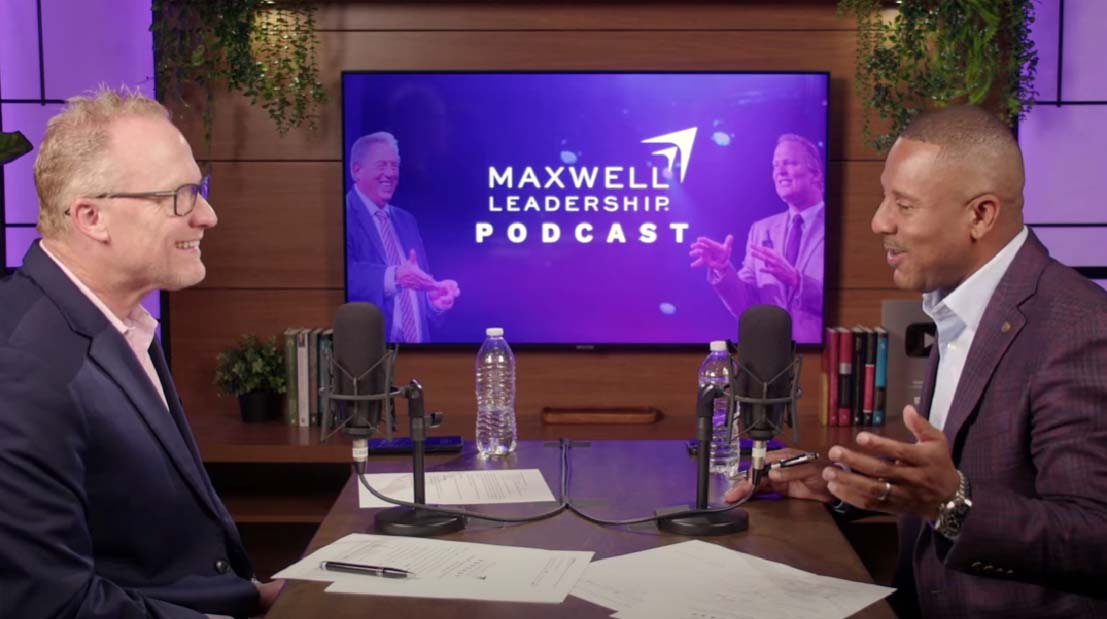
After his lesson, Mark Cole and Chris Robinson sit down to discuss what John has talked about and help you practically apply it to your life and leadership.
Our BONUS resource for this episode is the Strategies to Stop Complacency Worksheet, which includes fill-in-the-blank notes from John’s teaching. You can download the worksheet by clicking “Download the Bonus Resource” below.
Take the next step in your growth journey and become a Maxwell Leadership Certified Team Member. Click here to speak with a Program Advisor today!
Mark Cole:
Hey, welcome to the Maxwell Leadership Podcast. Our podcast is committed to adding value to you, so you will go and multiply value to others. My name is Mark Cole. Today, John is sharing a lesson on strategies that will help you to keep you moving forward, even when. When the temptation is to stop. John makes a statement in this lesson. I want you to catch it already. And he hadn’t even given it yet.
Mark Cole:
Get yourself connected to people that are bigger, better, faster than you. And if I could tell you today, John Maxwell, at this stage of his life, continues to look for strategy to keep him from being complacent. I’m also joined today with Chris Robinson, my co host. You know Chris. In fact, I’m going to introduce a new component to Chris today for those that really think you know Chris. And between Chris and I and John, we’re going to give you some practical advice on how you can apply what you’ve learned to both your life and your leadership. If you would like to download the free bonus resource for this episode or even watch this episode on YouTube, you can go to MaxwellPodcast.com/StopComplacency. All right, grab a pen. Get ready.
Mark Cole:
Here is John Maxwell.
John Maxwell:
There are strategies that will keep you moving when you’re tempted to stop. It’ll keep you improving when you become complacent. The first strategy is that you need, okay, when things are going well for you and for your company, for your team, whatever, go shopping. When I talk about go shopping, let me explain what go shopping means. The best way to stretch your thinking, the best way to get out of your comfort zone is to go places, visit companies, see people that are bigger and better than you are. So when I say go shopping, jump the fence, go look at people, places, organization, go expose yourself to bigger, better, faster people. Now, the moment that you do that, it’s extremely humbling, very humbling. Because the moment I go do that, I find somebody bigger, better, faster than me, and immediately I look and say, wow, I’m chopped liver.
John Maxwell:
Look how well they’re doing. So there’s a humbleness about this exercise. There’s an incredible awareness about this sexual exercise. But I’m going to give you three questions I want you to ask yourself. These three questions ought to keep you just absolutely engaged. Here they are. Because. What am I talking about? I’m talking about jumping the fence, getting out of your comfort zone.
John Maxwell:
You’re a little fenced in property. Okay, you got that down. If you’re going to be a pioneer, if you’re going to go where you’ve never gone before. You got to jump the fence, you got to go shopping. What’s over, hey, what’s in that store that I need to buy or see or, or know about? Okay, so here are three questions you have to ask yourself to get you moving when maybe you don’t have a tendency to want to move. Where are you going right now? Where are you going that’s going to stretch you? You got to jump the fence. Where do I need to go to be exposed to somebody bigger, better, faster than me? Where am I going that will stretch me? Question number two, who am I seeing that will stretch me? It’s not only going to maybe see another company like yours that’s bigger, better, faster, but who? It’s the where and it’s the who. So where am I going that’s going to stretch me? Who am I seeing that’s going to stretch me? And then the third question, what am I doing that’s going to stretch me? And let me tell you something, the doing question is absolutely essential to your self improvement.
John Maxwell:
You’ve got to do take action and listen to me very carefully when I say go shopping. You just gotta ask yourself, who am I seeing that I need to see they’re bigger and better than me? Where am I going? What am I doing where I am today, what I know today, who I know today, what I’m able to connect with and receive in my life was because you got to go shopping, you gotta jump the fence. You can’t stay with the people that you’re with now. I should have said that you can stay with the people who can stay with, but you gotta go find other people that can stretch you. The hardest lesson I learned in personal growth was all the people in my journey of all these years now I’ve been growing for 50 plus years. All the people I had to leave, I just had to leave them. Why? They were in the people pile. They weren’t going, they were not going.
John Maxwell:
If I stayed with them, I couldn’t go either. I had to say, am I gonna keep growing or am I gonna just, am I just gonna settle there? Huge question. The second question or the second thing is I’m talking about strategies to keep moving. You need to stir up what I call inspirational dissatisfaction. And you gotta keep those two words together. You gotta keep inspiration with dissatisfaction. In other words, there’s a dissatisfaction that is positive, that inspires you. So you gotta keep inspirational right beside dissatisfaction.
John Maxwell:
And so let me pull this out, let me, okay. What I’m saying is I’m not talking about never being pleased with yourself. I hope you are pleased with yourself. I’m not talking about like beating yourself up and saying, maxwell, you just everybody else is succeeding, you’re not dying. I’m not talking about that stuff at all. There’s a dissatisfaction without inspiration is extremely depressing. I’m talking about putting yourself in a position where you create awareness in your life that you can do more and that you can become better. And that only happens by exposure to other great people.
John Maxwell:
It just happens because of that. So don’t miss this. It’s this awareness. I want to create awareness in your life that you can become bigger, that you can become better. And one more thing on this, and that is continue to set goals that will stretch you that are beyond who you are. You gotta put them out in front of you and say, this is. This is where I’m going. A goal that does not stretch you is not a worthy goal.
John Maxwell:
I’m not talking about a walk in the park here. I’m talking about a climb uphill. A walk in the park is leisurely and it’s wonderful. But a goal, climbing uphill, that’s what I’m talking about. Let me close by saying just the other night, Mark and I and his co partner there that helps ride the company fence with him, Reggie was there, and then a friend of mine who’s highly, highly successful business had his COO with him. And we were talking about growth and business and this kind of thing about how do you get to the next level? I mean, we’re already good, but how do we become great? Cause we’re not great yet. What I want you to know is in that conversation around that table for about three hours, I can’t describe to you how good I felt. And I felt good because I was around people bigger than me, better than me, faster than me, smarter than me.
John Maxwell:
And I thought to myself, I can still improve, I can still go to another level. And I was so inspired by our session that night. And that’s what happens. That’s how you resist the temptation. You resist the temptation to stay the same by being around people that have never stayed the same.
Maxwell Leadership Certified Team:
If you’re ready to stop drifting and start growing, the Maxwell Growth Plan is your next step. This year, Long Journey guides you through four powerful seasons of growth. From building self awareness to clarifying your purpose, to strengthening your leadership. Each season includes reflection, prompts, action steps, plus live teaching and Q and A calls with John C. Maxwell. It’s personal development with a plan. Start your journey today by visiting MaxwellPodcast.com/GrowthPlan. That’s MaxwellPodcast.com/GrowthPlan.
Mark Cole:
Welcome back, everybody. John Maxwell has a quote that’s really worth underscoring right here. He said, of all the things a leader should fear, complacency heads the list. And what John’s really saying is that to you and I, podcast listeners, Chris, to you and I here in the studio, that at any time that we feel like we’re ready to coast, anytime we feel like we have arrived, anytime that we feel like, wow, man, look at what I have done is the time alarm bells, tornado drills, every kind of message in the world should be blaring at you. You are in trouble. Because none of us ever want to wake up one day and think that our best days are behind us. And so I’m glad today to challenge you to find people, find yourself in environments that are bigger, better with faster people than you have now. And so I’m super excited about that.
Mark Cole:
Chris, I’m glad to have you in the studio today.
Chris Robinson:
Glad to be here today. Let’s rock and roll.
Mark Cole:
Let’s do, man, let’.
Chris Robinson:
Well, I love this topic of complacency, one that I’ve been spending a lot of time in, which was actually spawned or actually created by John Maxwell, spending some time with him last year in Cambodia. And I’m really, really excited about this topic today. You know, in here, the first thing he talks about is that when things are going well, go shopping. So talk to me about where you are shopping now or tell me about a time in the past when you had to go shopping.
Mark Cole:
Yeah. Boy, I love that analogy. When I first saw that statement in my notes, and of course, I’ve heard John and say something like this, but my first thought was, please don’t let my wife read this. It’s not the kind of shopping ladies that we’re talking about. Guys, get out of the sports. Sports stores. That’s not what we’re talking about. We’re talking about get yourself out and go looking for something.
Mark Cole:
Go buy something. Go get in an environment to where you have to invest in that environment so that you can get better. And I can remember. So this would have been, let’s see, this would have been about 12 years ago. I was a new CEO of a leadership brand, Maxwell Leadership, the John Maxwell Company at the time. And I can remember one day waking up feeling overwhelmed not at the role, not at the responsibility, not at John’s trust in me, but the realization that I’ve got to be a leader above my current reality to lead a Brand that represents leadership like ours. In other words, how am I going to really do that that year? Chris, in the next four years, I went out to five powerful CEOs in the Atlanta area. I’m talking about CEO of Delta Airlines, CEO of Honey Baked Ham, the CEO of PI Pies, the CEO of Herschend Family Entertainment, and the CEO of Home Depot.
Mark Cole:
So these are big, big brands, Much bigger brands. Many more zeros in their P and L than my little P and L. And I went in and I began a series of teach me to be the CEO of a brand like Maxwell, leadership of John Maxwell Co. And what I would do. One year I went in and just asked them very specific questions to leading an enterprise brand. The next year I went in and I came up with seven questions. I wanted to grow that year. And I went in and I met all of them once a quarter for five years.
Mark Cole:
And I would go in and ask every one of them the same exact question and then compare notes of their answers. It was the exact same question. And some people go, whoa, that’s really stale. Gotta get creative. You gotta be relevant. And I was like, no, I’m trying to shop in a different way. I can truly tell you this, Chris. This again was 2012, 2013.
Mark Cole:
We had just started the organization that introduced me to you, Maxwell Leadership Team, our certified coaches, speakers and trainers. And it was in that that I began to see myself as an enterprise leader or a CEO of a vision than just the president or the leader of a company. It began to extend and expand my thinking as I listened to their answers, as I received their mentorship. It was during that, one of those sessions that they said, what are you doing to surround yourself with bigger ideas? So every month for a year, I went down to Buckhead, Georgia. For those of you that don’t know, that’s kind of the north part of Atlanta. A lot of big brands are headquartered there. And I’d go sit in a coffee shop. Now I don’t even drink coffee.
Mark Cole:
There’s not a point. I don’t like danishes and all that kind of stuff. I don’t like muffins. I went, ordered a water. And I sit in this coffee shop surrounded no sunshine because there were too many big buildings. And I would go and I would stare at the buildings and I would imagine our logo on the building and what it would feel like to lead that many people, to influence that many, to be able to mobilize that many people. What would it look like? And what would it look like to fill that entire building. And I can tell you, those brainstorming shopping sessions were absolutely some of the biggest things that has led to some of the big ideas that we’re living out today.
Chris Robinson:
Wow. Wow. I love that. I love that. You know, for me, you know, I think about a time that I went on a trip with John Maxwell yourself, and there was probably about 16 of us that went down to Guatemala. And so we were on, and I was. I was on with some giants. I mean, these were some big donors.
Chris Robinson:
And we were inside the room, and I remember sitting down at the table because, you know, my aspirations always to Ben is to be a big giver. I love giving. I love giving at the bottom of my heart. And I remember at the end of the actual event, we sat down and John began to cast vision for, you know, giving help inside of Guatemala. And I was sitting down at the table with five other gentlemen that were working on, okay, how much are we going to give to this particular organization at the time, Maxwell Leadership Foundation. And, you know, there were six of us at the table. And can I tell you that in about 12 minutes, my table had raised $500,000. In a matter of 12 minutes, it actually turned out to about $500,027.
Chris Robinson:
That’s what I contributed. So collectively, we stepped into the table. We did. But what that did, Mark, by getting around those other people in the environment that were given at that higher level, it gave me the vision of giving at a higher level to eventually get to that point that day. And so I love being around other people that are bigger, faster, stronger, that give us that encouragement to say, hey, look, you can give at a certain level, but you can give even more. And same thing with business. You can do big business, but there’s even more to be done so that we’re always moving ourselves down the road.
Mark Cole:
You know what’s funny is Chris and ladies and gentlemen, the best gift giver in the universe right here in studio with me today, giving me a lot of things, mostly love and support and brotherhood. But one year, Chris, I love Mont Blanc stuff. Got a new watch from John today. Check that out. That was my birthday gift. Happy birthday to me. Thank you, John Maxwell. And got me this really nice Mont Blanc watch.
Mark Cole:
I love Mont Blanc pens. I like it. But, Chris, one year and I think this will tie in really well. You said gift giving, and I just went, this guy loves to give gifts, but he gave me an advent gift. I’d never received an advent gift before, and it was a Mont Blanc advent gift, which means for 30 days.
Chris Robinson:
30 days.
Mark Cole:
30 days. I would be able to open this big, big mountain. It’s in the shape of a mountain. Different things, different memorabilia, things from Mont Blanc to this day. You know how you walk in John Maxwell’s office and he’s got all these different memory things. That gift is still in my office to remind me the power of doing things that are memorable. And so we’re talking today a little bit about the concept of strategies that keep you memorable, that keep you relevant. John says to keep you from being complacent.
Mark Cole:
I think, man, I think you’ve really figured something out on that. We’ll talk more about that in just a moment. But I just wanted. You said gifts and I was like, oh yeah, phenomenal. Phenomenal.
Chris Robinson:
That gives still haunted me though, because I can’t seem to find a thing to top it.
Mark Cole:
So don’t. It was a one and done, man. You killed it.
Chris Robinson:
Hey, your birthday’s coming around. Christmas comes around. I’m searching, I’m searching.
Mark Cole:
No, you’re doing it, buddy.
Chris Robinson:
I just can’t get it.
Mark Cole:
It’s still right there in my desk.
Chris Robinson:
Now, you know, how have you seen. Obviously you travel with John Maxwell a lot. 90% of the time you’re on the road with him. How have you seen him intentionally stir up inspiration that he’s talking about here?
Mark Cole:
I was just so I think and this is going to be dated because on social media I put this as yesterday, but it really was yesterday. When we’re recording this, we’re the last 48 hours at the recording time of recording. John has Talked to over 6,000 educators about our foundation content I lead, which is a student based. Our student led rather values based curriculum in public school systems. Got over a million kids by the end of this year. Be a 5 million kids in the US that are now a part of this program. And so we were talking to all the national educators in the state of Washington, Seattle, Washington. And then we traveled as if John is like 38, not 78.
Mark Cole:
We traveled across country again, crisscrossed and went to Alabama and spoke to all the state educators in Alabama. We spent four hours flying back just he and I and I’m telling you in a matter of four hours he told me of no less than 10 areas where he feels challenged that he needs to grow and expand his life and leadership in. And so I could literally give you 10 because it was just fresh as yesterday. What I will give you in an answer to your question, however, is it’s become such a way of life for John that he doesn’t even feel like he has a new strategy. Every day is a new strategy, but you lay a new strategy over the constant discipline that I am not going to allow myself to get complacent. I am not going to allow myself to become irrelevant. If you ask me, what is John Maxwell’s greatest faith fear it would to become irrelevant and complacent in his growth. He absolutely challenged me all the time.
Mark Cole:
Mark, if you can’t identify somewhere that you see tangibly see growth in me, you better rock my world, because I have lost it when I’ve ceased to become or when I become complacent and cease to become passionate for that next level of growth.
Chris Robinson:
Right? Yeah. And I think that’s where our listeners, you know, if you listen in here is like, you may be asking yourself, where am I complacent now? And you got to look for those early signs. And so the early signs of complacency, it looks like busyness.
Mark Cole:
Yeah.
Chris Robinson:
It feels like comfort. And it sounds like excuses.
Mark Cole:
Yeah.
Chris Robinson:
Okay, that’s really good. Okay. It looks like business. And so we could be busy and thinking. Well, you know, because I believe that if you called 99 people and said, hey, is Chris Robinson a complacent person, I’m guessing you’re going to get a lot of, no, no way. But that’s not the truth. I’ve got complacency in my life just like everyone else. But you.
Chris Robinson:
We have to kind of identify those areas. So it may not be visible because in certain areas that are out to the public, but there could be other areas in our life where we do have complacency. So we do have to pick up that early detection. So I guess one of the best ways to identify complacency is where are you comfortable right now? Whereas, you know, and John will talk about the next one that we cover, whereas. Good. Good enough. The second thing would be, is, you know, where are you Busy but not productive. You know, so how do we go from what are we doing to what are we accomplishing? And then a third way to kind of identify it is, where am I consuming but not doing anything? Because we have a lot of people that love shelf help.
Chris Robinson:
They love all the books on the shelf. They love all the books on the shelf. You listen to podcast after podcast, watching video after video, but not taking action. That could be an early awareness identifier to say, hey, I might be complacent in an area.
Mark Cole:
Wow. Wow. I love that. Good grief. That’s so Good man.
Chris Robinson:
So give me some ways that you identify. How do you identify whether you’re coasting or driving in your life?
Mark Cole:
Well, so first, let me say this. I’ll give you two, but I really am going to put the question back to you and podcast family. I’ll tell you why in just a moment. A couple of ways that I keep myself from becoming complacent is every year I have a disciplined approach to growth, and I reflect growth and reflect on tangible growth aspiration every single month, every single quarter, every single year, I am diligent in living the life I want to live. And I do that by looking myself in the mirror and saying, where are you growing? Where are you not growing? Where did you perform? Where did you not perform? At a personal level, it is a gospel to me. It’s a religion to me. The second thing that I do on a consistent basis is whether it’s board members, whether it’s inner circle people, or whether it’s people that I have the privilege to call a direct report. I’m constantly asking, where do you see growth in my life? And where do you see.
Mark Cole:
Where do you see stagnation? Where do you see paralysis? And I’m constantly asking for both the positive and the negative. Where do you see growth? Where are you seeing complacency or stagnation? Those are two things that I do. But guys, I want to tell you this right here. I’m going to ask you the same question and I want to know what you’re doing and here’s why. For those of you that are watching the podcast, you’re getting ready to get a treat that everybody else is not getting, because I’m holding something up. And I’m just going to pause for a minute for all you listeners to wonder what I’m holding up, because I’m holding up right now a first time ever, which is your fun thing. Chris Robinson. Most of you know Chris as a podcast co host with me.
Mark Cole:
He’s also a co leader with me. We’ve been leading side by side for the last five years. We’ve been working together for the last 15. And many of you know Chris as the executive vice president of our entrepreneur solutions team called the Maxwell Leadership Team. But today I’m introducing on visual. And now I will tell those of you that are listening, I’m introducing Chris Robinson, the author. Chris Robinson has just released his book. In fact, when I say just release, it’s not even deliverable yet, but you can order it, you can go to a website.
Mark Cole:
I’m Going to give you in just a moment. And he’s written a book called From Drift to Drive. Now, today’s podcast is not about From Drift to Drive, however, it is about From Drift to Drive. Right? It’s about it because we’re talking about complacency. What do you do to keep yourself from becoming complacent? And again, you’re now an expert, so this better be a good answer because you’ve written the book From Drift. From Drift to Drive, right?
Chris Robinson:
Yeah. Well, I think that, you know, one of the things, it’s really along the same lines of what you’re talking about here and what John talks about, not just in this podcast, but the next one that we’ll be talking about. It’s first identifying those areas of complacency in my life. And, you know, oftentimes that’s areas that I’m going to look at are going to be places where it’s automatic versus intention, because oftentimes we think that we’re growing just because we can do something automatically and, and we don’t give our very best in the area. So the best example of this was Real Time Live back when I was in Cambodia last year with John Maxwell. Had came off stage and, you know, we had just met the president of Cambodia, and then now we were speaking in front of 2,500 people, only two people on the agenda, John Maxwell and me. And then I gave the presentation, had a bunch of stuff go wrong, no big deal, got through it, you know, and the masses came up afterwards, had a long line of people and was shaking hands. Oh, Chris, it was so often awesome.
Chris Robinson:
And then I sat down with John and said, hey, John, could you give me some feedback on my talk today? I was looking for one, two things. And he obliged. He obliged one or two times. Right at about 10 points in the table, now begins to think that it’s a brainstorming session. So they’re all kicking in ideas. But that night, I go back and I looked at everything that was on that list, and there wasn’t a thing that I did not do or did not know on that list, but I hadn’t done it because I was in automatic thinking. I was in motion. I speak every single week.
Chris Robinson:
I, you know, without fail. I’ve spoken thousands of times. And I realized that I was in a drift and didn’t even know it. You see, the thing about drift is that it’s subtle, it’s not apparent, and it’s in those areas where we’re good.
John Maxwell:
But.
Chris Robinson:
But there’s a gap between our good and our potential. And so that was a wake up call for me again, getting feedback from others. So if I had just asked the average person, hey, how was the talk? I would have got, oh, yeah, it was good. They might have been in line, but being able to intentionally ask someone that was a lot further along, that had a ear, one of the greatest ears of communicators, to be able to say, well, this is what I heard. It was a lot different. And so, like yourself, I use evaluation and reflection. I get feedback from others. And then I go back into this cycle that I teach inside the book of the seven steps that actually break the chains of complacency is what we do inside the book.
Chris Robinson:
So I love it, man. We’re on the right track. We’re drinking out of the seven.
Mark Cole:
Don’t give me the seven. That’s another podcast. And by the way, he’s not giving you seven because you got to go buy the book. And I want you to do me a favor, podcast family, because we’re going to do a podcast specifically for this for all the late adopters, but all of you that are on the bleeding edge, the cutting edge, I want you to go order this book and I want you to order someone else that you want to do this book. I want you to. I don’t want you to order one. I want you to order two. By the way, you can go to DriftToDriveBook.com and by the way, the two is T-O, not the number.
Mark Cole:
DriftToDriveBook.com. Let’s show Chris some love and let’s show that we really are going to stop complacency. Chris, kind of. As we wrap today, I do want to ask you, I do want to ask you when you have a goal. John said it like this. A goal that does not stretch you is not a worthy goal. When you set goals, and I’ll come in and give a little bit behind this as well. But when you set goals, how do you determine if they’re worthy or if there was just fleeting or just a whim or just emotional?
Chris Robinson:
Yeah, well, you know, John has got a great book called Put yout Dream to the Test where he walks through 10 questions to help you evaluate. You know, is your dream really your dream and is it worthwhile? You know, for me, I used to set a lot of goals. I mean, I used to set a lot Mark and I taught it and it was probably the stupidest thing I ever taught in my life. But I would teach and a lot of People still teach it. So maybe it was stupid for me, I’ll say that. But here’s what would happen is I would set goals in five areas of my life. Five goals in five areas of my life. And then I remember sitting back, I can see it clear as day that I was looking up at the board and I went, Holy smokes, that’s 25 goals.
Chris Robinson:
And at the end of the day, the year, or at the end of the quarter, I would look at these 25 goals. And I was only really excelling in one, two, or three of these things. And so that’s when I dropped that philosophy and I began to say, okay, what’s the one goal this year or this quarter that would have the greatest impact to move me towards where I ultimately want to go? And so I want to make sure that whatever my goal is, it lines up so that everything that I’m doing is in alignment with where I want to go. And then what happens is I achieve those goals faster. So most people that are watching you set goals at the beginning of the year, and I want you to do a quick test. I want you to look at the goals that you set from the beginning of the year, and then I want you to look at your to do list from last week.
Mark Cole:
Yeah, come on. That’s exactly right.
Chris Robinson:
It often looks crazy in comparison with where we say that we want to go. So for me, on setting a worthwhile goal, I’m always looking at and asking the question, what’s the 12 goals this year that I could achieve that would move me further down the roll? So I’m not looking at a bunch, I’m just looking at a couple.
Mark Cole:
Yeah. So for me, and I mentioned a little bit earlier in today’s podcast that my year end intentionality is a game changer for me. I’ve tried. I spend most of my time trying to get other people to adopt some their own policy, but some way to do that, and many of us have, and it’s a game changer for us. When I’m setting a goal for me to determine if it’s worthy or whimsical, is it a worthy goal? Is it a whimsical goal? Is it emotional, or is it sustaining? And for me, I first have to ask the question, if I accomplish this goal, will I have a personal sense of accomplishment? And to answer that question, the personal question, I go back to myself and I go, what’s my purpose in life? What’s my mission? What’s my calling? And will this goal take me in that direction or will it distract me from accomplishing my purpose? Because often I want to get a goal of being a better golfer. And by the way, if I become a better golfer, I have set that as a goal. The reason I did that is where I’d be more respectful in my position, where people wouldn’t want to go, what’s that guy doing being president of a company that does a golf event at Pebble Beach? And he’s this bad. So it was like, I got to maintain my reputation of being a leadership right now.
Mark Cole:
It didn’t work. But I really do filter it through that. I don’t even set personal frivolous goals. That does not link back in my mind to a personal sense of fulfillment, which is back to my purpose, my calling, my mission. The second question that I ask to make sure it’s a worthy goal, would my family be proud of me if I accomplish this? That keeps me grounded. I want to do things and pursue things, that those closest to me will be proud of me and believe me to be everything everybody else says. So I always ask the question, if I accomplish this, will my parents, will my family, will my kids, will they be proud of me? Or is it really a non issue? Would they even care? The third goal that I set is all about will the people that know me, my team, would they be proud if we accomplish this? Because as a leader, my goals should only benefit the people that I’m leading. It’s a leader creed.
Mark Cole:
It’s a leader creed. What I’m chasing should be for the benefit of the people that’s going to be impacted if I accomplish this. And when I ask those three questions, the personal, the family, and then those close to me that call me a boss, if you will, when I ask the question, that way I can then go and say, I’ve got a worthy goal. What I would challenge all of you to do as you listen to this message from John on strategies to stop complacency, I would really challenge you to ask yourself the question, where am I complacent? I loved your authenticity, Chris, when you went, man, I’m sitting up there, I’m writing a book. You were in the middle of writing this book last year and then you realize, man, I am drifting. And I’m writing a book about not drifting, I’m drifting in my communication. And you’re a great communicator, you’re a world class communicator, but you had been drifting, you had been slipping. You had not allowed yourself to feel that sense of urgency where are you podcast viewer, podcast listener? Where are you complacent? The people around you are being impacted because of your complacency.
Mark Cole:
So challenge yourself, reflect. Where am I complacent? That needs to change. I can tell you, watching John at 78, the reason John is still as relevant today, more so more relevant than he is today because he never allowed complacency to settle in his life. Hey, I want to close this today and it’s a great question from Nigeria. Dominic. Dominic says Mark, can you recommend great books to me on how I can become a good conversationalist? Well, Dominic, you didn’t know when the team gave me your question that you had committed submitted to us on YouTube. You didn’t know that I was going to be holding up a brand new book. So I can’t give you a different book than this one right here.
Mark Cole:
Dominic, seriously, get the book Drift to Drive. You can get that at Drift to Drift to Drive book and pick up more than just one copy of that. The other one that I would give you though, Dominic, is the book that John wrote. Everyone communicates, few connect. John wrote Another book called 25 Ways to Win with people that will help you on connection. Ryan Leak, our big buddy just we had him on the podcast not too long ago. He wrote a book on how to work with complicated people and we need to learn how to connect with him. And then finally another non-Maxwell Leadership book, just where I can be an equal opportunist.
Mark Cole:
Opportunist. Here is a book called Fierce Conversations by Susan Scott. Brilliant book. So there’s some. But again, did I mention from Drift to Drive. Hey, thanks everybody. Thanks for listening to the podcast. Go challenge yourself in complacency because everyone around you needs you not to be complacent because they deserve to be led.
Chris Robinson:
Well.
Maxwell Leadership Certified Team:
Hey podcast listeners, many of you listening right now would probably love the autonomy that comes with owning your own business or becoming a coach that helps other businesses succeed. Well, we have a phenomenal strategy where you are 100% in control of your own business, earning income on your own terms, and have access to the people, tools and resources you need to build a thriving leadership development business. When you become a Maxwell Leadership Certified Team member, you join a global community of entrepreneurs led by our expert team of mentors and faculty, including John C. Maxwell. You’ll also get one of the top leadership certifications in the world next to your name, giving you the boost you need to get started. Visit us online at MaxwellLeadership.com/JoinTheTeam to find out more.
Transcript created by Castmagic.



Be the first to comment on "Strategies to Stop Complacency"