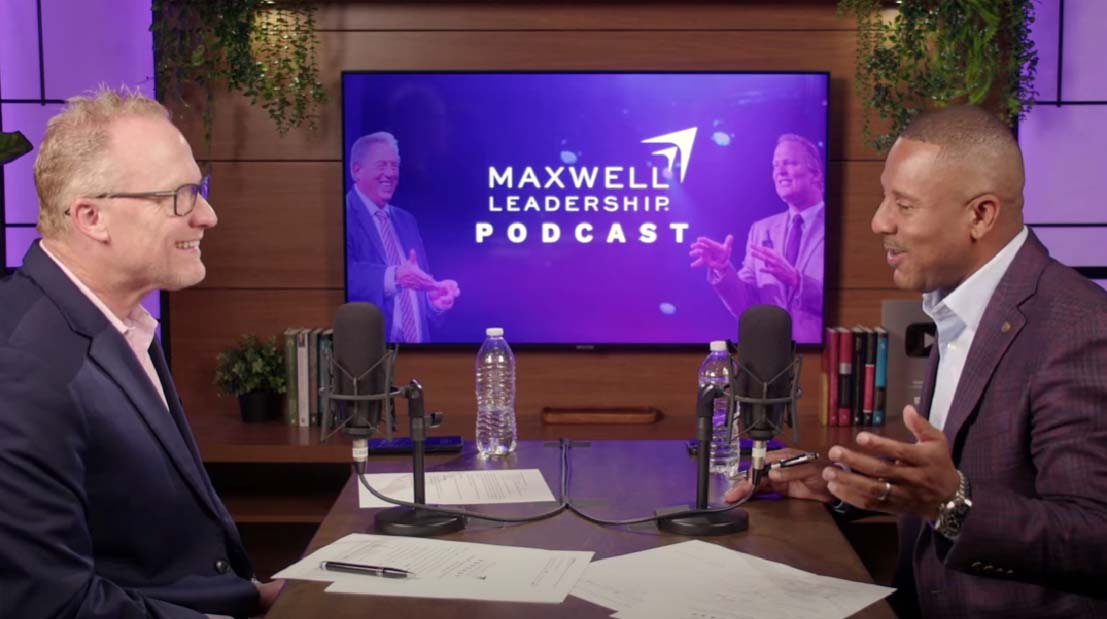
In this episode, Chris Goede and Perry Holley sit down with speaker and executive coach Corey Baker to discuss what’s off-limits for leaders: disengagement. They share practical stories demonstrating the importance of self-awareness and intentionality in a leader’s daily actions and choices. They also highlight the necessity for leaders to set personal guardrails and maintain authenticity, even when facing challenging circumstances. Discover actionable strategies for building accountability, strengthening team culture, and ensuring a positive influence in both professional and personal settings.
Perry Holley:
Welcome to the Maxwell Leadership Executive Podcast, where our goal is to help you increase your reputation as a leader, increase your ability to influence others, and increase your ability to fully engage your team to deliver remarkable results. Hi, I’m Perry Holley, a Maxwell Leadership facilitator and coach.
Chris Goede:
And I’m Chris Goede, executive vice President, Maxwell Leadership. Welcome and thank you for joining. You guys are in for a treat today because we have what I’m going to call is one of the OGs. Now, if my kids heard me say that, which they’re not going to listen to this podcast, they’d be like, dad did not just say that. Right? But this guy right here has been one of Maxwell Leadership’s executive coaches and facilitators for a long time, goes way back. And that’s why I call him one of the OGs, because when we decided to start the coaching and training and consulting side of things, it started with Corey and Mark Cole, because I think Corey was coaching Mark Cole back then. And just part of that. And so we’re grateful to have you here on the podcast.
Chris Goede:
The other reason he’s here, not only is he one of our trusted advisors that’s out in the field with us every day, but also he shared with me a message, a leadership principle, a concept that he went up and spent some time with one of our clients and some of his clients. And it just grabbed me and we talked about it briefly at an event. And I came back home and I made a note. I was like, see if Corey wants to come on and share this message, a leadership message with. With. With you, with those that are listening right now, whether you’re working out, you’re what might be doing, maybe you’re watching us on YouTube. And this is one that I want you to listen to, and then I want your team to listen to it, and then I want you guys to unpack it and talk a little bit about it. So we’re going to dive into that in just a minute.
Chris Goede:
Before we do, I want to encourage you to go to MaxwellLeadership.com/ExecutivePodcast. Click on this podcast, and there you can fill out a form. Get the download the learner’s guide. From today, you can fill out a form. If you need some coaching, some training, or one of Perry’s favorite things, leave a topic on there so he doesn’t have to create it for another one. Because we are now at episode 395
Perry Holley:
thirsty’s in a Row.
Chris Goede:
Great. Yeah. Now listen, I’m sorry it took Perry almost 400 to invite you on here.
Perry Holley:
I was trying to get it past 400, but you insisted.
Chris Goede:
Here you are today. So, Corey, thanks for joining us. Thanks for being here.
Perry Holley:
Cory Baker, by the way.
Chris Goede:
You didn’t say Cory Baker. Yeah, good friend of ours, Cory Baker. And he knows where all the bodies are buried.
Corey Baker:
I do. I might have buried one or two, so.
Chris Goede:
Yeah, you might have. Yeah. Well, just. That’s a separate podcast.
Perry Holley:
Yes, it is.
Chris Goede:
And we’re grateful that, again, not only you’re here today, but what you have done for John, for Mark, and then all of our clients around the world and still continue to do that and be a coach and a facilitator. Talk to us about this concept you don’t get to. Where did it originate from? Where did it come from? And then we’re going to dig into it a little bit with you.
Corey Baker:
It really. I’m going to tell you the story to kind of set this thing up.
Chris Goede:
Okay.
Corey Baker:
The idea of it just didn’t come to me. It just happened. It happened in life. So you know how things just come out and you just like, where did that come from? And I actually, as I tell the story, you’ll hear it. I. It came out and I didn’t think it was a big deal because I kind of whisper this to myself all the time. There are times for me as a leader, as a person, I’ll just whisper to myself, you don’t get to do that. You don’t get to.
Corey Baker:
And so it’s kind of part of my inner dialogue and that kind of stuff. But here’s how the story starts. It goes back to October 22, so not too long ago, like six months ago. And I lead a group called Joshua’s Men. So a great friend of mine, Dan Ryling, created this incredible curriculum, and it’s fantastic. And it’s a year long. So I would invite, say, Perry. I don’t know if I’d invite you, but I’d invite Perry.
Chris Goede:
That’s okay. I already went through it a long time ago. Yeah. And I still haven’t changed. So I just. You lost all credibility with.
Perry Holley:
Call Riley.
Corey Baker:
That’s right. Call him. Delete. So I would invite Perry into my group. And so I’ve done this for 23 years now.
Chris Goede:
Wow.
Corey Baker:
So over two decades. And I started doing it 23 years ago. And I would pick eight men from our church, and those eight men would come from. Guys were previously in my group, say, hey, Harry’s a great guy. We all talked to him about being in Joshua’s Man. And so I pick eight guys every year. It’s a calendar year, January through December. We read 12 different leadership books.
Corey Baker:
You have application guides. You have projects you have to do. Every month, two retreats. You’ve got to give a speech. We critique it all kinds of. It’s really intense. And the idea is it’s high commitment. Like, if you say, I’m in, not showing up is not an option.
Chris Goede:
Yeah.
Corey Baker:
Not showing up with your material done, not an option. And when you show up with everything done, you don’t get a high five for it. That’s. That’s the given.
Chris Goede:
It’s expected.
Perry Holley:
Yeah.
Corey Baker:
And so I invited another group last year in 2025, into my group, and it’s great group, fantastic group. And they came in and we kind of started our year, and we’re about six months in, so call it June. And a guy named Nick. Now, Nick is a guy in the group now. Let me paint the picture. So Nick’s a bodybuilder, much like Perry, you know, he.
Perry Holley:
What part of his body? What part of his body?
Corey Baker:
And he is. He’s got one of those guys, man, when he turns, his whole body turn. You know, he’s just jacked, man. And he’s got. He’s got the beard, he’s got the tats. I mean, he. He is a. He’s a bodybuilder.
Corey Baker:
He owns some gyms, has a coaching business that coaches people who do bodybuilding. And Nick began to build influence in the group and just a great guy. So Nick, in June, we had lunch, and Nick was sitting across the table, and here. And he’s just this kind of guy. And he said, hey, Corey, what’s one thing I can do to get better and what’s one thing I can do for the group to get better or add value? And I said, you know what, Nick? That’s a great question. I said, I’ve really never had that question before. What’s how somebody could add value to the group? He said, well, I would love to. And I said, well, do what I can’t do.
Corey Baker:
And what that means is go have extracurricular. Go play pickleball. Y’ all, go play golf together. Just connect. Outside of the monthly meeting, the level
Chris Goede:
two is what we call it.
Corey Baker:
You got it?
Chris Goede:
Yeah.
Corey Baker:
Go dive in. Go do level two. Because we meet for four, four hours every month, and that’s the one time we get together. He said, I’ll do it. So he goes and does it, and he gains influence with the group, and I give him some more influence within the group. And then 10th month of the year, October 22nd, he’s got the date. We’re having the meeting in my backyard, which is pretty odd that we would have it back there. But the reason I say that is I’m just viewing him coming in the back gate.
Corey Baker:
And he’s coming in the back gate and said, hey, Nick, how you doing, man? Go to shake his hand. Good. And he looks down. I’m like, what’s going on with this guy? So I say, okay. And I go in and meet all the other guys. And they’re coming in, hey, how you doing? And as we’re getting started, Nick is, you know, with all the muscles and everything, man, he’s just looking down. His posture’s like this. He’s looking down and he’s not saying anything.
Corey Baker:
As the time goes, the group is sitting around. And I could tell because he can’t see them. But as they’re looking at me, I’m looking at them. Every time they make a comment, they’re looking to see if Nick’s going to say something because he’s got influence in the group. And he’s sitting there, and I’m getting pissed. I mean, I am getting. If he wouldn’t have been that big, I might, you know. But Nick.
Corey Baker:
And usually I address the elephant in the room. I would say, hey, what’s going on, Nick? Let’s stop everything. Something’s obviously going on. Little whisper said, no, just let it go. So we’re two hours in, three hours in, four hours in. And I’m like, man. And he hadn’t changed a bit. And I shake his hand on the way out.
Corey Baker:
And I was just like, man, I’ve got to address this. And so a week later, I have lunch with him. I’m sitting with Nick, and about two thirds of the way through our lunch, he looks at me and goes, hey, Corey, what’s one thing I can do to get better? What’s one thing I can do for the group? And I said, oh, I’ve been waiting
Chris Goede:
for this, big boy.
Corey Baker:
I said, are you ready? He goes, what do you mean? I said, bro, I am pissed. And I said, I’m not only upset with you. I said, we’re gonna have a talk. And I said, I’m fixing to hit you between the eyes, so you better get ready. And he goes, wow. I said, yeah. I said, I’m upset, and I’m mad because you walked into a meeting one week ago and you gave yourself permission to disconnect emotionally and disconnect relationally and you decided before you came in that gate, it’s okay. I said, nick, you don’t get to.
Corey Baker:
Nick, you don’t get to do that. I said, if you want to be the leader that I believe you’re called to be, and the influence you gained in the group and the influence you’ve been given in the group, you don’t get to do that. I said, have you ever seen me do that before, ever? He goes, no. And I said, you never will because I don’t get to. I said, what also bothers me is this. I said, if you’re doing it here, you’re doing it at home. If you’re doing it here, you’re also doing it at work. And I said, it is something that you’ve got to get your arms around.
Corey Baker:
And I said, nick, man, I got to have something better out of you. And he looked at me and he goes, and this is the best part of the whole story is Nick’s reaction, his response. He goes, hmm. I’m sorry. I’m sorry. I said, well, man, thanks. I appreciate that. And he said, that’ll never happen again.
Corey Baker:
And I said, nick, we got two meetings left. Not too tough.
Chris Goede:
I was getting ready. You told me when it was. I was like, all right, big boy, you got two.
Corey Baker:
He’s only got two more left. And I was like, no. He goes, no, you don’t understand. He said, that’s never going to happen again ever in my life. Nobody’s ever called me out on that. I said, good. I said, I hope so, man. Great.
Corey Baker:
And we hugged it out, and he left. And we met in November, and we met in December. Now, in December is a different meeting, because December is the celebration of the year. So I bring all them into my home. We have everybody with their wives. I hand them a sword that’s got their name inscribed. I mean, this sword’s, like this long, man, and it’s got a great thing. You put it on the wall.
Corey Baker:
It’s pretty cool. And then I read something about how I’ve seen them grow over the last years on the air. And I did all that, and I did them all, and it was great. And they got to the end and they said, corey, we got something for you. I said, oh, great. Awesome. They brought up this plaque, looks like this. And they said, we got a plaque for you.
Corey Baker:
This has become our mantra for our group, and we talk about it all the time. It’s probably made the biggest impact and kind of some nice things they said. They said, we got something for you. They Said we had this made, like, from one of the dudes, cousins, like, you know what I mean? Like, like, like a friend of theirs or cousin who does crafts. You know, it’s just. And she did this, which he did an incredible job and great job. And she said. He said, we put this together.
Corey Baker:
You don’t get to. We decided we’re going to put a period right there. He said, because we think it deserves a period. Not an exclamation point, not a comma, not a. Not a blank. Because you don’t get to. And I, you know, as the leader, I’m like, tears are coming down. I’m like, my boys, they’re growing up
Perry Holley:
right in front of us.
Corey Baker:
They getting it, man.
Perry Holley:
Yeah.
Corey Baker:
And it was so great. And they said, here’s what we’ve also done. They brought a Sharpie and they said, we would love to all sign the front of this to show you our commitment that we believe as a leader, you don’t get to in some areas of your life. And as a leader. And they said, we want to sign it. So I took it, man. I got it. I put it in my office.
Corey Baker:
And, man, that’s really cool.
Perry Holley:
And.
Corey Baker:
And I began to think about it. And as I began to think about it and began to look back on the moment and stuff, and I began to just kind of talk to some people about just. You don’t get to. And because life’s full of get tos. Like, I get to lead. That’s a get to if it ever becomes a got to. That’s not something you want to do. You want to get to life and a get to mentality.
Corey Baker:
And I think as a leader, we have get tos when it comes to. I get to develop people, I get to set vision, I get to create a disciplined organization. I get to do all these awesome things. But there are things that we don’t get to. And when you begin to think about the things you don’t get to, you begin to say, what are those? And what does that look like? And it’s one of the things I believe, and I know y’ all believe this. I believe leadership principles, they go with you wherever you go. So at home, that’s right. At work, in the community, you just got to apply the same principles everywhere.
Corey Baker:
Most of us apply them at work. We don’t apply them at home.
Chris Goede:
That’s right.
Corey Baker:
We leave them at the door. And I remember. Quick story. I remember it was probably 25 years ago, I pulled up in my driveway, and I pulled up my driveway on the phone, just. I did that a lot. I pulled up on the phone, and this is when phones were new, with cell phones and everything. So I was happy to be efficient, effective man. Pulled in and.
Corey Baker:
And then the garage door went up. And when the garage door went up, Perry. My kids heard it, and they came running out. And they’re running out, man. And I’m on the phone. I pull in, and they’re jumping up and down at my window, and I’m going, sh. Daddy’s on the phone. Just gonna be a minute.
Chris Goede:
Just a minute.
Corey Baker:
They jump up and down. Then they faded off. I didn’t pay much attention to it. And the next day, though, I pulled up and the garage door went up. Nobody’s coming out. And I made a promise that day. I will transition better from work to home. Because if I come home with the same intensity, the same critical eye, the same expectations, all those things, if I bring that into my home, man, it does not go well.
Corey Baker:
So I said, I’ll never pull up in the driveway ever again on the phone. And so you would see me in the cul de sac in the neighborhood. You see me at the clubhouse, and I’m on the phone, but you. And today I’ve got one child out of six children. Five boys, one girl. The last one, my princess. She. She’s the only one there.
Corey Baker:
She’s a senior in high school, so she’s never there, right? So I still pull up in the driveway, and I’ll pull up on my phone because I believe it’s the ability to be able to say, I don’t get to. I don’t get to. As a dad. Certain things I don’t get to as a. As a husband, I don’t get to. As a leader, I don’t get to. And there’s a list that goes in for me. It puts guardrails around roles that we get to have in our life.
Corey Baker:
But there’s some things that we don’t. We don’t get to. There’s a great formula that I love, and. And it goes like this. E plus articles O and y’ all probably heard of this, and I love it. And there are events that occur. The R is response and O is outcome. And events are going to happen we don’t have control over.
Corey Baker:
The R is. I circle that R because the R is about this. You don’t get to respond in this way. You don’t get to. Because the outcome. The quality of the outcome has a lot to do with the quality of your response that you don’t get to. Has a lot to do with our response.
Perry Holley:
I love that and I teach that often. Because you can’t control the E’s. You’re going to determine the O. The only thing you control is the R. And it could also stand for react. And if you react to an event, you’re going to get a different outcome. If you respond as you said, you’re going to get a different outcome. A better outcome.
Perry Holley:
I found. Tell me this. So we all coach, we all work with executives, leaders around the world. This is. I think what you just shared is gold. But what do you find behind that? We get to set vision. We all these positive things we get to do. But then we have these things we don’t get.
Perry Holley:
But we occasionally do the things we shouldn’t get to do. What’s behind that? Just a bad mindset, a bad day, a bad emotion. Not understanding E +R equal. Not that I’m controlling the R. What’s your gut on that one?
Corey Baker:
I’d say it’s this. And I’ll use an acronym. Air A, I, R. Very simple. I don’t think we’re aware. I think the A stands for aware. I is I’m going to be intentional and R is I got to get some reps. So if I’m going to be aware, I’ve got to be aware that when I transition.
Corey Baker:
So I became aware in that example I gave you about my family. I became aware when no one came out the door. So the garage door came up and I’m looking around and I’m not on the phone and nobody’s out there. So I think first it’s got to be awareness. I think we have to know and understand and be aware of ourselves and be aware of the choices we’re making or the choices we’re not making. And the I’s, man, I got to be intentional about it now. So I can not only you can be aware but not be intentional about the behavioral change. This is the behavioral change.
Corey Baker:
And then the R being. I gotta get some reps, man. I gotta work on this. A lot.
Chris Goede:
A lot ties into emotional intelligence for me, right. When you think about self aware, you know, others aware, all of that and thinking about where this plays into one of the things I wrote down. And both of you as executive coaches, I’d love your feedback on this is you said your mindset and this is interesting that the self talk you have and the awareness is you don’t get to. Wouldn’t you say there are leaders out there that maybe have the opposite of that. And it’s almost like, well, once you become the leader, which we talk about it as influence, not title, not status, but a lot of leaders out there lead from that level one. And. And so then it’s all like command and control. It’s like I get to.
Chris Goede:
And it’s. And it’s opposite of that. Do you guys see that in executives and coaching? And if so, have you coached somebody, maybe even you, because this is such a Cory Baker kind of mantra that you flipped that for them if they were honest enough and self aware enough to be able to say no, I walk around, say I’m a level, I leave from level and I get to versus how you’ve taught yourself to think as a leader.
Perry Holley:
I don’t think people are aware sometimes I think they’re driven by the event drives an emotion that if I had to tell you, the majority of the coaching I’m doing where they’re having a problem is driven by. They don’t know how to respond correctly to the event to keep themselves in the. I don’t get to go off on you. I know. I don’t get to tell you what I think I’m going to go into. I get to coach you. I get to flip it. Yeah, there’s gifts that are positives.
Perry Holley:
But I also. Often people say I have to versus I get to. And you’ve added another dynamic which I love, is that I hear people say, well, I have to go watch my kids ball game. I’m sorry, what? You have to. Or you get to go watch your kids ball game. And then you don’t get to say I have to go watch my. Now you gave me another flip on that. But what do you think?
Corey Baker:
I think it’s. I’ll give you a real life example. I spend seven, eight hours Monday through Thursday coaching every hour on the hour. And I only say that because this is so recent. And the great news is I got a lot of recent stories because like you, there’s just a lot of things I get to hear and see. And there’s a new guy that just became a general manager of a car dealership and he became a new manager and I had his whole team in the room and I do a group call with them and we’re going through. And we’re going through this material actually. And he left the room to go get these things.
Corey Baker:
He left the room to go get these. So the new general manager name is Brad, left the room and I said now that he’s gone, we get to talk. I was like, tell me about it. How’s he doing? First thing they said, you know what he does every morning? And every person applauded this. He walks around and says hello to every single person and comes in the back door and comes around and sees everybody and they’re like, it’s incredible. Changes everything.
Perry Holley:
Yeah.
Corey Baker:
So here’s why. I’ll give you the answer to your question. In this example, he decided he doesn’t get to. You don’t get to just go straight to your office. You don’t get to do that anymore. His get to is changing. You don’t get to. To a get to.
Corey Baker:
I get to go in the back door. I get to go around to every technician. I get to go see every person, tell them how much they mean. And that room lit up like a Christmas tree from a guy walking around and simply saying hello and everything.
Perry Holley:
That’s really good.
Chris Goede:
He just convicted me. Like, I come in the office and I’m going, I got 15 things I’m ready to knock out and I go
Perry Holley:
straight to my office. I didn’t know there was a door by the elevator where you slipped me out. I’m kidding.
Chris Goede:
Maybe, maybe not. And that’s so good though.
Perry Holley:
Yeah. Yeah.
Chris Goede:
Like he gets promoted and the shift, the leadership and the mindset shift was I don’t get to go straight to my office and start working on stuff.
Perry Holley:
But he’s aware.
Chris Goede:
But he’s aware of his impact on people and he probably calendars it.
Corey Baker:
Yes, he does.
Chris Goede:
To make sure, hey, look, I want nothing on my calendar before 9 o’ clock because when I come in the door, I’m going to make sure that I do that. And that’s a brilliant example of even just having that shift. Because he’s responsible now for that culture, for that temperature of that team.
Perry Holley:
Do you get any pushback when you. I know you’ve delivered this to several groups and does it. Is everybody like us gaga over at Cory Baker’s new profound teacher?
Corey Baker:
Absolutely not. So I can answer that one very quickly. But I did have a follow up that was really good. So I got to speak to Hendrick Motorsports, to their four drivers, their crew chiefs and their team. So I got to speak to them. It was great and everything. And one of the wonderful thing was when I have them turn this over, then I’ll have them write in a dead Sharpie one professional thing that they don’t get to anymore. So they’re going to write it on there.
Corey Baker:
Then they have a number two in red with a Sharpie what is one thing personally that you don’t get to anymore? And we kind of set up for 20, 26. These are. You don’t get tos.
Chris Goede:
Right, right.
Corey Baker:
And so then you turn it over and I have them with the black marker, sign their name, commit to it, whatever it may be. So we did that. And I’m just giving you the background of it. And so a month later, I coach one of the crew chiefs. His name is Alan. And Alan, we get on Vegas, man. He’s literally clapping like, man, I am so excited for this call. And I was like, well, finally, finally
Chris Goede:
somebody’s coming to after 18 years. But most coaching people, they’re excited to
Perry Holley:
come to the call.
Corey Baker:
And I was like, well, that’s great. He goes, no, no, no, I did. He said good things. And he goes, no, seriously, I’ve been waiting to ask you this question. He said, because I love what you did with. You don’t get to. I got the plaque. He’s like, man, and he just said some nice things or whatever.
Corey Baker:
And then he goes, I got a question, though, man. It’s been driving me nuts. So what is it? He said to me, it sounded like you just had to fake it and act like everything’s good. And he said, if we lose and something’s going bad, man, I’m just not being my authentic self.
Chris Goede:
Yeah, if he’s mad, you’re just gonna fake it.
Corey Baker:
In other words, I can’t act mad. Is that what you’re saying? I said, no. I said, I love your question. I said, it was a fantastic question. And I said, let’s do this. I said, let’s go back to the story with Nick. Okay? So Nick came in. Now, let me tell you how I would wanted him and recommended that he would handle something like that.
Corey Baker:
I said, if you think of a scale, 0, 100, 0. I’m totally, emotionally and relationally checked out. And I’ve given myself permission. That’s a key word, permission. I have given myself permission for that. Then over here, you’re just jumping up and down, man. It’s a great day. Awesome.
Corey Baker:
Fully engaged as 0, 100. I said, as a leader, your minimum is 30, 40. So here’s how he should have come in. I said, I would recommend this. Nick, come in. Hey, Corey. Good to see you, man. It’s been a rough, rough day, week, whatever it may be.
Corey Baker:
I’m not going to be 100%, but, man, I’m going to be fully engaged. I’m going to be here. But just know I’m Going to be a little off tonight, baby. I would have fist bumped Nick. Absolutely. And he would have been engaged at the requirement of being an influencer in that room. So there is an amount that you have to be engaged. You don’t have to be jumping up and down.
Corey Baker:
You just got to be engaged. You can’t check out.
Perry Holley:
So he gave himself permission to go to zero when you said no, no, there’s a minimum requirements. Meets requirements here, which is 30, 40.
Corey Baker:
You got it.
Perry Holley:
But he also asked for permission.
Corey Baker:
He did. In that example. Yes.
Perry Holley:
Yeah. So a leader. There’s so much here for a leader. I’ve got so many questions.
Chris Goede:
Hold on one second. While you’re thinking about that question as we’re sitting here, I just realized something in the power of this content as we’re recording today. Just this previous weekend, Alan and Chase won the first race for Hendrick. They’ve been a little behind and now I know why. So I’m just telling you right now, as a leader of a team in an organization, maybe even Brian Porto could use this.
Corey Baker:
Brian Porto. Well, let’s just point to Brian Porter. Right. That’s the reason.
Chris Goede:
But, but they did, right? And, and, and they.
Perry Holley:
Is that why his face is on the car?
Chris Goede:
On the COVID On the car. But before I throw it back to you, what I, what I love what you’re saying about this right here. I want to stay in this moment for just a minute. Is authenticity as a leader is, is the key.
Corey Baker:
It is.
Chris Goede:
Right. And I think that’s what Alan is saying and he’s asking, and you’re leading them. Say no, no, no. Because when we’re authentic, that’s when the trust of the team builds. Because I can come in and like Nick, I’d be like, man, I’m here, Corey, physically, but it’s not been good. Right, right. And that changes versus coming in. And by the way, this is not.
Chris Goede:
We define leadership as influence, so it doesn’t matter when we say as a leader. It’s not a title thing. This is as a team member like you, you don’t get to come in and do that on the team. Come in and let’s be authentic and communicate. Give me 30, 40. Not every day. Right, but it’s not that zero. And I love that, love that question, love the concept.
Chris Goede:
And what you’re saying is it’s about the authenticity of where you are. Because days can be hard, situations can be tough, they will be challenging, they’re
Corey Baker:
going to be hard. You’re going to have events all day every Day all the time, it’s going to happen. And that’s one of the reasons I believe so much in the fact that saying you don’t get to that mindset follows you everywhere you go. That’s why I haven’t put a professional. Because the number one thing I see when I go through this and they’ll write down one thing, and I’ve done this with quite a few folks and they’ll write down and they’ll write down this. I don’t get to isolate myself as a leader because many leaders were just overwhelmed. And so I want to be by myself and I’ll pull away from people in a negative way.
Chris Goede:
And I want to go right to my office first thing in the morning,
Corey Baker:
first thing in the morning because I want to get things done. I don’t want to talk to people and, and it doesn’t have to be an hour long conversation. It’s just got to be the touch points and the catch and just kind of like Brad does, walk around and say hello to everybody. Then the other big thing that’s every, almost every single time they write is a personal one they’ll write to, they don’t get to is I don’t get to check out when I go home. We live in a culture, we live in a world that we’ve been allowed to check out. And here’s what I mean by check out all day. Four and a half hours a day is the average the person spends in America on social media. Four and a half hours a day.
Corey Baker:
Some two, some eight. Here’s where the checkout is. I’m bored, so I’m gonna look at social media. If I’m having a rough day, I’m gonna pull away. So we have conditioned and everybody in the business world now is we have said through our culture, you can check out whenever things get tired, bored, whatever it is, you can check out. It’s one of the most dangerous leadership principles. You don’t get to check out as a leader and you don’t get to check out when you go home. You don’t give the people you love the most in this world your worst.
Chris Goede:
Yeah, that’s right.
Corey Baker:
And a lot of us will show up and a lot of us don’t have a lot left and they get the worst of us. And all it takes is just a little intentionality. Got to be aware, got to be intentional and get some reps. And the reps are, man, every day when I come home, I’m going to transition into dad and husband. I’m Going to transition into the man that I’m supposed to be when I come into my house. And it doesn’t take much. It’s just a yes. It’s just, hey, kids, want to play ball? Last thing in the world I want to do is go outside and play ball.
Corey Baker:
Maybe the answer is yes. I become a yes man when I come home to that kind of stuff. Then I’m present and it’s usually 10 or 15 minutes. It’s not eight hours. You’re going to want to throw the ball. But how do I make sure and understand that? I don’t get to check out, I don’t get to do that.
Perry Holley:
That’s the intentionalness of it. Do you think back to you if Nick had asked for permission and said, I’m going to be a little off, but as a leader, should you let people know or should you just talk to yourself and say, I need a 30, 40, I need to maybe ratchet it up to 50. I don’t feel like it, but I don’t get to go low. So I’m going to. I’m just going to handle it myself now. Or should you tell some seduce.
Corey Baker:
It’s a great question. And I would say this depends on the organization, depends on the teacher, the leader, and depends on the situation. I think there’s. I don’t think there’s a black and white. You tell people every time or you don’t tell people at all. I think it’s dependent on your authenticity, your relationships, the people around you. There are times I want to be authentic and tell people where I’m at if I’m not in a good place because I want them to know and I’m going to allow them into my world and I’m going to get closer to them because I allow them into my world. And there are times they don’t need to be allowed in.
Corey Baker:
There’s times that you just muscle through it and you just got things you got to do, man.
Chris Goede:
I also think your level of responsibility in that room. What I’m thinking about here is as a again influences what we talk about. Team member or leader. But with Nick in that situation, Nick was an influencer. He was a leader in that group. And so maybe if he was a individual contributor on a team, that it’s 30%. Maybe as an someone who had influence, it was a leader of that group next to you. Maybe it should have been 50 or 60% sure to what you guys are saying.
Chris Goede:
I think every situation will determine where your influence level is in that situation. What that percentage is to be able. When you have bad days, to show up and how you show up.
Corey Baker:
Yeah.
Chris Goede:
Talk to us a little bit about. We have a lot of people that listen that are part of this, that have teams that develop teams. And as you’re coaching through this, and this is fresh and hot on. On your mind, how are they using it to develop their team? Maybe. Maybe it’s even Brad’s team and that team call or how are they doing it? Or maybe some others share an example of how you see this phrase. And it’s a mindset shift and then an action where they’re using it to develop their teams.
Corey Baker:
Here’s how I’m seeing it. And again, I’ll go back to Brad and his team. So we did this with Brad and his team, and here’s what was great. I’ll have them. When we go through this exercise and they write on the back, they write one professional thing that they don’t get to. They write one personal thing that they don’t get to. When they write that down, they’re not ready for this. But I say we’re going to go around the room and Perry, start us off.
Chris Goede:
Oh, I love that little surprise. So this is not private. We’re about to share this. So you’re going to change your mind.
Corey Baker:
Everybody starts stumbling. Oh, well, you know, do I need to go first? But the reason I do that is this, because that’s how it helps the team.
Chris Goede:
Yeah.
Corey Baker:
When you hear your teammates saying, like, things. When you start hearing things that everybody’s thinking in the room about this leader.
Chris Goede:
That’s right.
Corey Baker:
But now they’re recognizing. And now they’re. So everybody in the room starts. Their heads start going like this. Like, yeah, that’s a great idea. And not only a great idea, but it also creates authenticity in the room. There was a girl that was at the table with us. Her name was Brittany.
Corey Baker:
And she wrote a really good answer. I mean, it was just really good. And I thought to myself, as she was writing it down, I was like, that’s really good. I thought, I’m going to affirm her in front of the group. So sushi day. I said, brittany, can you say that again? That was fantastic. So all of a sudden, she kind of stood up a little bit more. The group kind of circled around her.
Corey Baker:
And I said, what a great statement there. So when you’re developing this within your group, one of the ways I’ve done it, and there’s so many ways you can do it, but one of the ways I had done it is I get them to become closer and know each other better. And not only that, they verbalize the things that they don’t get to. So there’s some accountability in there. There’s a common language now, peer to peer accountability. So now they’re looking around saying, you don’t get to. And they smile and have a high five and. And they kind.
Corey Baker:
And then he goes to take Brad coming in the dealership, he goes around and you just look at me and you say, you don’t get to. Yeah, I don’t get to go in the front door and go straight to my office. I don’t get to do that. So what does he do as a leader and what’s the influence that he’s having on his team that they literally, when he leaves the room, they didn’t say, think about this. He’s helping us make more profit.
Chris Goede:
Right.
Corey Baker:
He’s driving sales, he’s cutting cost. He’s developing me as a leader. I mean, I’m sure all of that is true.
Chris Goede:
All of it is true.
Corey Baker:
But my goodness, the first thing they say is, man, the fact that he goes around, says hello to us and everybody just stood up and they said, oh, man, it’s great when he does that. I love that. Now Brad’s going to drive all the other things we talked about because he could come in and shake everybody’s hand and kumbaya all day long. But if he doesn’t get results, he ain’t going to be around for a general manager.
Chris Goede:
That’s right.
Corey Baker:
So it’s an. And you get results and you connect with culture.
Perry Holley:
Think of the opportunity just to. If you get this common language in your organization and your home, how beautiful. To hold each other accountable for that.
Corey Baker:
Yeah.
Perry Holley:
I mean, thinking my wife and I just, hey, you don’t get to do that.
Corey Baker:
Yes.
Perry Holley:
Just a reminder of each other to say, hey, we could really take our organization, our culture to the next level of just reminding each other about why we’re here. Like you said, we got all the profit and the business and the calls and the leads. But if we don’t, if we give our permission to check out or to not show up full, we’re going to kill all that. And yes, so by holding each other to that level of, hey, Perry, you don’t get to do that.
Chris Goede:
Yeah,
Corey Baker:
yeah, yeah.
Chris Goede:
And I think as I, as I wrap us up and then I’ll let you close. Going back to that authenticity. I’m thinking about that lunch with you and Nick and you speaking into. We Talk about in feedback, you know, them giving us the right or us giving somebody else the right to speak into our life. You had built the influence the right way.
Corey Baker:
Yeah.
Chris Goede:
You were leading the group as the title. You had connected to him. Now you’re having a level three conversation, and he’s wanting to know how he can help make the group better. And then you get to the situation, you go, I have trust with him to be able. And I think that’s the key because I was just. What made me think about that is I love talking about you and Bonnie going around saying, well, you don’t get to. Sometimes that might not be taken very well. And so we gotta make sure that the.
Chris Goede:
Yeah, I’m like, I’m fixing to tell her what she said, but I think understanding the five levels is what everything this podcast is built off of. And every topic is understanding that Corey got to a place to be able to say, yeah, Nick, you don’t get to. Right. And that is huge. Now, as you’re listening, as you’re watching, you don’t get to not do anything with this. Like, I mean, this right here, this is fresh. And I don’t know if you’re gonna think about a book or future things, and we want to support all of that, whatever that is, because there’s something here. There is a common language, there’s a mindset.
Chris Goede:
And you don’t get to keep this to yourself. We want you to reflect. We want you to write down some personal thoughts. Maybe a person personal, maybe professional. But then I want you to share this with your team.
Corey Baker:
Yeah.
Chris Goede:
And then more importantly, you know, Perry’s going to give you the. The call to action and where you can do this, but on that form that we’re talking about, maybe you just put your information in and you write. You don’t get to. And we’ll follow back up with you. I know Corey would love to. To coach, to. To speak on this, to talk about it with your team. We would love to help you do that because this is a culture change.
Chris Goede:
I mean, even just Brad’s example in the morning, he doesn’t get to. Which now I’m completely convinced, not going, you know, and connect with everybody. That. That is a culture statement and a leadership statement, the same thing. And, man, Corey, it’s really grateful for you to be here and just share, you know, what you’re learning, what you’re coaching on and what you’re teaching on lately and the impact that it’s having on you personally.
Corey Baker:
But.
Chris Goede:
But teams around the world so we’re good.
Perry Holley:
Fantastic. Well, thank you Corey for being here.
Corey Baker:
Absolutely.
Perry Holley:
Chris, great stuff. So reminder, as Chris said, you go to Maxwell Leadership. There is a form there. You can ask us to send you information about our offerings. More about you don’t get to lots of information you can ask for there. You can see our other podcasts and our podcast family. You can also leave us a comment or a question there. We love hearing from you.
Perry Holley:
So grateful you spend this time with us. That’s all today from the Maxwell Leadership Executive Podcast.
Transcript created by Castmagic.