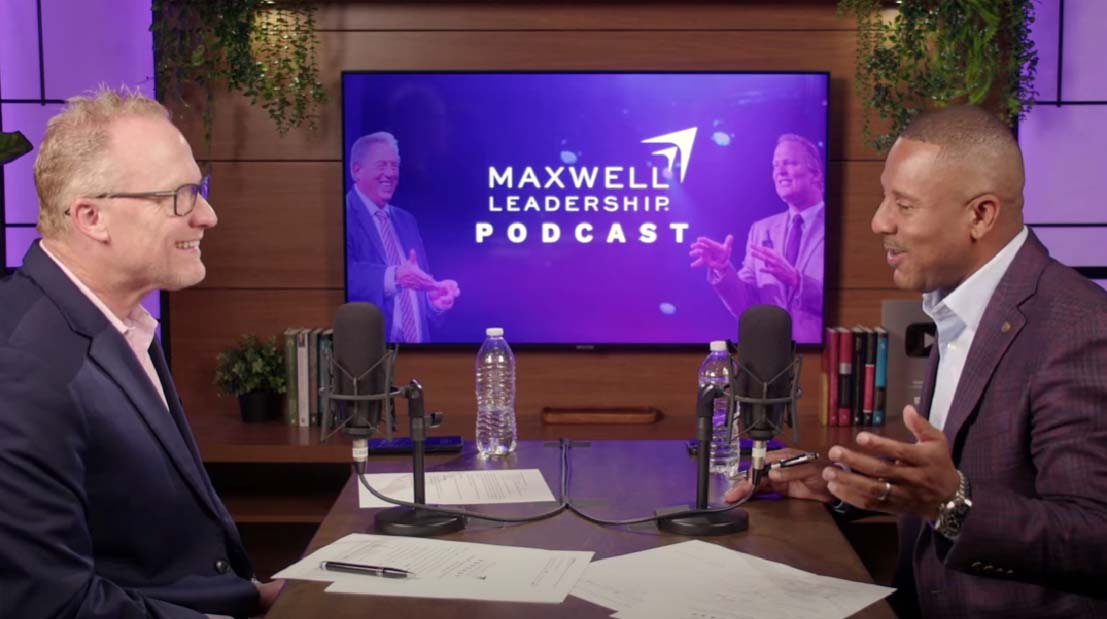
There are two kinds of people in the world: those who drift through life and those who take ownership of their journey. In this bonus episode of the Maxwell Leadership Podcast, Mark Cole and Jared Cagle are joined by Chris Robinson, who’s sharing the story behind his brand-new book, and how it can help you move From Drift to Drive!
Mark Cole:
Hey, welcome back, everybody, to the Maxwell Leadership Podcast family. Podcast listeners, podcast viewers, I have a treat for us today. First treat is my friend Jared Cagle is with me and you’ll hear from him in just a moment. And then our guest today is no guest. He’s a homebody. He’s here.
Chris Robinson:
This is his home.
Mark Cole:
But Chris Robinson, he’s in a new seat today and I’m so excited to introduce him in that seat. But I’m going to let Jared, I’m going to let you, because Jared Cagle is now running Maxwell Leadership Publishing. Hey, we’re legit. We’ve got a publishing company, got a content development company, and Jared actually wears two hats and runs those two divisions for us. And so, Jared, not only am I glad to have you on the podcast, but I’m glad that you’re in that chair with me to talk about a brand new Maxwell Leadership book. And I’m excited to be partnering up with you to talk to this guy.
Jared Cagle:
I’m honored, Mark. Thanks for having me. Thanks for both of you for having me on and podcast Family, we’re so grateful that you’ve joined us. This is an opportunity for us to bring to you a piece of content that we’ve worked really hard on. And this is a first time author, but he’s not a normal first time author. I’ve worked with several. This book is like a 10th or 20th book from an author today that you’re going to get to hear from. And we’re excited as Maxwell Leadership to be able to bring good content that’s going to help you with your life, your personal growth and your business as well.
Jared Cagle:
So can’t wait to get into the content.
Mark Cole:
Well, yeah. And so, Chris, I want to hear from you. I want you to greet everybody. They know you, but I’m so glad you’re here. I’m glad you’re here because I love doing things with you. In fact, we’re going to meet all afternoon since you’re in Atlanta. I’m going to work you. But I love leading beside you.
Mark Cole:
I love learning beside you. I love impacting beside you. I love traveling beside you. I’ve done all the above. I love doing podcasts beside you. But today, hey, I’m excited about this.
Chris Robinson:
Right here with Satya buddy.
Mark Cole:
Way to go.
Chris Robinson:
I love it.
Mark Cole:
Glad you’re on.
Chris Robinson:
Yeah, well, I’m glad to be on first and foremost to be here with you guys, Jared and Mark, to be able to get this book done underneath the Maxwell Leadership umbrella. It truly is a privilege. I Mean, when we think about. When I think about the next steps, for myself, this was a logical next step. And to be one of the first to come through Maxwell Leadership Publishing, just an honor and a privilege to be able to do that. So I’m excited about it. It’s a good one.
Mark Cole:
Well, Chris leads in his day job. Chris leads our 58,000 certified Maxwell Leadership coaches in 169 countries. I don’t know what you’re sitting here doing. You got some work to do, what’s going on? But Chris is our global ambassador. He is our spokesman. But I tell people all the time that one of the things I love about Chris Robinson is you’re a product of. Of the product. In other words, you have allowed this product, Maxwell Leadership, to shape you into being Maxwell Leadership.
Mark Cole:
And you’ve done that as a leader, you’ve done that as an entrepreneur, and now you’re making the boss proud of you. Talked to him this morning. I said, john, I’m on the podcast today with Chris Robinson talking about From Drive to Drift, Not Shift. From Drift to Drive. John said, leadership, Martin, Leadership. That’s great. From Drift to Drive, his book. And I’m gonna challenge you.
Mark Cole:
I’m gonna challenge your podcast family. You’re gonna wanna go take advantage of this book. We’ll put it in the show, notes how to get it. But, Chris, why a book with all the success you’ve had? Why’d you do the book?
Chris Robinson:
Yeah, well, again, it really wasn’t intentional to go in and write the book out the gate. You know, initially, I was actually going with Jared to go work with another organization to see if we can kind of collaborate with the Maxwell Leadership Certified Team. And as I sat through there, I began to just kind of engage inside the process. And they’re like, well, if you were to wr, Would you write the book on? I said, well, I’d like to maybe talk about underperformance and just performing better. And we dug a little bit deeper, and then we started talking about this word complacency. And then that word just kind of took hold of me. And so that night, I go back and I’m thinking about this book. And the next day, I’m waiting for the Uber on a bench and the framework and contemplating all the times I had dealt with complacency in my life, thinking about how I had overcome it.
Chris Robinson:
The framework came to me. So I go back into the room, and I go up on the board, and I said, hey, look, I’ve got the framework for this book from Drift or dry. I write out the framework. Jarrett was in the room, Rory, a bunch of other people, and they’re like, yeah, that’s it. Now I got the approval of the room. They’re going, yes, this is a good concept. But then the real work begins. Now, I’ve not only just got to have some bullet points, I’ve got to go and flesh this thing out.
Chris Robinson:
And then that’s when I had to make that decision. Hey, am I gonna drift here and go, oh, I’ve got a good book that’s sitting here, or am I gonna go ahead and drive this thing? And, man, we put that thing in high gear, and we got it done.
Mark Cole:
That’s awesome. And I’ll tell you, I don’t do a podcast on a book team. I don’t do it unless I’ve went through the book, unless I’m familiar with the content. And you’re a friend of mine. I love you. You love me back.
Chris Robinson:
Oh, yeah. Okay.
Mark Cole:
We can tell that that’s not the weird hair. I’m proud of you. I’m so proud of you on this book. It’s gonna do well. It’s got legs. But podcast family, as I was reading it in preparation for you, I wasn’t even reading it to consume yet, because this is so fresh. I mean, we’re talking like, I just got my heart back today. Okay? It’s fresh.
Mark Cole:
And so I read it to be prepared for you, my friends. And as I read it, it’s a page turner, it’s systematic, it’s applicable, and I’m proud of you. John Maxwell says, you’re never good the first time I say to him, you don’t know what you’re talking about. This is a great book. So that’s why you decided to write the book. What is it about this concept of busting up complacency or defying complacency that just kind of awakens you? That said, this is going to be my first book. I’m going to get people out of drifting into driving.
Chris Robinson:
Well, complacency is this way. I redefine complacency. Inside the book is a secret place of satisfactory success. As I was thinking about and we began to research, okay, where has complacency been the root or the problem of the fall of many people’s demise? And it was everywhere. It was inside of, you know, empires, the Roman Empire, they attributed to complacency. It was inside of companies that we looked at. It was complacency that led to their downfall. I mean, even Going to Richard Petty, it was complacency that he attributed for his demise in his later years.
Chris Robinson:
And then as I looked at my own life, oh, my goodness, Mark. It became like, whack a mole. You know, anytime that I began to contemplate, well, why wasn’t I doing something? Or why didn’t I have something? I’m going to. Ooh. There was this secret place of satisfactory success that I just. Just said, I’m good enough right there. And so I fell in love with this concept, and I’m going, man, I want to stomp this out of people’s lives, because everyone deals with it. We all have a secret place of satisfactory success where we have more potential.
Chris Robinson:
It’s good, but there’s this potential over here. And my goal with this book is to bridge this gap between your good and your potential.
Mark Cole:
So you’re a vulnerable guy. You’re an approachable guy, but you started the book very vulnerable. I mean, you’re sitting here saying, I’ve got triplets and they’re foreclosing on my house, and you grabbed me. I knew a little bit of that story, Chris, but you grabbed me with the challenge of that and then attributed that to complacency. So talk to me about why you chose to start there and why did you allow that story to shape the message of this book?
Chris Robinson:
Oh, man, I hate to get emotional on that. Come on, man. It was really, really vulnerable to share that. I think the primary purpose that I started there is because, you know, the book is written for high achievers, okay? But I don’t ever want achievement to feel unattainable and unreachable. And so I started there because John teaches us, hey, success will separate us. You know, failure closes that gap. And I never want what I look like on stage and, you know, where I am today. For someone to go, oh, man, he’s too far.
Chris Robinson:
That’s too it. And so, I mean, we dive deep immediately. Immediately into the pit of where I was at life in that point. And so I just wanted to open up. That’s who I am. I think I’m an open book. And I never want to hide from any of that failure. I never want to hide from any of that stress.
Chris Robinson:
You know, my wife read the first chapter. She was like, I think I got some trauma from that. She’s like. She’s like, there’s some trauma tied to this somewhere, you know, because it was. It was. We were in trouble. We were in trouble, but it was from adrift. I did very well throughout my early 20s and started multiple businesses that failed.
Chris Robinson:
And then it was. I was still living, like, I was still making this high income, and all of a sudden, everything was gone. And so that’s when I found myself really crying out for the first time for complacency. I was driving on the road. I take one of those long rides, and, you know, at that time, I’m. I’m in that Hummer, and I’m just crying out to go. I mean, I’m crying, you know, gosh, why can’t I just take a normal job? And in that moment, I believe what would be audible. Voice of God, he said, because I didn’t put that inside of you.
Chris Robinson:
Oh, wow. And I had this overwhelming peace that came in that moment. I said, okay, I want to continue on as this entrepreneur. So. But that was me in that moment, crying out for complacency, because complacency is comfort. Complacency is busyness. Complacency is excuses. And I was right there square in the middle of that side.
Chris Robinson:
Hey, should I go back and just get a normal job, or should I pursue this passion of helping people, adding value to people? And, man, I’m glad I chose the latter.
Jared Cagle:
Chris, you bring. You bring these pictures together for us, so. Well, you know when you talk about cruise control as well, and complacency kind of drifting into cruise control, and you mentioned a story in the book. I think it was chapter two, maybe when you were in Cambodia with John.
Chris Robinson:
Yeah. Oh, yeah.
Jared Cagle:
And you were in cruise control on the stage, and you asked him for feedback after. And how fun was that dinner?
Chris Robinson:
He obliged. I asked for feedback, and he obliged. And not only did he give me one, but I really think it was the foundation for a book he wrote, sixteen Laws of Communication. Yeah, there you go. There you go. I think he came down the next day and said, hey, you were my inspiration. He gave me a long list of things to do. And then, in fact, there was five other people at the table that weren’t speaking that day.
Chris Robinson:
They jump in, and they are just giving me feedback as if they were on stage because they think it’s a brainstorming session. So, you know, I’m sweating, but what can you say at that moment besides thank you? Yeah. And the thing. The reason I was able to receive that information is because I knew everybody at that table loved me. It was a safe environment. It was an environment that you pursue to be around people that are further than you so that you can get that feedback in order to pull you. And so Although it was tough, it was looking at that going, okay, well, nothing on here is brand new. There’s nothing on here that I haven’t read.
Chris Robinson:
There’s nothing on here that I haven’t done in the past. I was drifting. And what that did was that ignited a fire inside of me to really go back and work on communication like I did in the beginning. Because one of the subtle signs of complacency is that what used to fire you up doesn’t fire you up anymore. Okay. Like, I used to get fired up about preparing for speaking. I mean, I would prepare for hours upon hours, you know, to give a three minute presentation at an imc. I would prepare hours upon hours to go speak for free at a Rotary Club or a Chamber of commerce, you know, just to be in front of the room.
Chris Robinson:
And here I was, was speaking in front of 2,500 people, just meeting the President of Cambodia, two people on the stage, John Maxwell, Chris Robinson. And I spent more time at a chamber of commerce. Now, I prepared for the talk, but not to the depth, to the degree that I did in the past. And so that was an indicator. Man, I was in a drift.
Mark Cole:
You know, it’s funny because when you were talking, I was reminded of John saying there was a time in his life to where he figured out that he could wing it or he could win it. In other words, he could become complacent and be good at communicating or he could win it and become great. And what you just described to us is a principle that we’ve learned from John Podcast family. Some of you are great leaders out there. You’re doing great things. But the question, the challenge that Chris just gave you, the challenge this book is, are you going to wing it? Are you going to win it? Are you going after it? Or are you just going to settle with it? I love that. I love that message. Now, by the way, we’re talking to Chris Robinson.
Mark Cole:
He’s always on the podcast as a co host of mine, but not today. He’s on today as an author. And I’m holding up for those of you that are not watching podcast video on YouTube, you’re missing it because I’m holding up a good looking book with a good looking dude on it. From Drift to Drive. By the way, we’re going to put in our notes section the link for you to go order this. And I really am expecting podcast flaming. If you love us, if you enjoy this every single week, I want you to get this book and I don’t want you to Just get one. I want you to get your friend one.
Mark Cole:
I want you to get that complacent friend. It’s your way to look at somebody and say, stop being lazy. You may not say that, but this book will say it for you.
Chris Robinson:
Okay.
Mark Cole:
Hey, so let’s go to chapter three, because this is where you break down complacency at the vision level. Loved it. Absolutely. Probably my favorite one, because I’m responsible for vision implementation and visioning the future of our organization. And I realized in some of my leadership, I’ve got some complacency as it relates to vision. So talk about it. When everything outside looks like it’s working, but the vision has become a little bit complacent.
Chris Robinson:
Yeah. So that could be easy, because busyness. So the way that complacency looks is. It looks like busyness. We are busy people, and as long as we’re moving forward and it looks like we got things going on, we can begin to drift in that. So the way that I define in the book is what we call complacency. Myopia. Now, myopia is a optometry term for near sinus.
Chris Robinson:
Now, this person is that busy person. This person looks like this. They’ve got goals, they’ve got dreams, they’ve got vision. But one week they are busy trying to figure out how to build their own podcast. The next week, they’re looking for all the equipment for the podcast. Now, this week, they are now not going to do podcasts. They’re not going to do webinar funnels. And now they’re all the way down this track.
Mark Cole:
And.
Chris Robinson:
And every single week, they’re busy, but they have no idea where they’re going because they just hop on the next thing that comes up in their atmosphere. That keeps them busy, and so they get frustrated. Then you have what’s called complacency, hyperopia. Now, hyperopia is an optometry term for farsightedness. And this person was literally in the chat, on a webinar I was on two weeks ago. They said this exact phrase. I know exactly where I want to go. I see my vision.
Chris Robinson:
I just don’t know where to start. They literally type that in the chat. I’m going hyperopia, you know, and it could be, you know, that person. They just don’t want to take that first step, or they’re waiting for every single step to be in place. And so we have to find that 2020 vision to where we can bring everything into motion. So that’s where we have that multifocal lens which you might be wearing right now. I don’t know if you’re there yet.
Mark Cole:
Progressive.
Chris Robinson:
You know, you’re a little bit up, a little bit down, you know, depending on what you need. But that’s what we’re trying to get to with clarity. We want to get clear on where it is that we want to go.
Mark Cole:
It’s beautiful.
Jared Cagle:
I thought this would be a good opportunity for you, Chris, to do some coaching of Mark and his vision for the organization. Would you describe him as hyperopia?
Mark Cole:
Today’s podcast is going to be four hours. Yeah, Chris is coaching me.
Jared Cagle:
And the last one, where Jared Cagle.
Chris Robinson:
Is a part of it.
Mark Cole:
That’s good.
Jared Cagle:
Let’s talk about guidance for a second. Chris, that’s one of your seven steps in the process that laid out. And you talked about proximity being important, right? Having proximity to the right people. What would you say to someone who feels stuck maybe because they don’t have access to the right mentors or the right coaching?
Chris Robinson:
Yeah, proximity is key. I think Mark can attest to that. I know that you can attest we’re in this Maxwell bubble. We can attest to proximity and the power inside of being inside of a room. But it is hard from the outside, you know, with that concept of, well, you know, my neighborhood is my neighborhood, my block is my block. I’ve always been around here. It’s hard to see yourself beyond that. So it starts with high intentionality in the area that you do want to grow.
Chris Robinson:
So whatever area that it is that you do want to grow, you start out from a distance. Meaning that it may start out in a book as being mentored. Then it may start off as a course online, being mentored. Then it may be that you get out to a conference or an event and. And that you get around that individual. But you have to start learning from someone that’s ahead of you. And so when it comes to guidance, my life was forever changed when I began to look at people that were further ahead of me and began to get uncomfortable to get inside those rooms. Because typically, we are held to our relationships and those that guide us based upon proximity and history.
Chris Robinson:
And that is the anchor in so many people’s lives. A long time ago, a pastor told me, said, chris, if you want to get around people that are really movers and shakers, you’re going to have to go a lot of airplanes. And he was right on the money. And so every single month, I am somewhere around some great people. But proximity is critical in Whatever it is that you want to achieve.
Mark Cole:
You know what I love about the book, Chris? And podcast listeners, viewers and readers, you’re now readers, leaders are readers. Is you’ve got some human element in their emotion. You even felt it at the beginning of this podcast. Felt that emotion. The stories are incredible. Even the references back to some stories that we’re very familiar with. And you show how complacency is. There’s great storytelling in the book and there’s great application to it.
Mark Cole:
You’ve got something, by the way, there’s seven, isn’t there seven? There’s seven steps to just eradicate this drifting that we do and start driving again. And I promise you, every leader listening to this, no matter how successful you are, this book will expose some areas of complacency in your leadership. One of the ones that you talk about is filtering. Yeah, that’s. It’s a brilliant, it’s a brilliant concept of how that a great intentional leader will filter to make sure that over obsessive content consumption does not cause you to be complacent. Brilliant, brilliant. And then you give us this three step process of filtering. The content filter, the learning filter, and then the action filter.
Mark Cole:
I want you to take some time, talk the action filter.
Chris Robinson:
Okay?
Mark Cole:
Just give our podcast family some stuff on action filter.
Chris Robinson:
Yeah, so the action filter is what do I need to do? The simple terms. And so I always teach the two step process all around the world. It doesn’t matter where I go. I teach this two step process of learn a little bit and do a little bit, because you can learn all you want, consume all the information you want, but if you’re not applying it, there’s things that you just cannot learn without application. And so inside of this chapter, what I’m really trying to get people to do is realize that, you know, one, we need to gather information on whatever it is that we want to learn. But two, we need to filter because in the past, our success was based upon the access to the information that we had, information we had access to. So like in the early 1900s, hey, it was illegal for people to read. Right.
Chris Robinson:
You know, and then you get into the mid-1900s and, you know, you couldn’t get into certain colleges and then information was only for certain people. Today, as we’ve got these devices, these phones, we’ve got an overabundance of information. So now the trick is filtering the information that we have access to. So it looks like this in most people’s lives. Okay. Because I teach that B vacc Method inside the previous chapter. But the. Where the filtering and the layered learning comes into place is where we go, okay, have you ever been reading a book on one topic, watching a video on another topic, listening to audio on a different topic, taking a course on a different top, and attended conference on a different topic?
Mark Cole:
That’s the truth.
Chris Robinson:
And then wondering, oh, I’m so overwhelmed. I can’t get anything. I can’t take action on anything. It’s because we haven’t filtered the information to all line up. And so whenever you filter the information line up and you layer it, it makes it easier to take action, and we can move forward on things so much faster.
Mark Cole:
So Jerry’s got a question. I’m busting in right here for you, but podcast family, you’ve heard me talk about the intentionality around getting mentors, and you talk a lot about mentoring in this book. It may be your question, but I can remember a time I was given the privilege to meet with the CEO of Delta Airlines, the CEO of Home Depot, the CEO of Honey Baked Ham, the CEO of Popeyes Chicken, and the CEO of Herschend Family Entertainment, which owns about 14. In one year, they would mentor me every quarter, all five of their CEOs, women and men, they would mentor me. You know what I did that year? I came up with the seven most critical questions to my development, and I asked them those seven questions. Each person the same question. The amount of information I got because of the intentionality of filtering is what made a difference right there. And when I read that in your book, I went, I did that without Chris’s book.
Mark Cole:
Now I’m really going to be able to do it. Right. Way to go.
Chris Robinson:
But that. But think about that. Because you were intentional in asking them all the same question. It kept you focused in that specific area. But if you had went to, you know, seven different people asking seven different questions, a set of seven. So now you got 49 different questions. Now you’ve got this, you know, shotgun approach to your growth, where this was all lasered in to hear what seven people had to say about this topic. Topic, what seven people had to say about this one.
Chris Robinson:
And it penetrated your time faster because of filtering. You got to do it.
Jared Cagle:
It’s so good.
Chris Robinson:
And that allows you to take action faster, for sure.
Jared Cagle:
Yeah, you’re one of the best at that. For sure. It’s. It’s overwhelming to watch, to be honest. I got the challenge, my friend.
Chris Robinson:
I got the challenge. We work with.
Jared Cagle:
We work with a lot of organizations who suffer maybe without realizing it. From something you talked about in the book Victory Disease. And that complacency settles in when year over year over year, the performance has really been good enough, you know, and we’re, we’re, we’re settled into that. What do you say to organizations maybe to help them guard against that type of drift?
Chris Robinson:
Yeah, you know, when it begins to sell inside the company, it’s because it’s settled inside of an individual. And whatever individual is leading that portion of the team has found a secret place of satisfactory success. Whether they admit it or not, they may virtually out loud say, hey, we’re going to do this this year. We’re going to do this this year. Because that’s what the leader has to do out loud. But if you really boil down, if you really ask yourself, there’s probably a secret place of satisfactory success that they have not tapped into, like, they’re good, they’re going to be okay. So what are some signs, I guess would be the question of what to look for whenever a organization is saying, hey, are we inside this now? There’s also a full quiz that you could take individually as well, too, that they’ll put inside the show notes here so you can kind of assess where you are with complacency. Let’s take a look at these signs inside of companies.
Chris Robinson:
You know, the first one is that comfort is the baseline. Comfort is the baseline. So just straight up, wherever you are comfortable, it’s cozy. You might be in a drift like, because everything that has to do with growth starts with discomfort. And so if whatever role you have inside the organization, whatever it is that you’re doing, if it’s comfortable, it may be an area of complacency right now. The second thing may be that you’re busy but not challenged. You’re busy but not challenged, meaning that you can go through the motions, you can do the things, but there is no challenge to you right there. Routine has replaced reflection at that point in time because it’s become automatic.
Chris Robinson:
You know, we do things every single day that we don’t even think about. Like what pants lay did you put in first on your pants today? Was it your left or right? Know that it’s automatic. Yeah, jam that in most people, you got to think, well, did I do my left or did I do my right? Did I wash my arm? My left armpit first? My right arm. It’s automatic without intention. Again, in those areas where you’re busy but not challenged, where you can do things automatic without intention, it might be drift. I’ll give you two more here. Number three is that you consume more than you create. You consume more than you create.
Chris Robinson:
And that is really about companies that are forward focused, going. We’re growing, we’re growing, Chris. You know, we’re learning, and yet you don’t see the growth in action. They’re consuming information, but the application isn’t there. And then the next one that may find yourself in complacency, maybe a signal is that you’ve lost energy for what once inspired you. Lost energy for what once inspired you. Wow. And so again, inside your company, inside your organization, if you had energy for something that once inspired you, hey, you may have been adrift right now because you’re going through the motion.
Chris Robinson:
So we’re going to look for these identifiers again. That full quiz will give you not only to identify where you’re at with complacency, but it also, again, because I never do anything without trying to help you. It’s got three to four pages of action steps of things that you can do immediately to help pull yourself out of the drift.
Mark Cole:
Yeah, I told you guys that, that there are so many actionable systems or processes that you can take from this book. One is that complacency assessment that you’re talking about. Here’s what we’re going to do, podcast family. I want you to go take that. We’re going to put it in the show notes. Don’t take it if you’re not going to buy the book. Cheapskate. Don’t be using that assessment if you’re not going to buy Chris’s book.
Mark Cole:
Come on, podcast family, I know you better than that. Go take that complacent assessment. Here’s what I want you to do. I want you to go give us some comments in wherever you listen, Spotify, YouTube, wherever you listen. I want you to tell us where you rank it. Chris started vulnerable. I want you to be vulnerable. Okay.
Mark Cole:
I want you to tell us where you ranked in this complacency assessment. And after reading the book and applying the book over 30 days, I want you to come back to this show and I want you to give us a new and updated version of your complacency. I think there’s going to be some great progress right there. And so, Chris, I’ll give you some reports on that. In fact, in some of your podcast that you co host with me, we’ll look through some of the reviews and we’ll talk about some of you that went from high complacency to low complacency. Okay, that’s what we’re going to do.
Chris Robinson:
Let me share one real quick. Okay, I got. Because if you purchase the book and you go to and get the. The first two chapters are available to you. And so this, this is one from the first two chapters of this book from a person that reached out to me and said, hey, this is what this done on the first two chapters. Okay. Okay. All right.
Chris Robinson:
So here’s what this mess said right here. This is last night says, I want to take a moment to express my sincere appreciation for the impact you’ve had on me, your encouragement through the Maxwell programs and especially the first two chapters of the upcoming book. It lit the fire I needed to get off the sidelines and into action. I’m thrilled to share. I just about completed my book and have submitted parts to the publisher. It’s under review now. I’m attending the upcoming imc and I am looking forward to learning more from you. I can’t wait to get the rest of the book so I can dive into it and bring even more encouragement and fuel to me to keep moving forward with my mission.
Chris Robinson:
I mean, that’s the payoff.
Mark Cole:
Exactly right?
Chris Robinson:
So, like, it’s actionable steps. This is a. This is, this book is for reading, but it’s also for review. When we say that it’s a guide, it truly is a guide. A book that you’re going to come back to, to keep checking, going. Okay, where I’m at with this, how can I apply this now? And so this isn’t a one time read through when you’re done book. This is a tool.
Mark Cole:
Well, this podcast community, Chris, that you and I invest in every single week, they’re going to come back and invest in this book and they’re going to give you some additional feedback that goes along with that. Hey, you end the book. I love the way you end the book. You don’t end the book celebrating success. You end the book celebrating freedom, the ability to live and lead with intention. So what does freedom look like for you now?
Chris Robinson:
Yeah, freedom for me now is really making the choice at any time that you can move in whatever direction that you want to like. It is a choice right now. Your current circumstances today are, you know, because of thoughts, the ideas and the habits that you held onto up until this point. But here’s the beautiful thing about life, is that today I could choose to do something different. Today I could choose to live healthier. Today I could choose to be in a better relationship with my wife. Today I could choose to have a Better relationship with my kids, despite all that’s happened, you can always choose something new today. And we can start at any point in time.
Chris Robinson:
That’s freedom to me is that every single day, this gift that we’re given, we can start in the direction that we want to go.
Mark Cole:
So what would you say with a leader that today, listening to this, a leader that will buy this book, begin to apply this book? What would you say to a leader who’s ready to leave good enough behind and stretch for that new plateau?
Chris Robinson:
Yeah, you gotta dive into these seven steps and it starts first with that clarity of what it is that you want. So asking yourself the simple question, what do I want? We live this life that’s very busy, very packed with all these different things. And so what we actually want in life oftentimes gets cluttered by other people’s vision, other people’s dreams, and just life itself. So take some time to pause, get clear what it is that you want. So get clarity. The second thing would be, is to begin to gather information on that specific topic, then start to filter it, then find a mentor, a guide, someone to help take you in that direction. Next, get around like minded people so that you move in that direction, taking action on the things you’re doing and then evaluating again. Those are the seven steps.
Chris Robinson:
I’ve applied that from everything to business to pickleball, you know, these seven steps apply. It doesn’t matter. So get out there, get the book, get clear on what you want. Let’s take the steps.
Mark Cole:
You said it right. Go get the book. Hey, we put in our show notes. Many of you don’t even know where our show notes is. Right there, where you’re watching or listening to the podcast, right there is your show notes. Go there. The link to buy two copies at least of this book is right there. Go take the assessment, come back and give us a comment and let us know how this book has helped you.
Chris Robinson:
Man.
Mark Cole:
He’s a speaker, he’s a leader, he’s a friend, he’s a father, he’s an author. Chris Robinson, author of From Drift to Drive thank you so much for being with us today, Jared. I love doing this with you, buddy. Isn’t it fun to set people with a message free to help people like you listening so that together we can bring power, positive change to the world around us because everyone deserves to be led well.
Transcript created by Castmagic.




Be the first to comment on "From Drift to Drive"