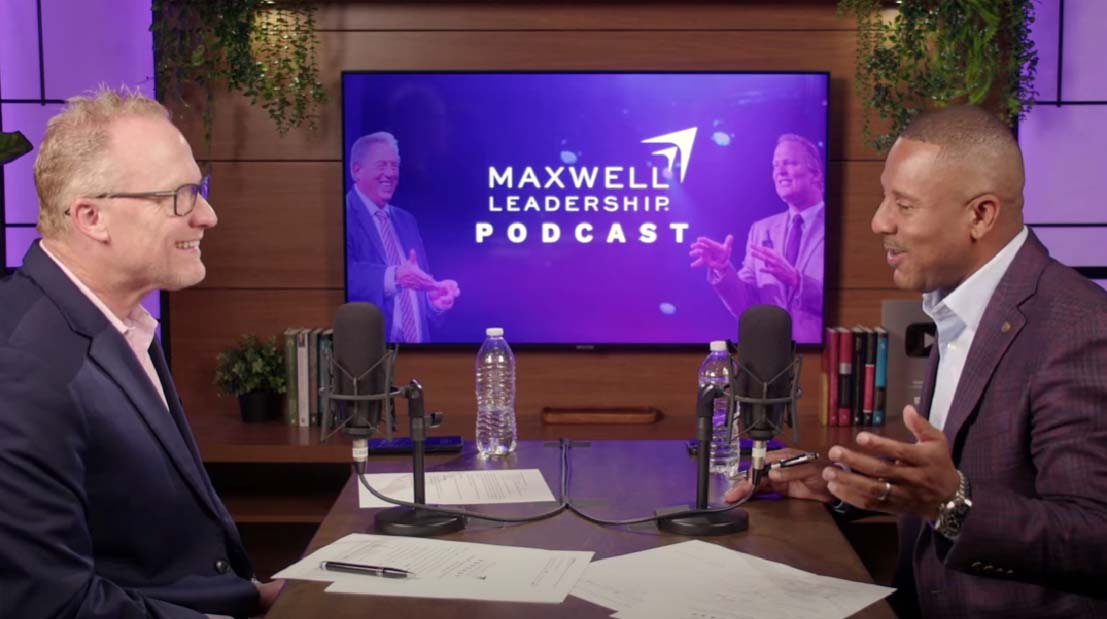
You’ve been there: Pressure is high. Priorities are competing. Everything feels urgent. How do you stay focused when you’re being pulled in a million different directions? In this week’s episode, John Maxwell reveals the mindset and habits that empower leaders to bring stability and hope to the seasons that matter most.
After his lesson, Mark Cole and Chris Goede provide practical strategies you can use right now to lead your team through challenging times with clarity and confidence.
Our BONUS resource for this episode is the How Great Leaders Stay Focused When Everything is Falling Apart Worksheet, which includes fill-in-the-blank notes from John’s teaching. You can download the worksheet by clicking “Download the Bonus Resource” below.
Mark Cole:
Hey, thank you for taking your time today and joining us on the Maxwell Leadership podcast. We are so glad to add value to you today because we want you to go multiply value to others. Today we’re going to talk about how great leaders stay focused when everything is falling apart. And Chris, you’re with me. But it was just two weeks ago we were talking about no two good days in can save your life. What’s going on here that we’re digging into these podcasts?
Chris Goede:
I don’t know, but I think you need to go have a conversation with John because the messages he’s having us unpack I think is leading our way out.
Mark Cole:
What are you saying to me? Leaders? I think, you know, we’re in the middle of the year and it has been quite the year globally. If you look at leadership, you look at companies uncertainty, I think it’s really relevant. And we do. We think we’ve got something for you today that I believe will. Will make a difference. Because as you know, the longer you lead, the more you’re going to lead through difficult times. You’re going to have some times that need your leadership. In fact, we say often around here that leadership is not really needed, felt, heard, or even noticed.
Mark Cole:
When times are good, it should be all about the team. But when times are difficult, leaders need to be prominent. And so that’s what we’re talking about today. You’re going to enjoy John’s lesson. When John is done, Chris Goede and I will come back and we’ll do some application. We’ll have some good conversation, and we will challenge you and challenge ourselves to lead better, live better, and experience teamwork better because of good leaders that know how to lead in difficult times. So if you would like to follow along with John’s lesson, you can go to MaxwellPodcast.com/StayFocused. You can also see some value add resources that we have there, as well as the link to our YouTube channel.
Mark Cole:
And you can see the podcast on YouTube as well. All right, here we go. John,
John Maxwell:
The time that leadership is most needed and demanded is very difficult times. Tough times demand good leadership. In fact, that’s the reason we lead. Why do we lead? We lead to help people finances. We lead to help people solve problems. What do we do? We know the way we go, the way we show the way we give hope. So when they need leadership the most is in the darkest times. In fact, when I’m doing Q and A in companies and they’re asking questions, 90% of all the questions asked me in that corporate type of setting is how.
John Maxwell:
Almost every question is a question about how do I lead a difficult person or how do I lift? I got this big challenge in front of me. How do I overcome. Overcome that. So it’s interesting. We’re needed the most during very difficult times, and yet so many times. It’s during those difficult times as leaders that we can. If we’re not careful, we lose our way because we begin to be distracted. So this is a lesson on difficult times, adversity.
John Maxwell:
It’s a lesson on how to keep focused and not let all the clamoring around us began to kind of cause us to lose our way. Because here’s what happens with challenging times. Challenging times take us out of automatic, and automatic is what we love most. People love automatic because you’re comfortable when you’re doing automatic because you’ve always done it, and so therefore, you really don’t have to think a lot. It’s just kind of like habit, and so it’s kind of nice to be on cruise control. So during challenging times, all of a sudden, what we have always done sometimes doesn’t work. And what we have always thought sometimes isn’t what we need to say to the people. So how do we keep our focus? How do we let the light shine? Not curse the darkness, but how do we let the light shine? How do we get rid of.
John Maxwell:
How do we get rid of the distractions behind us so that we can really, really focus? You got it? Okay, here we go. So let’s take the word traction for a moment. The traction. The word. We know what traction is. When somebody says they have traction, it means that they are gaining ground. That they are. The team has traction.
John Maxwell:
They’re pulling together. We’ve got a kind of a commonality of our push. And it’s a good word. Traction’s a good word. It’s just like, oh, my gosh, we’re moving uphill. It might be slow, but it doesn’t matter. We’re moving in the right direction. So traction is a good word, but the moment you put dis in front of it, it’s a bad word.
John Maxwell:
Because if traction means we’re pulling toward, we’re pulling together, we’re focused. Distraction means we’re pulling apart, we’re pulling away, we’re losing traction. Now, my father, who was such a great leader and such a great mentor, whenever he was gonna talk to us about something that was important, he would say two things. He would say, write it down, man. He was. I mean, he was a write it down, man. I mean, he just said, write it down. Don’t just say, I got it.
John Maxwell:
No, write it down. Write it down. And then he would say, after you write it down, put it someplace where you see it all the time. Put it before you. Put it before you. Write it down. And put it before you. Write it down so you don’t forget it.
John Maxwell:
Put it before you, so you keep focused on it. We’re talking about distractions now and how to keep being, as a leader from being distracted. We want to take our team to a whole new level. So write it down. You won’t forget it. Now put it before you. Now you’re going to be able to focus on it. In fact, it was so funny because my father would.
John Maxwell:
Many times after he’d get done teaching, especially my brother and I that are very close in age, after he’d say, write it down, he’d go to our old bathrooms and he’d stick it on the mirror for us. It’s kind of like, put it before you. In other words, this was so good. I think you wrote it down, but I’m not sure you got it before yet. So sometimes we walk in the mirror and here what we just talked about 20 minutes ago, he’s got right in front of us. You know, when you look in the mirror, I want you to see, because here’s what you gotta understand. What you focus on expands. That’s why you put it before you.
John Maxwell:
And what you don’t focus on contracts, it gets smaller, it shrinks. So when you put it before you, it gets bigger, it’s clearer. Expands. When you put it behind you, it shrinks. Put behind you what you can’t do and put before you what you can do. So the first thing, when I start to prioritize, I look at myself and say, now what can I do? I had a mentor, Fred Smith, who one time taught me. He said, john, a problem is something that you can fix, something you can do. But he said, a fact of life is something you can’t control.
John Maxwell:
And he said, know the difference between a problem and a fact of life. In other words, what’s he teaching me? He said, put behind you a fact of life. It’s just life. It’s going to happen, it’s going to rain. There’s certain things you don’t control, certain things. But put before you the things that you can fix. And so what you’ve got to do is in difficult times, the first thing you’re asking to yourself is what has a tendency to distract me. That’s probably out of my control because whatever that is, I gotta put that behind me.
John Maxwell:
But what do I put in front? And I can give you several examples. There may be one or two. Real quick. As you know, for 25 years I was a pastor and my last church was in San Diego. And we were growing very fast, and so we had to relocate. So we bought 80 acres out on the freeway in east san Diego. Great. 80 acres just right off the freeway.
John Maxwell:
Fabulous location. So the good news is we bought the land. The bad news is it wasn’t zoned. And if you live in California, if your land isn’t zoned, that could be a problem. Okay? And so we told our people it’s such good property, we’re going to buy it. It’s not zoned, but we think in two or three years we can get it zoned. We have good people, good attorneys around us. We think this is gonna happen, but we can’t promise it.
John Maxwell:
And so we bought it only to find out that it was a lot worse, higher hill to climb than we thought. It was going to take a lot longer than we thought. It was going to take a whole bunch more money than we thought. I think we went. I think we went in a period of 6 years to 100 hearings on this land. And will it be zoned and will it not be zoned? And the reason that we were having a hard time was that there was an endangered bird. It was a black tail gnatcatcher that didn’t live on that property, but as it would be flying, it would land on that property. Get the picture? And I thought, you know, when it’s just like a landing spot, this can’t be too complicated.
John Maxwell:
But it was very complicated. And I don’t want you to get into it all except to tell you that it wasn’t going to happen in two or three years. It was going to take nine years. And it wasn’t going to cost us probably a million or $2 million. It’s probably going to cost us $15 million to get it landed because we had a blacktail gnatcatcher. There’s nothing I can do about that. But what can I do? I can start raising money for the land because it’s going to have to be about $55 million. And I knew I couldn’t raise it immediately.
John Maxwell:
So I would stand up in front of the people and I would say, I would ask them to help us. And I said, now let me explain something to you. That land is not sown. There is a Possibility it’ll never be sown There’s a possibility we never can build on it But I need you just to help me and will you help me and can we give? And we started raising millions and millions of dollars. I was just very old and I had every time. You have to understand, we may not now. What can I do? I can raise money. Now, it’s harder to raise money for land in the stop zone than raise money.
John Maxwell:
You got the. So it’s not ideal. See, here’s the thing. What we do is we fail to do what we can do in tough times because it’s not ideal. And what you gotta understand is you don’t get ideal in tough times. There’s nothing ideal about tough times. There’s just something real about tough times. And you deal with the real, not the ideal.
John Maxwell:
And you say, okay, this isn’t what I wanted. This isn’t what I like. This isn’t what I planned for, but this is what it is. And during tough times, you put before you what you can accomplish and you put behind you what right now is out of control. If you’ll do what you can do, if you’ll just do what you can do, it keeps you going until you’ll be able to do what you couldn’t do. Don’t miss this. But you gotta do what you can do. Don’t worry about what isn’t gonna work, what isn’t happened, or, my gosh, I lost that opportunity.
John Maxwell:
No, no, no, no. If you do what you can do, it’ll keep you doing. It’ll keep you going until you can do what you couldn’t do.
Ela Bijlani:
My father passed, and I was in a really difficult time, really questioning what is life really about. One day, we’re all going to be gone. What makes you think that you live that life? Well, I was really looking for answers. I met a girl who told me about John Maxwell. The more I looked at the information that I found out, I realized, well, he’s really offering all the resources that I’m looking for right now, which was amazing. In three days, there was a conference. I was on a call with Kelly. I had this feeling that I just really needed to be there.
Ela Bijlani:
I got in the car and I drove. When I walked in and I saw the sign, welcome home, I thought, wow, that’s amazing. Kelly introduced me to Mark and she told him that, you know, I just found out about John Maxwell three days ago, and here I am. I didn’t really know what I was getting myself into, but it felt so good.
Mark Cole:
Come right up here, Ella. This is all unscripted. She’s one of our Maxwell leadership certified new team members, John. She said, I really want to do more with my life. I want to begin of kind coaching. I want to do something with my life. And John, her friend said, well, you’ve got to talk to John Maxwell team and be on the Maxwell leadership team. She said, who’s John Maxwell? I think this is drop dead funny.
Mark Cole:
She said, I have a saying that says when the student is ready, the teacher appears and I’m ready. Show me the way.
John Maxwell:
To Ela.
John Maxwell:
Where have you been?
Ela Bijlani:
I remembered John’s question, where have you been? So I decided to take action to achieve my dream. Now I know it was the best decision I’ve made in my life because I get to do what I love to do most, which is helping others to achieve their goals and dreams. Now I know that it’s never too late to be what you might have been.
Maxwell Leadership Certified Team:
Your story is waiting to be told.
Maxwell Leadership Certified Team:
Learn more at MaxwellLeadership.com/JoinTheTeam.
Mark Cole:
Hey, welcome back, everybody. Chris, this whole statement, John says it’s in, it’s in your show notes, by the way, but tough times demand good leadership. Isn’t that true?
Chris Goede:
Yeah. And I think as you were opening up, you’re talking like that’s when leadership needs to show up. And we’ve been through several challenging times over our journey. The one positive out of it, I think, is that really, really good habits of leadership and of the team show up through some bad times. The problem is when we get onto the other side and things start going well, we forget and maybe develop some bad habits. One of the habits, I think, is focus. Yeah, we have trouble with that in the organization. Right.
Chris Goede:
We admit that because John and yourself have never met an opportunity to add value to people that we don’t want to take advantage of. And so it’s like spinning a lot of plates. So I want to stay here for just a minute because when times are tough, when we’ve gone through some challenges, we’re in challenging times now. It’s always right around the corner. And by the way, if you’re not in one right now, get ready because it is coming. I want to talk because it’s not natural, I think, for leaders when you have all these different things that are spinning out of control and you want to keep all the plates spinning and then yet you really ought to get really, really laser focused on determining what is really important or matters the most for the organization or your team versus really what’s urgent. I’ve seen you do this over and over again. Talk to me a little bit about the system or maybe your mental process or coaching from John.
Chris Goede:
How have you been able, when we get into some challenges, have you been able to do that and stay focused on the things that really matter, not just the urgent things?
Mark Cole:
Well, and we’re going to get into this today in the podcast for sure, but I think you have to really get centered in who you are. You’ve got to really determine what kind of leader should you be. And if that is true, that’s the kind of leader you should be in difficult times. It should be more obvious. How many times have we as leaders seen people that we work with, leaders that we’ve worked with, that become altogether different in the difficult times? It’s like, I mean, they just turned on you and you don’t know which style of leader you’ve got. And so one of the things that I will do, in fact, I’m going back in my mind and thinking about COVID because that was a very difficult time for all of us to lead. And I can remember sitting down and saying, okay, the leader that I have been for 20 years is the leader that Covid needs for me to be right now. And really just having this reorientation to understand exactly who I am as a leader and then finding out how to do that even more effectively in the difficult times.
Mark Cole:
We said a little bit earlier, you mentioned it, difficult times reveal a leader. They don’t develop a leader, it reveals a leader. Now we get developed on the backside, right, and we recognize that. But when the difficult time shows up, it is not time to start developing yourself as a leader. It’s time to start showing up as the leader you’ve always been. And we often think, oh, difficult times requires different leadership. And I do agree we need to adapt and grow and learn and mature. But difficult time requires you to be the leader you’ve always been and do it in an incredible effective way.
Chris Goede:
I love what you said is you’re going to learn from it, but you’re going to learn from it after you go through it.
Mark Cole:
That’s right.
Chris Goede:
By the way, we also encourage you to reflect on any experience and that’s where you’re going to learn it. But I love it because that allows you to not only know who you are and be confident in that, but to make decisions in times like that because of the trust that you have in your leadership. So I love the focus on self of who you are. What are other things that you have. When you look at all of your responsibility through many different things, where does your focus go next? Is it the organization? Is it the people? Is it the clients? Like, where, when you, when you get into that mode, like, where does your mind go next?
Mark Cole:
Yeah. So I think if I, if I put it in steps, Chris, I think it’s one, be certain who I am to be aware of where your team is.
Chris Goede:
That’s really good.
Mark Cole:
And three, define what needs to be true about your leadership during this time. So during COVID let me tell you what everybody needed. They needed a lot more phone calls, a lot more zoom calls, a lot more visualization to hear your voice. They needed to hear the voice. And so in a difficult time, people, most of the time, in fact, I’ll tell you five things that are four things I think that everyone needs from their leader during difficult times. One, they need confidence. It’s going to be okay. Two, they need steadiness.
Mark Cole:
I’m here. I’m all good. Three, they need hope. They need to believe that there are better times coming. And then four, they need presence. And so what? That’s just common. But in every challenge, there’s a little nuance to what people need. So one, know yourself, know where your team is.
Mark Cole:
How are they processing this difficulty? And then three, get a game plan on what’s going to be said about your leadership after difficult times. And most of the time, if people can go, wow, he was steady. Wow, he gave me hope. You know what? It felt like that, that his presence was more here during this time than any other time. And then if there is this confidence that, hey, I’ve got this leadership, I don’t know. I was telling you something the other day about leadership and about, you know, asking questions and trying to not go in with the answers. There’s a difference in pursuing answer and not being confident.
Chris Goede:
Yeah.
Mark Cole:
You’ve got to have confidence even as you’re pursuing what the answer or the solution is.
Chris Goede:
So you actually were. Several times I’ve heard you say around that point, clarity versus uncertainty, or you are extremely certain, maybe not clear on the direction. And that certainty helps the team. What I love about everything that you just listed out, the confidence, the steadiness, the hope, the presence, all of that is not necessarily even solving the challenging problems. Right. It’s how you’re showing up as a leader now through that. You may say some things that that will attach to what’s falling apart, but it doesn’t necessarily solve the problem. But those four things, while focused on the problem, Allows the team together to solve the problem.
Mark Cole:
And that whole concept of clarity versus certainty. We’ve got to be clear on the next step, not certain on the final step. And most. Yep, we got to be clear on the next step.
Chris Goede:
That’s right.
Mark Cole:
But not certain on the final step. And most leaders in difficult times, they want to be certain. This is how it’s going to look
Chris Goede:
when we get all the way out.
Mark Cole:
You don’t know how it’s going to look all the way through. Remember Covid, again, we didn’t know how long that was going to last. There was no certainty there. Here was what was clear. We’re going to show up for our team today. Here’s what’s clear. We’re going to still be here. Here’s what’s clear.
Mark Cole:
You still have a paycheck coming in. Here’s what’s clear. We are right now working on a plan of what to do because we’re not going to have this event. And if people, if leaders during difficult time would spend as much time on the next step as they try to find on the final step, the team would get through the difficult times a lot better.
Chris Goede:
Well, and I think when you do that, I think the team then rallies around the leader and your leadership becomes somewhat collaborative, collective, as you’re ultimately the leader making decisions, but you bring everybody with you versus if you’re so decisive on what the final step is. There are people in the team that are going to he or she. That. That’s exactly. That’s not, that’s not going to happen. Like, come on. There’s no reality here. But I love that movement and I love the next step that you were talking about.
Chris Goede:
And when that happens, I think the team comes together in, in hard times. And often, I don’t know about you that are listening or watching. If you’ve been through some tough times and challenging times with teams, when you come out on the other side, man, you’re closer than when you went into it. And so by leading through there like that, I think is super important. Yeah. The other thing you do really well besides stay focused. And then obviously those four points and you’re communicating in your presence is that you emotionally show up.
Mark Cole:
Yep.
Chris Goede:
You’re a high energy leader. You always have been. The joke is always, here comes the red hair. Right. He’s coming in with a lot of passion. How do you, how do you make sure that you’re very aware of. Of how you’re emotionally showing up? The reason I’m asking this is I think it’s super important because a lot of leaders just want to come in with energy and think that that’s confidence in a situation that may not need that energy. You have lots of energy, but you don’t always show up with over energy.
Chris Goede:
But you come, you do show up with the passion, the certainty. How do you, how do you regulate that and make sure that emotionally you’re showing up in the right tone, I guess, for the team?
Mark Cole:
You know, I think we mentioned this a little bit earlier at the beginning. I think you’ve really got to know who you are, what kind of leader you are. And I was hoping we would get back to this. I was given a gift at 33 of clarity on where I was most effective and when I was most effective and where and when I’m most effective is when I’m motivating and inspiring people to reach their full potential. That is my life mission.
Ela Bijlani:
That’s.
Mark Cole:
That’s my purpose statement. People say, hey, Mark, what, what was the second day, second most important day? As Mark Twain says, it was the day that I discovered why I was born. And it is I was born to motivate and inspire people to reach. Reach their full potential. I can remember a time in my leadership, a pretty particular time to where we were having cash flow issues. And I can remember for almost one year I would come into meetings and I would challenge them. Where is it? Why is it? What are we not doing? And something clicked on me about three quarters of the way through that year. And I went, I am not coming in and beating people up on cash flow anymore.
Mark Cole:
I’m coming in and staying true to myself. I’m going to motivate you. I’m going to inspire you. We’re going to reach our potential here. And Chris, you were there.
Chris Goede:
Yep.
Mark Cole:
I remember when I changed my approach to be more consistent with my leadership. Guess what happened? Cash flow started impacting it. We did a hockey stick it. I don’t believe necessarily that I get the 100% credit because I remember some of the things that unlock that. But I can tell you this. I had a lot more peace. I was much more effective with my leadership. And people quit dreading coming to leadership meetings anymore because I stayed true to who I really am, which is motivating and inspiring people to reach their potential.
Chris Goede:
Yeah. And let’s go a little bit deeper here because it’s not just artificial in the hype. It was how you changed in showing up that then led to conversations that you were part of that that led, that then led to solutions that you were also a part of. But it was the way you showed up, allowed the team to open up in order to then begin to solve some problems that we weren’t solving before because you weren’t leading from truly who you were. And that was a game changer in how you do that. So the reason I bring that out, leaders, is just to make sure, as Mark is talking about, if you, if that’s your style, that’s your style. Make sure you do it authentically. And it’s not just hype and galvanizing the team gets you out of challenging times.
Chris Goede:
What it did was we knew as a leadership team, sitting on the other side of that is that we absolutely, we knew that it wasn’t, it wasn’t normal for Mark to be leading like that. And so we then probably shut. Not probably, we did. And then he, I remember the meeting, he came and said, no longer.
Mark Cole:
I’m not doing it anymore.
Chris Goede:
You’re not doing it anymore.
Mark Cole:
Let me say this because I am a hype guy. I’m a rah rah, fired up, get people excited. That’s a personality factor of mine. However, motivating, inspiring people. I have been more effective at motivating, inspiring people without the emotional hype than with emotional hype. And here’s why it gets caught up. We’re all emotional and passionate about something, every one of us. But when we can take emotion out of our purpose and show substantive results or substantive focus on our purpose without the hype, it’s a lot more effective.
Mark Cole:
And so I just want to caution a lot of you out there that are like me, you’re natural hype men and women, you’re naturally excited. That’s all good. We love that. That’s you too. But get over some of that emotion and get really intentional in your purpose in a non emotional way and you will see a greater impact and a greater return on your impact by doing that.
Chris Goede:
Yeah, during challenging times, you have to have something you go back to that grounds you, that fills your tank to come back and, and lead. What is that for you through all the challenging times? Is there a common denominator that you go back to that ground? You.
Mark Cole:
Well, I, I’ve said this on the podcast before. You’ve heard me say it, you’ve quoted it. Stephanie gave me a great favor in 2007 when she came into my office and she said, mark, I want you just to understand something. We’d been married, I don’t know how many, how long at that time, five years or something like that she said, I want you to know something. You were made for heart. And that clicked for me, Chris, in a way that I just went like, you know what? When it’s tough times, this is what I was made for. I’m needed. That’s a place where I feel like I matter is in the hard times.
Mark Cole:
And so truly understanding the significance of how I’ve been equipped is for moments like that, reminding me that I have a purpose, that I have a place, that I have a responsibility. All of that against very much internal work. What I do to ground me in difficult times, however, is I verbally process. I just right before this podcast right here, I went, hey, you meet me this afternoon. Of course, he stood me up and said, no, but he is gonna meet me tomorrow morning.
Chris Goede:
That’s right. That’s right.
Mark Cole:
And that’s as much. I just was sitting here teaching, sharing this podcast, realizing, you know what I need to verbally process a little bit right here.
Chris Goede:
Yeah.
Mark Cole:
Because in difficult times, I’m a verbal processor, and I’m watching for feedback and trusted in places. And a lot of times, leaders that are verbal processors are leaders that need community or companionship because of the difficult time, they can’t show the struggle. And so they lose their secret sauce. My secret sauce is verbal processing. And I was sitting here just the last 24 hours going, no, probably not. I need to get a little bit more clarity. I need to do more listening. No, it’s time for me to do a little verbal processing.
Mark Cole:
And I just realized my secret sauce of verbal processing, which is where I listen to myself talk in a safe environment, is something I need right now. And I just went, that is a big piece for me. What is your piece?
Chris Goede:
That’s right.
Mark Cole:
And how you work through things. For me, I work through it by talking it out in a safe environment.
Chris Goede:
And I think Mark is telling you, don’t go through this alone. Right. Like, you are going to go through challenging times, no matter what size, team, organization, whatever situation you’re in. The other thing, I’m going to stay here for just a minute because the other thing that came to my mind is that, yes, you want a verbal process with a trusted partner that has probably some context. But, you know, a prior challenging times we’ve been through. But also what I’ve seen you do that grounds you, is to seek. So we talk about the inner circle and the outer circle. You know, John’s got this inner circle, which is what you’re talking about verbally processing.
Chris Goede:
Hey, am I seeing this right? This is aligned with organizational values. But what I’ve seen you do lately, and more so, is then to also get outside circle input that keeps you grounded and maybe even gives you some ideas, maybe calms you down a little bit. It’s not that big of a deal, Mark, or, hey, no, you gotta go. And I’ve seen this in this different industry, and maybe these principles apply. And I’ve seen that ground you throughout the years as well.
Mark Cole:
Yeah. Would you agree with that 100%? Yes, I would agree. And I just did that a couple of weeks ago again, working through a couple of leadership questions that I’m having. And I went to somebody completely outside of the industry and I said, if you’ll trust me, I don’t want to try to explain my industry to you. Because often when we go to people that are out outside of our industry or our expertise, we feel like we’ve got to explain all the nuances and then we cloud the whole ability to get outside perspective. And I went, if you’ll do me a favor, I’m not going to explain my industry at all to you. I’m going to tell you my challenge. And I want you to look at this from a leadership perspective and a financial challenge.
Mark Cole:
Don’t try to understand my business. Try to understand the leadership difficulty or the financial difficulty. And, man, now this was a big, big thinker. But the results I got from that was incredible. Most of it was I wasn’t as crazy as I felt like I was.
Chris Goede:
Yeah.
Ela Bijlani:
Yeah.
Chris Goede:
That is awesome. That’s a great idea. Because we do oftentimes clout. What’s going on?
John Maxwell:
Yeah.
Chris Goede:
Okay. Want to do something a little bit different?
Mark Cole:
Okay.
Chris Goede:
On today’s podcast.
John Maxwell:
Okay.
Chris Goede:
I have four rapid fire questions.
Mark Cole:
Okay.
Chris Goede:
I’m putting you on the hot seat. All of it is around staying focused as a leader. Right. In challenging times. And so I just want you to respond to what. What comes to the top of your mind, which is what you normally do in these podcasts anyway. So this may not really be rap fire, because Mark often doesn’t know necessarily what’s coming. All right, number one, what’s.
Chris Goede:
What’s the first thing a leader should do when everything starts to unravel?
Mark Cole:
What’s the first thing I think they need to get a companion, a partner, a mature leader that’ll keep them stable. We get too emotional, and you need community around you to feel that support, because loneliness is a reality of leadership. But you don’t have to be lonely.
Chris Goede:
Love it.
Mark Cole:
And so get a companion.
Chris Goede:
It is a reality. I’m just going to stop for a minute. John did some lessons recently. We were in the room for.
Mark Cole:
Oh, yeah.
Chris Goede:
And I was like, oh, I felt that. Maybe not the depth that he’s felt it, but I felt that. So that’s real. Second one, what’s one habit a leader must eliminate immediately in chaos? It’s one habit.
Mark Cole:
Being emotionally vested.
Chris Goede:
Yeah.
Mark Cole:
Get the emotion out of it because you will get angry during difficult time, you’ll be condescending. During difficult time, you’ll be blaming others. Get to an emotional neutral place. You and I have read a book, Sacred Pace. It’s a spiritual book, but it’s a great place. Talking about how a leader gets neutral as quick as possible in difficult times. Get neutral. Get neutral.
Chris Goede:
Just like everything else compounds, your leadership consistency in times like that is going to compound. Okay, third question. Biggest mistake leaders make under pressure. Oh, maybe just a mistake. Right. Because there’s all kinds of them. Biggest mistake you’ve seen leaders make while
Mark Cole:
under pressure, they lose their sense of identity of who they are back who
Chris Goede:
they are back to their point.
Mark Cole:
So. So what happens with a lot of leaders when they get squeezed? They do something morally, ethically that they would never do under that pressure, and so they lose their identity and that. We talked a lot about this in today’s podcast. But get clear on who you are and get serious about. Stay there protecting it, defending it. Go get nourishment centers to keep it. You need to know who you are.
Chris Goede:
Love it. Final one. What’s one question every leader should be asking themselves in a crisis? What’s one question? What’s the question you ask yourself when you hit challenging?
Mark Cole:
What’s my responsibility to the crisis and how will I make sure that I don’t get surprised by the next crisis?
Chris Goede:
That’s so good.
Mark Cole:
So if you can have a posture of learning and go, what did I do that would have made our challenge in the crisis? Because again, you’re not trying to think about controlling the crisis most of the time. We can’t. You are asking the readiness question. Was I ready for this crisis? Was I prepared? And what will I do to debrief so that I am prepared the next
Chris Goede:
time I’m going to throw this back to you. Wrap up. What I love about that is that is in direct alignment with a principle that you, you teach all the time that you believe in, which is that we need to take responsibility and we need to be teachable or coachable leaders. If you have those two, if you have those two attributes about leading, period, but especially during Challenging times. You’re going to be all right.
Mark Cole:
There’s a quote by Winston Churchill that our team gave me. That’s just an incredible way to wrap today. The pessimist sees difficulty in every opportunity. The optimist sees the opportunity in every difficulty. There’s just so much right there just to teach Chris that. It’s incredible. Hey, what I love to do is one, give you resources, give you value. And there’s an episode that we did not too long ago called how to Increase your Focus.
Mark Cole:
We’re gonna put that in the show notes. And then we have a question from Leslie today. Leslie’s one of our podcast family. Leslie says there have been quite a few changes within the organization I work for, and I’m navigating how to lead my team. Those changes. Where should I start? By re listening to this podcast, Leslie. That’s the first thing I’m going to say because that’s really what we’ve been talking about, Chris, is that kind of that whole. Define the next step.
Mark Cole:
Go to your team. Know yourself, Leslie. Know your team. Find out how they’re responding to the difficulty, and then ultimately give them the next step. Don’t give them steps 2, 3, 4. Give them. The next step in that presence will be really what they hear.
Chris Goede:
Yeah. I would only add to that because I think that’s exactly the right answer is to. When you find your team is to learn what the capacity of change that person can handle, like the pace of it. Because you’re going to have to lead everybody through that the way they need to be led. Welcome to leadership, by the way.
Mark Cole:
That’s right.
Chris Goede:
You cannot lead change. You can’t lead, period. With a collective group. You’re going to have to lead them through that individually. Some are going to move faster, some are going to move slower. That’s your responsibility.
Mark Cole:
Yeah. You know, John wrote a book. It’s a timeless book. Still. Thousands and thousands of copies leap off of shelves every single month. It’s called the 21 Laws of Leadership. And we have a digital product for those of you that are just kind of really needing to get refounded in your leadership. And difficult times makes us sometimes do that.
Mark Cole:
Go check that out. We’ll put that. We’ll give you a great discount on that digital product. And we’ll put that. The show notes as well. Go make a difference. Grow yourself. Lead better.
Mark Cole:
Because everyone deserves to be led well.