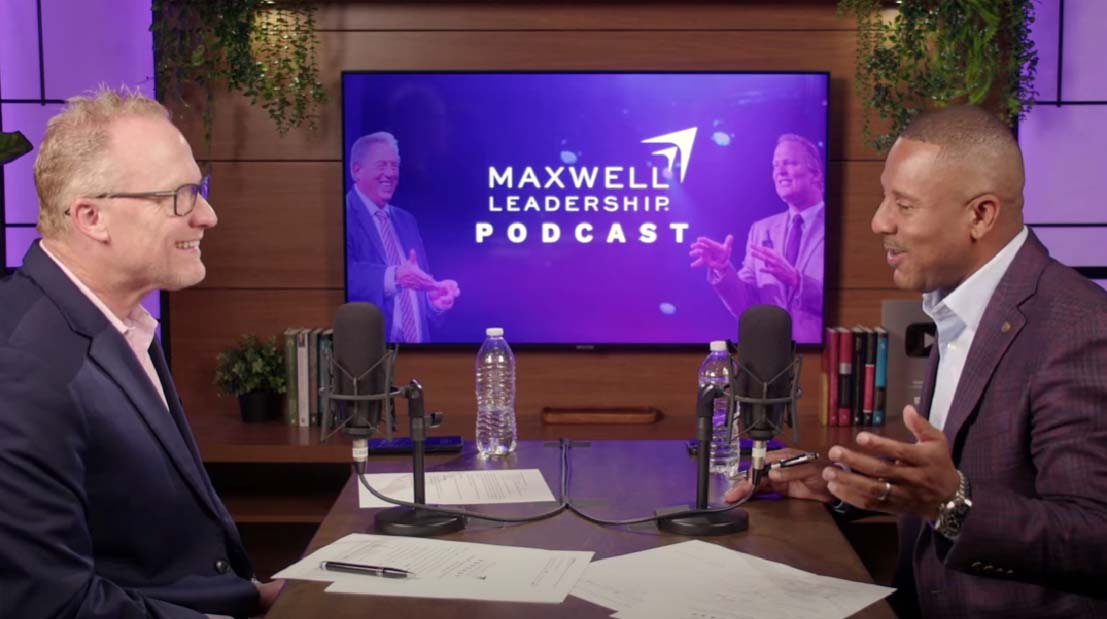
Are you letting your success create distance between you and your team? In this episode, John Maxwell unpacks why leadership success can easily lead to isolation—and what you can do to resist it. Discover how making friends (not just fans) helps you stay relatable, authentic, and influential.
After his lesson, Mark Cole and Chris Goede dive into real-life strategies to help you put connection at the heart of your leadership journey.
Our BONUS resource for this episode is the Good Leaders Make Friends, Not Fans Worksheet, which includes fill-in-the-blank notes from John’s teaching. You can download the worksheet by clicking “Download the Bonus Resource” below.
Mark Cole:
Isolation is bad. Connection with people is good. That’s kind of the polar opposite, the paradox, if you will, that we’re trying to create here. Leadership causes both. You got to resist isolation and you got to fight for connectivity. Thank you for joining us today on the Maxwell Leadership Podcast. We are so excited about talking about friends and fans. Chris, I’ll tell you this right here.
Mark Cole:
You’ve been a fan, you’ve been a friend, you’ve played ball at college, collegiate level, at the pro level. And you have a lot that you could say about friends and fans, but it’s good. It’s good when you have the opportunity to know somebody that you’re a fan of and then realize there is a human element of them.
Chris Goede:
Yeah. Yeah. It just, it helps with the credibility, right? I know people ask me all the time, What’s Sean like? I’m like, exactly like he is on stage and whatnot. And so, yeah, when you’re a fan and a friend, that’s a bonus. Doesn’t happen often.
Mark Cole:
It doesn’t.
Chris Goede:
But I agree with you.
Mark Cole:
I grew up, and again, you probably have a story like this as well. I grew up a huge fan of the Miami Dolphins. In fact, I’m still a fan of the Miami Dolphins. And the fact I’m saying that publicly lets you know I’m a fan because we’ve been terrible forever. And I’m a season ticket at the Falcons, by the way. All my friends at the Falcons, I love you, I love you, I love you. But I’ve always been a fan of Miami Dolphins. Huge fan of Bob Griese, Nat Moore, all these guys, Larry Zonka.
Mark Cole:
And one of my greatest chances in life was when I turned being a fan to Bob Griese into being a friend of Bob Griese. And I was given the opportunity to play 18 rounds of— or 18 holes of golf with Bob Griese. And I can tell you, by about the 3rd hole, I went, boy, I’m so glad I spent so many years being a fan, buying his jersey, supporting him.
Chris Goede:
Awesome.
Mark Cole:
Because being a friend to him Was much better than being a fan to him.
Chris Goede:
Yeah, that’s awesome.
Mark Cole:
I wanted to give you that thought today because as we send you over to John and let him talk a little bit about what he’s done extremely well to stay, hey, I’m John Maxwell and I’m your friend. And that is not just a cute thing to say. That’s something that the leader that is getting ready to communicate to you has done way before he became the world’s most noted leadership expert. John Maxwell made a decision. I don’t want to be an expert. I don’t want people to be fans of mine. I want to be a friend to people. And so I hope this will help you today.
Mark Cole:
It certainly has helped me. Chris, we’re going to get a chance to break it down and give you application. If you would like to follow along in today’s podcast with a bonus resource, you can find that at MaxwellPodcast.com/Friends. If you want to see Chris Goede in a jacket, I mean, he wore a jacket today.
Chris Goede:
Yes. And we’re in our new studio, which has been awesome.
Mark Cole:
I’m impressed in our new studio. If you’ve not checked us out on YouTube with our new studio that Jake and the team have put together, it’s a different look and feel. I kind of have the same look except a few more gray hair. But hey, you got it. You got a new studio and you got a guy with a jacket on today. I’m just going to tell you there’s something there at YouTube. You can find the link to YouTube at MaxwellPodcast.com/Friends, as well as some other things we’ll reference throughout the show today. So grab a pen, grab a paper, because John’s going to help you know how to stay a great Be a great leader, but stay connected and be a friend more than a fan.
Mark Cole:
Here is John.
John Maxwell:
Success isolates us. There’s a tendency when we’re successful to begin to be isolated from people. Success separates. There’s a separator with success. I don’t like it either, but there is. And the stabilizer for isolation and withdrawal is to have solid relationships in your life. I can remember when I started out speaking at conferences, during a break, I would go offstage and stand on the main floor, and people would come around and we’d just talk for the 20 minutes, whatever the break was. We’d just talk, and I just loved it.
John Maxwell:
We’d just talk, and then I’d get back up and I’d teach, and we’d get back down and we’d talk, and just basically teach, talk, teach, talk. I can remember the day when I went down to the floor to talk and somebody had a book. They said, would you sign the book? Well, sure, be glad to sign a book. And all of a sudden my talking time got replaced by signing books and I started to be separated. And then they wanted pictures.
John Maxwell:
And every day I ask myself, how do I close the gap? Because I want friends, not fans. I don’t want fans. You see, if I’m gonna have fans, I have to make the gap big. I have to be way up here and you gotta be way down there. And then you gotta say, oh my gosh, he’s amazing. I can hardly wait to hear him talk today. And oh my gosh, this is amazing. Maybe I can get a picture.
John Maxwell:
All this stuff.
John Maxwell:
Okay, okay.
John Maxwell:
If I want fans, I want that separation because I want you to never think you can get where I am. But if I want friends, I wanna close that separation. I want you to think that you can do the same thing because you can. And so walking slowly, walking slowly through the crowds, that’s why I use depreciating humor all the time. That’s why I make fun of myself all the time. I’m trying to close Close the gap. If I say the word adulation, do you know what that means? Adulation, you know, when people kind of just adore you or they put you up on a pedestal. Maybe the word should be pedestal.
John Maxwell:
I think it should be pedestal maybe. But when you’re successful, people put you on a pedestal. Are you with me?
John Maxwell:
I mean, they think you’re better than you are and they put you up on this pedestal. And it’s not a good place to live. First of all, if you’re clumsy like me and you’re on a pedestal, you’ll fall off and break a leg. I mean, pedestals aren’t good. I don’t like titles. I don’t like any titles ever. Never. I mean, I have an earned doctorate, but I don’t want it back home.
John Maxwell:
I mean, Dr. Maxwell, really? Really? I just paid a lot of money and served some time and got educated and got a doctorate. Really? I mean, I didn’t come out of Mama’s womb and she said, oh, Dr. Maxwell, it’s good to have you here today. She just called me John, just John. It’s a good name, simple name, just works. My name’s John. So I’m not into titles.
John Maxwell:
I’m not into any pedestals. I’m not into any— when I’m with you, I wanna walk with you. I get really frustrated when they— I go to these conventions. I’ve been in every kitchen In every convention center in America. Because I get there and they won’t let me go out with the people. They make me go through a kitchen so nobody will see me so that I can make a grand entrance on stage. And it just frustrates the heck out of me. I say, I don’t wanna go through the kitchen.
John Maxwell:
I wanna be out with the people. So I frustrate them. I figured it out since I go the kitchen tour all the time.
John Maxwell:
‘Cause they’re wanting to keep me away from the people and they’re wanting to make sure I’m okay and they wanna get me to the green room and isolate me and all that other stuff. And so I’ve just found, so I take my time going through the kitchen. And it just frustrates them to death. And I stop and I thank the kitchen people. I say, I wanna thank you for serving us and I wanna, can I get a picture with you? I got more pictures of kitchen people. I have intentionally, since 1995, I’ve intentionally served 10 people. Now that 10 people changes, but every year I make sure there are 10 different people that I serve. Just make sure I serve them.
John Maxwell:
It’s really good if you’re being served to serve people. It just stabilizes you, makes you solid. It helps me to understand that everything shouldn’t come my way. I’ve got an awful lot of people that take care of me. I’ve got an awful lot of people that help me. I’ve got an awful lot of people that serve me, but there’s something really important about serving people. And it shows you that you value people. You see, when you’re on a pedestal, everybody’s valuing me.
John Maxwell:
But when I’m off of that pedestal, you just— Jesus took it so personally. What did he say in Matthew 25? He said, I was in prison and you visited me. I was naked and you clothed me. I was hungry and you fed me. And all the people were looking at him saying, now, excuse me.
John Maxwell:
What?
John Maxwell:
When did we visit you? When did we feed you? When did we clothe you? And what did he say? He said, the moment that you did this to the least of all these people, you did it unto me. Jesus takes valuing people so personal that when you value others and serve them, he says you did it to me. That’s huge.
Mark Cole:
Hey, I love, what John said, and it’s a quote that I’ve heard him say many, many times, relationships are the foundation of leadership. And you heard John in this session today really talk about what he has done and what we all should do to stay connected with the relationships, with our family, with our friends, with our community. And so, Chris, I’m really excited about breaking this down.
Chris Goede:
Yeah. And what I love about this is we’re going to talk about How do you close this gap? Because we all are in situations where, as you’re growing, even maybe it’s within your personal journey, your family, at the local community, at the church, or your organization, there is a trajectory that begins to separate at times, and there’s this gap that will happen as you grow your leadership, and we’re gonna talk a little bit about how do you close that, practically how we’ve done that. And I thought, what better example than for us to unpack Mark Cole’s journey? And you guys have all heard his personal testimony and story and how he’s come up through the ranks. And with that has been— he has stated this— more success than you probably thought you would ever have. I had a guy tell me one time, he said, hey, just remember, your title walks into any meeting or any room before you do. Well, and then he said, it’s your responsibility that when you walk out of the room, do they remember your title or do they remember something that maybe they learned or they were lifted up? So leaders, listen, no matter what your title is, it’s walking in the room and people just posture a little differently.
Mark Cole:
Yep.
Chris Goede:
And they will isolate, just not because of anything you did, but they will do that. And so it’s going to happen. We’re going to talk about how to close that gap and how Mark does that on a very practical basis. So let’s start Let’s start here. What have you learned about this journey of becoming successful? All of us are successful in different terms, right? But becoming successful, the relationship between that and then how it has driven some isolation in your life.
Mark Cole:
Boy, it’s so good, Chris. And this is some behind the scenes. Chris and I come in, we listen to John just like you do, and then we go deep within and say, how have we applied that? What are we doing? That’s how we prepare for you week in and week out. And again, I said this, I said this a podcast a few weeks ago, you got 50-plus years combined right here from guys that have learned from John, led for John, learned to watch John. And so when I was first listening to this lesson, when we were talking about it just a few minutes right before we go live, I went, man, John’s level of success is hard to kind of connect with. And I was trying to go with how John does this so well.
Chris Goede:
He does it.
Mark Cole:
But how do I apply that? to those of us that are not at that level of success. And you went, well, no, no, no, let’s talk about yours.
Chris Goede:
Yeah.
Mark Cole:
And so the reason I say that is because I believe 100%, I’m getting ready to tell you how to stay relevant and not get isolated as it relates to your success, which is what we’re talking about the last couple of weeks. We’re talking about success stabilizers, but I’m going to also talk about isolation from another direction too, Chris, and go just a little bit of a tweak. But we’re talking about right now in this aspect, we’re talking about isolation as it relates to your success. And Chris Goede tells us this incredible story of a friend that says, hey, if you’ve got a title, your title went before you. There’s already a separation.
Chris Goede:
Know it’s there.
Mark Cole:
And my response to this podcast that I was listening to is exactly John’s response to success. I don’t see myself as successful. I see myself as striving, as trying to get there. I do not find myself as even relevant to this isolation of success gap. I think the best way to not see yourself as isolated from success is to not see your success as success. It’s a gift. It’s because of others. It’s a privilege.
Mark Cole:
I’m a person of faith. It’s because God has exorbitantly looked over my faults and given me great accomplishment. It’s not what I’m doing. And so I listened to this podcast and it never even occurred to me.
Chris Goede:
Interesting.
Mark Cole:
I need to talk about that. I don’t see myself as successful. By the way, my wife don’t either. So we share that at home and that’s a good thing. But seriously, I think the first thing we do, I love it. I am going to talk about John just a moment in this idea. It never fails that somebody of great notoriety tells John, I read your book and I have died to meet you. That John doesn’t get in the plane or doesn’t get in the car or doesn’t do something and go, Can you believe that we were able to impact somebody like that? He never takes it for granted that he had the ability to influence somebody of influence.
Mark Cole:
I feel the same way. I think every leader, every one of us that have been gifted with a title that has a tendency to separate, are given the privilege of a platform, like even this podcast, that has the ability to separate you, the best thing you can do is not read the press clippings and not believe that you have a success gap.
Chris Goede:
That’s right.
Mark Cole:
Be humbled by the fact that people even think there is a success gap. And so when you said that, I went, well, okay, I can do that, because certainly I’m a lot more successful today than I was 26 years ago. That’s not a rocket science statement right there. I had nothing to give. But today I do have a little bit to give, a whole lot that we’ve been able to accomplish because of the wonderful team around us. But I never want to even feel like I should be on a pillar or have some level of success. And never, never, Chris, it does not occur to me that I got that.
Chris Goede:
And I agree. And I think you’re spot on with John too. Let me change it just a little bit.
Mark Cole:
Okay.
Chris Goede:
Because maybe the word successful may be a little bit of a barrier for both of us. Neither one of us feel that way. John doesn’t either. But maybe it is the higher you go in leadership. Let’s look at it this way, because if we’re being honest with those that are watching us on YouTube, listening to us wherever you listen to your podcast, I know, I know, I know, I know, because I’ve known you long enough that it breaks your heart because you love to lead teams. Love to lead teams. And I tell Mark this all the time. The best Mark Cole is in some one-on-one development meetings, and the second is watching him galvanize and lead a team.
Chris Goede:
And so we’re going to change out the word success for increasing your leadership responsibility.
Mark Cole:
Yeah.
Chris Goede:
What happens is you then begin to get isolated from your team, from your friends, whatnot. And people are like, man, they’re a fan of Mark, right? But they’ve moved from being maybe a friend to a fan. So I think that has happened organically. So let’s use those words as we unpack this a little bit. So when that happens, because you’ve been there, what are some of the warning signs that you experienced as a leader, as you grew in your leadership, that you sensed or intuitively sensed or felt that you were becoming isolated?
Mark Cole:
Well, I think I love that. Thanks for even the reframing for me. I think that the first thing, the underlying lesson behind the lesson is the need for relationships. and what success does to cause you to disconnect from relationship. And we use that word isolation to drive that. I believe there’s 2 major reasons a leader isolates. And I believe it’s, one is they don’t feel understood. Nobody understands the load I’m carrying right now.
Mark Cole:
Right now, I’ve got some isolation that is being—
Chris Goede:
Yeah.
Mark Cole:
And what that does is it creates a gap It can even be a success gap, but nobody understands because nobody’s had to carry the load I’m carrying right now. And it’s all this stuff that we use to justify the isolation that we have.
Chris Goede:
Yeah.
Mark Cole:
And I think that’s really the lesson behind the lesson. Isolation is bad. Connection with people is good. That’s kind of the polar opposite, the paradox, if you will, that we’re trying to create here. Leadership causes both. You got to resist isolation and you got to fight for connectivity. Because the second reason that I think people isolate is because they don’t feel like they have anything to add. I can remember no success when I started this company 26 years ago, and I wouldn’t even enter the conversation.
Mark Cole:
I isolated because I did not feel like I had anything to offer.
Chris Goede:
Yeah.
Mark Cole:
Well, I have went through some leadership challenges in my 26 years of leadership journey here, as well as another 10, 15 before I came here, to where I would justify isolation because I didn’t feel like I had anything to offer and/or because everything that I was carrying felt irrelevant to the people around me. I was in a meeting with you recently, and I sit through about a quarter of the meeting, and I hope nobody knew because I wasn’t running the meeting, but I spent for the third and went, Boy, nobody knows the vantage point I’m having to bring to this leadership. So I use that statement, may have been true, may have not have been true, but it was an isolation statement that I was telling myself. And I remember the moment because the meeting feels still fresh to me right now. I remember the moment when I went, dude, are you going to go to where the people are? Are you just going to lament that you’re only where you are?
Chris Goede:
Yeah.
Mark Cole:
A leader has to go where the people are. If you are isolated, It’s because you have allowed yourself. If you’re standing on a pillar today, if you are not being brought into meetings, I’m just going to tell you the leadership perspective is insert yourself, find a way to find the people, and don’t allow the disconnect to happen.
Chris Goede:
Let me come back. So I think all of that is real. Are there a couple of things that when you look at, let’s just take your leadership team. You go, I feel like I’m isolated more than I need to be. So from your perspective, what are some of those maybe warning signs that a leader should be aware of that there’s some isolation happening?
Mark Cole:
Yeah, I think the first is when you feel like you are the author of your success and you can’t quickly go to other people that have you stand on their shoulders with your success, you’re isolated. Your actions may not show it yet, but your thinking’s already there.
Chris Goede:
That’s right.
Mark Cole:
You are isolated as a successful leader if you don’t first understand your success is because of others. Secondly, because you are grateful for the opportunity. And thirdly, because your success is the end game, you don’t have a brighter future ahead of you. The second thing, Chris, that I would say about these people that allow success to create this gap is they’ve lost their gratitude for the opportunity. I cannot believe John Maxwell lets you and I be on his team.
Chris Goede:
Me either.
Mark Cole:
I can’t believe I’m sitting in this podcast using his name to give my leadership thoughts to somebody else, and I cannot get over the gratitude of that. So the first is a humility. The second is a feeling of gratitude. The third is a sense of opportunity. Today’s success is only so that we can do something with it tomorrow. It’s not an end unto itself. Success is never an end unto itself. It’s the old passage that we all heard about.
Mark Cole:
John’s dad drove it in him. My dad drove it in me. To the person who’s given much, much is required. If I have some success, what keeps me from keep putting a gap to it is the belief I’ve got to have others to get to the next level of success.
Chris Goede:
Yeah.
Mark Cole:
So if I put separation between me and the people that have helped me get success because I feel like it’s all on me, I have just shortchanged my ability to take the success and with people accomplish greater success.
Chris Goede:
On the other side of that, and I agree with you 100%, the other side of that, we’re again, just being transparent. This is us living out leadership right here. Here at Maxwell Leadership, we’re talking a lot right now about truth-telling.
Mark Cole:
Yeah.
Chris Goede:
And I’m sitting here listening to you going, yeah, I agree with everything you’re saying, and I agree with the mindset, the humility, the gratitude, and looking for the opportunity, and especially the gratefulness. 100% agree with that. But I know you feel isolated at times as a leader when you don’t feel like you’re getting the truth. And we’re on this mantra right now, and I love it. Mark’s every meeting, like, we’re going to sit down, we’re going to tell the truth.
Chris Goede:
Truth-telling.
Chris Goede:
When you move up, you become more successful the higher you get. You probably do feel like there’s isolation to what the truth is of what’s going on on the day-to-day side of the business. How do you close that gap? What are you intentionally doing as a leader to get to the point to where— now listen, this could be in your family, this could be in a volunteer group that you’re leading. We want to be excellent in all that we do, and the only way to do that—
Mark Cole:
Yeah.
Chris Goede:
is to get to the point where everybody on that team, that organization knows the truth, defined reality, where to start. How do you bring that gap back together? How are you going about that personally that would add value to those that are listening right now?
Mark Cole:
Well, some of this is going to be applicable to the question to others that would not be in the same situation I am. First, let me say this, as a leader right now in my world, I’m having to unlearn more than I’m learning. I’m finding out that yesterday’s success is— it’s the old Steve Jobs quote that says, yesterday’s success is the enemy and the obstacle to tomorrow’s opportunity. And so we’re in a really place of great success right now. And I’m going, man, everything we did to get here has become a sacred cow that’s keeping us from there.
Chris Goede:
Yeah.
Mark Cole:
And so I’m honestly in a place of unlearning to be able to get there. One of the things that I am unlearning is how to have a positive environment. Kath McLay, a new friend of mine, did some incredible things in Walmart. She’s a brilliant, brilliant leader. She came in and she said, Mark, do you know that you have a very affirming environment? And I went, yes, we do.
Chris Goede:
How you like that?
Mark Cole:
We’re proud of that. And she said, yeah, but let me tell you something. An affirming environment that is not built with a truth-telling environment first, is a problem. And she says, you have an affirming environment, but you do not have a truth-telling environment. And she says, you can have an affirming environment and a truth-telling environment, but you cannot get them out of order. You got to have a truth-telling environment before you have an affirming environment, because if you have an affirming environment first, you won’t have a truth-telling environment.
Chris Goede:
Well, that’s so good.
Mark Cole:
And we have an affirming environment. Everybody is the best thing since sliced bread. Everybody is all incredible. Until we’re not. And then we don’t know how to tell each other that we’re not. Now, how do I change that? That’s the question.
Mark Cole:
Okay?
Mark Cole:
I just had to set that because not everybody is there. How I’ve had to change that is to create a safe environment. It is safe. You’re not going to be punitive. We’re not going to be punitive if you tell the truth. We’re also not going to let it defy the fact that we’re positive people.
Chris Goede:
Right. Yeah.
Mark Cole:
So here’s what I’ll tell you about safety. Hey, it’s safe here to be affirming of one another. It’s safe here if you say something that does not sound affirming. We’ve had to create that. Before, we wouldn’t be able to say what we want to say. The second thing that I would say that involves having a safe environment is you’ve got to let people know that unconditional love, unconditional acceptance, is just as prevalent as a strong sense of accountability.
Chris Goede:
Yeah, that’s good.
Mark Cole:
You can’t trade on that.
Chris Goede:
Unconditional acceptance.
Mark Cole:
Otherwise, you have an unsafe environment, and then you’re going to have a destructive environment because truth is going to become a tool, a weaponized perspective to say, yeah, I’ve been waiting a long time to tell you this stuff. Let me tell you what you are. I’ve got a leader right now that I am working hard with them to learn how to embrace negativity Because they have been so positive all of their life, and yet negativity is right underneath the surface and it’s coming out in other ways. How I’m doing that is by creating safety. You are still valuable. You still are important to the team. So I would say create safety. The second thing that I would do is create incentive for truth, create incentive for that connection that creates isolation.
Mark Cole:
Now, what do I mean by that? That behavior is what we’re celebrating now, not the accomplishment or the lack thereof. You’ve told me often, Mark, too often you make the person the champion rather than the behavior of the person. John Maxwell says it like this, Mark, when are you going to stop celebrating the strengths and the gifts of your kids rather than the choices of your kids?
Chris Goede:
Well, that sounds much better than mine. You just keep—
Mark Cole:
Well, yeah. Well, John said a few things, right?
Chris Goede:
That’s right. Yeah.
Mark Cole:
But it’s true, right?
Chris Goede:
Brilliant. That’s brilliant.
Mark Cole:
And so as leaders, we are rewarding behaviors more than we’re rewarding people, and we’re rewarding unlearning more than we’re rewarding accomplishment. So get an incentive. And then the final thing that I would tell you is get clarity. What’s going to happen if we don’t become a positive? Because you give that reward and that challenge or that difficulty, and I’m watching that help us unlearn some things.
Chris Goede:
when you think about this, we are all in the behavioral change business. Both starts with us personally first, but then as we have the responsibility and the privilege of influencing people, we’re trying to help them change their behavior. And so in this scenario, what Mark’s talking about is he felt the gap happening of not necessarily the team truth-telling.
Mark Cole:
Yeah.
Chris Goede:
And as a team and as an organization, That is not going to work. It is eventually going to get to a place where it’s going to fail and it’s going to explode. And if you’re not learning from it, then it’s not going to be beneficial to you.
Mark Cole:
Let me say one more thing, Chris, because boy, this is yet another podcast that Jake is raising flags, sending smoke signals, sending planes across the studio. But it’s such a good conversation that we’re having. I think there is one more component to success gaps that I want to just deal with. Because it creates isolation too. And that is the sense and feeling that a leader is not being successful right now. We talk about the success gap and we attribute that to unprecedented numbers, record-breaking years, teams accomplishing great things, and the leader gets successful and starts isolating.
Mark Cole:
I think there’s another component that may apply to one or two of our podcast members, not many of them, but right now it’s just not a good time.
Chris Goede:
Yeah.
Mark Cole:
It’s a challenging time.
Chris Goede:
Yeah.
Mark Cole:
And all of a sudden you have attributed your value to your sense of success, to your perception of your own success. And today you’re listening to this podcast and it’s like you’re holding onto something encouraging because you’re in the tank in your perception of your success because things are just not going well right now. And I got to tell you, that gap and that isolation is no better. In fact, in a world of people devaluing their own life at an alarming rate, let me talk to all you leaders and say, don’t isolate when you’re feeling no success either, because that’s just as damaging and potentially disruptive, if you will, to the other side of success. Because success, pro or con, Good or bad should not create isolation in your leadership.
Chris Goede:
That’s really good. One of the things that I want to just give you a practical example, when John talks about closing these gaps, he talked in the lesson about walking slowly through the crowd. And I don’t know about you, but John’s not a patient guy. He doesn’t want to walk slowly through anywhere. However, when it comes to the people, and he mentioned it on this episode, especially He gets frustrated because it’s in the kitchen. I remember we were at an event that we did. It was a large event, several thousand people there. And I was on a mission, needed to get something.
Chris Goede:
We were running the event. And so I walked through the foyer full speed, head down, and I didn’t think anything about it. I thought, well, you know what? I mean, I’m leading this thing. I got to get something done. And I had a buddy of mine that was there, used to work with us. And he texted me later. He said, man, you sure look like you were in a hurry. And I was like, oh, I was doing this and doing this.
Chris Goede:
And he said, well, I think we both worked for a guy one time that said you needed to slow down and walk through the crowd. You just walked right by all of your work. I was like, shut up. Why’d you text me in the first place? Right? But that’s another small example, much more on a minuscule scale compared to what Mark’s sharing, of the title of my position that day of running an event and something would happen. I literally allowed that to separate me from the people that were in there.
Mark Cole:
Yeah.
Chris Goede:
And it also made me think about, and I know this is in you and in John too, but you will make friends as you begin to go from success to being significant, not just staying at success. We could talk about this probably for a while too, is when you have the right focus of the fact that I’ve been blessed to be successful, but now I want to take that and get to a point to where we do some significant stuff together. Your people stay right with you, both in you’re closer to them, they’re closer to you. And so it is that mindset and that way of thinking. So that was just a thought as I was listening to you that I wrote down. Here’s what I want you to do as we wrap up today. What’s a practical habit? Let’s say there’s an up-and-coming leader right now that is experiencing success more than they ever have before, what practical habits would you challenge them with to develop right now? And I know we talked about your points, right? The humility and the gratitude and the opportunity. But is there a practical habit, something that you would say, hey, man, you’re a success, you’re killing it, this and that, but to make sure that there’s not a gap and there’s not isolation between you and your people and they become fans, what would you suggest they do?
Mark Cole:
Yeah. So it’s a discipline that I certainly learned from John. It’s something, Chris, that you do. And I would encourage every leader, every leader to ask this 4 times a year. And it’s 2 questions. What’s it like on the other side of me? That is such a connecting gap disintegrating question.
Chris Goede:
It really is.
Mark Cole:
What’s it like to be on the other side of me? that you won’t get much the first time, the second time, because you sign their checks. But when you start rewarding feedback like that with behavior changes, watch what happens. There’s been some times that people said, what’s it like? Give me an answer on what’s it like on the other side of me? And I went, good. I’m glad that’s what it feels like, because I’m kind of trying to deal with that behavior, if you don’t mind. But I’ll change it even though I know I’m getting results that I want, because I want that leader to continue to give me other things that I don’t see, because every leader—
Chris Goede:
Yeah.
Mark Cole:
Every leader, every leader. Did I say every leader?
Chris Goede:
Every leader.
Mark Cole:
Every leader has blind spots. The way you get those blind spots, get enlightenment of those blind spots, is not self-revelation. They’re blind spots. You get it with questions like that that says, what am I missing? What’s it like to be on the other side of me? The second question, I just said it, is what am I missing? Ask that question. I ask that question almost daily. What am I missing? What am I missing? One is I have a great fear that I’m missing a lot because I don’t see myself as a whole big old successful leader. But when you ask those questions, what am I missing? What’s it like to be on the other side of me? You start shrinking that gap and ensuring that you stay relevant in your leadership. There’s a couple of application questions I want to ask you today to wrap up today’s podcast.
Mark Cole:
Number one is, are you investing in your relationships the same way you invest in your job? and in your work? How are you investing? Talk to me, talk to yourself, put a plan in and how you are investing. And then the second question that I would ask you is, what relationships do you need to be intentional about building or rebuilding in your life? And I hope our talk today shows you how you have isolation in your leadership. You have a tendency, all of us do, to take success and move that into a disconnect. Put yourself on a pedestal, John.
Chris Goede:
Right.
Mark Cole:
what John said today. We have a product that’ll get you thinking about the world around you. It’ll get you out of your success isolation. It’s our best significance product. We talk about success is what happens to you. Significance is what happens through you. Our significant product is called Change Your World. It’s a book John wrote several years ago.
Mark Cole:
We’ve created a digital product off of that book that will help you see the world and what you can do for it, Rather than what you can get from it. And I wish you would pick it up today. I wish that something in the lesson today would make you want to think outside of yourself and think bigger than yourself. We’ll give you a— man, we’ll give you 2/3 off of that product. It’s normally $300. We’ll make it less than $100. You can find all that in the show notes. Check that out.
Mark Cole:
And then Joy, I have to get Joy’s question. That’s my sister’s name. That’s your sister’s name. I’m sure this is not my sister, but because she’d just call me and ask me the question. She listened to a podcast called 4 Ways to Turn Failure into Success. It’s a great podcast, goes right along with what we’re talking about today, and we’ll put that in the show notes. Here’s what Joy asked. She said, Mark, thank you so much for the comment that if you embrace easy, failure is the enemy, and if you embrace hard, failure is an ally.
Mark Cole:
Chris, I needed your comment about building stamina. When John says leadership is uphill, I intellectually understand it, but I have always struggled with that until you made the comment about stamina. Way to go, buddy. My brain suddenly went, I am struggling because I don’t have stamina yet. That is the missing piece of the puzzle. What advice do you have to build leadership stamina?
Chris Goede:
We happen to— the first thing that comes to mind is that we happen to be with a good friend of yours and John’s, a couple of weeks ago at one of our events, Maxwell Masterclass, Ed Bastian from Delta. And he was talking about decision-making. And so I’m going to tie this together to stamina because it has sat with me since he said this. And it was interesting. He said, the more decisions you make, the better you get. And oh, by the way, if the decision’s wrong, you have enough stamina, time, all that stuff to make another decision and correct it versus I have a tendency to wait, wait, wait, wait, wait, wait, make a big decision. And my biggest takeaway of that is just practicing that muscle of making decisions. He said, make them daily.
Chris Goede:
And that is something that really stuck with me that came out. And I think in order to increase your stamina from a leadership perspective, no matter what competency it is that you’re trying to grow in that area, do it on a daily basis. Make it a habit behavior that you start acting on every single day.
Mark Cole:
Yeah, it’s funny. I’d say this just to illustrate this perhaps. So ditto what he said. We just moved offices. We’re up on the 4th floor, I think now. Is it the 4th floor? And so I used to park on the ground floor and come to our office on the ground floor, but it really wasn’t the ground floor because there was a floor below us. It’s ground on the backside of the building. Well, I decided when we first started this, I said, you know what? I’m going to take the stairs every time.
Mark Cole:
I’m just gonna take the stairs. And so, man, I had to huff and puff and get all the way up here. I’m not in bad shape, but I was huffing and puffing. You caught me the other day when I got— I was like, man, are you okay? You need some oxygen? We good? Well, then I got that and I was like, okay, this is good. I got it. And then I realized, boy, I could come in on the other side of the building and add another floor, a flight of stairs, right? Right, to be sure of your core. And so now I am doing that. And so that’s exactly, Joy, what Chris is saying.
Mark Cole:
You need to find the area where you’re trying to build stamina and take an extra flight of steps. Just take it. And by the way, don’t do it just one time, do it every time. And that will help you. Great answer, Chris. Hey, we have thoroughly enjoyed it. In fact, longly thoroughly enjoyed it today, this podcast. Thanks for joining us.
Mark Cole:
We’ll see you again next week. Until then, go lead well because everyone deserves to be led well.