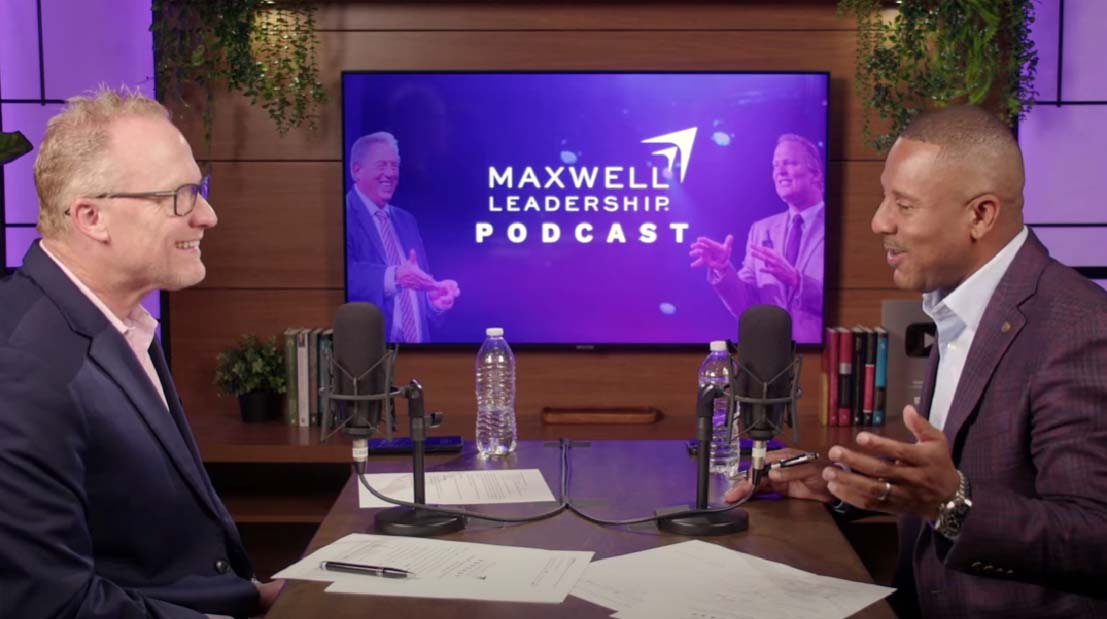
What separates leaders who keep expanding their impact from those who quietly plateau? In this week’s episode, John Maxwell continues revealing the promises and pitfalls on the path to continual, intentional growth.
After his lesson, Mark Cole and Chris Robinson share how to recognize your growth zone and offer strategies you can use to keep advancing in your leadership journey.
Our BONUS resource for this episode is the Growth Guarantee (Part 2) Worksheet, which includes fill-in-the-blank notes from John’s teaching. You can download the worksheet by clicking “Download the Bonus Resource” below.
Chris Robinson:
Now, Melvin Maxwell, I believe he was 92 or 93 years old before he passed away. He came to an IMC event and he spoke. Now, when I say he spoke, I mean he spoke.
Mark Cole:
He did.
Chris Robinson:
At 90-plus years age, fired that crowd up. But one of the statements that he said was that he was going to live until he dies, and that he did.
Mark Cole:
Hey, welcome back to the Maxwell Leadership Podcast. I say welcome back. If this is your first podcast episode ever, you are in part 2 of the Growth Guarantee. So go back to part 1 as soon as you’re done today, where you can have both. For those of you that are regulars, we’re so glad to have you, so glad to be on this growth journey with you. You’ll remember that we’re in the middle of the Growth Guarantee. John gave 3 disciplines. Your growth must be intentional, must be useful, must be continual for the guarantee to work.
Mark Cole:
Today, He’s going to talk about promises and he’s going to talk about zones. And you’re going to really want to take notes on that. In fact, Chris, he makes a statement here in this that I just wanted to hit you here on the front end. Continue learning more things about the same things when they’re the right things. Now, you’ll hear him teach that in a minute, but what are you learning still today that it feels like you’ve been learning for years, if not decades?
Chris Robinson:
Oh man. It goes back to the very beginning of of why I wanted to be in leadership in the first place, and that was falling in love with adding value to people and serving people. So still to this day, I’m looking every single day of how can I add value to an individual? How can I serve someone? How can I help someone progress just a little bit more? And so it’s still reading leadership books, still reading communication.
Chris Robinson:
How do I connect better with them? Still asking questions of staff, of team members around the world. Hey, how can I better serve you? So I don’t think that will ever ever go away, because I don’t think it’s something I could ever master. I think it’s something I can be good at and something that I’m going to impact a lot of people individually. But how do I really take that to masses and masses? Right now, it’s like it’s just serving the one in front of me. And so, for me, I’m going to always continue to learn, grow, and study how to add value, connect with people, and serve people.
Mark Cole:
Well, you do a great job of it. And we look forward to unpacking not only that a little bit more, because there’s so much to say there. I want to unpack with you what John talks today about relating to the promises of the Growth Guarantee and the zones that you want to be careful of and be aware of. So grab a pen, grab a piece of paper. By the way, if you would like to download our bonus resource, this is a fill-in-the-blank resource that you can follow along with John. You can get that at MaxwellPodcast.com/Guarantee. If you would like to watch this podcast on YouTube, you can find the link there at the MaxwellPodcast.com/Guarantee. And one more thing, we are creating episodes around your questions now. And what I would love to challenge you to do, and we’ll put this in the show notes, I would love for you to go to our Facebook community, and there you will find a way to submit your video-generated question for us to answer in a future podcast.
Mark Cole:
We’re enjoying this. We want to do more of it, and we want to answer your leadership questions in a conversation. All of that, MaxwellPodcast.com/Guarantee. All right, let’s go. Here is John, part 2, the Growth Guarantee.
John Maxwell:
Now let’s go to the 3 promises of the Growth Guarantee. The first promise of the Growth Guarantee, if you’ll do the 3 things, now remember, The 3 things are conditional. You gotta do them. You can’t ignore them. But if you’ll do those 3 things, the first promise is your growth will be expandable. The growth in your life will begin to expand more than you could ever imagine. Phillips Brooks was a clergyman. In fact, he preached Abraham Lincoln’s funeral.
John Maxwell:
And Phillips Brooks, when I was about 26, I read this quote. I asked him, I think it’s on the screen for you. But I read this quote and it had a profound effect on my life. Sad is that day for any man, woman, okay, person, when he, she becomes absolutely satisfied with the life that they are living, the thoughts they are thinking, the deeds that they are doing, until there ceases to be forever beating at the doors of their soul a desire to do something larger which he, she knows—
John Maxwell:
that they were meant and intended to do. When I read that quote, it just grabbed me. And I can still remember at 26 reading, writing down 3 conclusions and I give them to you now. The first conclusion is many stop growing. Sad is that day for any person. Why do they stop growing? When they become absolutely satisfied. What a horrible word, satisfied. What are they satisfied? Well, they’re satisfied with the thoughts they’re thinking and the deeds they’re doing and the life that they’re living.
John Maxwell:
This is a sad, sad state of affairs. So many people stop growing. Why? Because they become satisfied.
John Maxwell:
And when growth stops, it’s a sad day for everyone. It’s not a happy day. Nobody benefited by the fact that when you decided that you were gonna cross your finish line and you’re gonna plateau, nobody benefited from that. And the third conclusion was the purpose of growth is to do something larger than yourself.
John Maxwell:
That’s why when I was in my 20s and I had another mentor look at me and say, John, I want you to attempt something so big in your life that if you can accomplish it and pull it off, people who will know you will look at what has been accomplished and they’ll say, you’re not that good. And then they’ll give God all the credit.
Chris Robinson:
Amen.
John Maxwell:
That’s the kind of life I wanna— let me just, gotta ask you a question. Is that the kind of life you wanna live? Do you wanna live a life that’s bigger than you and larger than you and beyond you that is gonna make a difference in people’s lives? I mean, is that the life you want? If that’s the life that you want, there ought to be forever beating at the very door of your soul, my soul, it never stops beating. It never stops. I just— When I die, I’m gonna stop growing. I just am. In fact, when I die, I’m gonna stop working.
Mark Cole:
I just am.
John Maxwell:
I’m just gonna be dead. I just have decided to live until I die and not get the two confused. Let’s talk about my growth capacity journey just for a second. My gosh. That clock just keeps on moving. I’m just trying to give you as many practical things as I can. My growth capacity journey looks like this. You have to intentionally start growing.
John Maxwell:
We’ve talked enough about intentions. We don’t need to go there anymore. You have to intentionally say, wait, when is the day when you push the button and say, this is my day? From now on, I’m gonna grow. Listen to me, don’t be a know-it-all, be a learn-it-all. Don’t be a know-it-all, good Lord. After you do that on your growth journey, prioritize your areas of growth. Look at the areas in your life and say, we’ve talked about prioritize the areas of your growth. For example, when I was young, I have a counseling degree, so I did counseling.
John Maxwell:
And I wasn’t any good at it. I wasn’t anything. I’m not modest. I wasn’t any good at it. I knew I wasn’t any good at it. The people who came to me for counseling knew I wasn’t any good at it. I just had a little country church. And in fact, I remember a time when I got up on a Sunday morning and said, I don’t think I’ll do any more counseling.
John Maxwell:
And the people clapped. They just started applauding. And they just said, oh, thank God. He’s answered our prayer. He’s answered our prayer.
Chris Robinson:
He’s answered our prayer.
John Maxwell:
So in my growth journey, I prioritize the area. Where am I gonna focus on, grow on? Don’t set a timeline or a goal line. Don’t say, well, in 3 years I wanna be here, or 5 years I wanna be here. Just grow. Again, not how long will it take, but how far can I go? That’s the question. But, you know, don’t be hard on yourself. Just, if you’re growing every day, trust me, the growth in your life will begin to take over and after a while you’ll be amazed at how far you go. Prioritize what I call your layered learning.
John Maxwell:
I only learn in 5 areas, 6 areas, okay? We know that. Communication, leadership, equipping, attitude, relationship, faith. Okay, we got it. That’s where I spend my time. That’s where the return is. That’s my return. Now, What I do is I now start layering my learning in those areas. So here’s what I wrote down in my notes.
John Maxwell:
Just listen carefully. I don’t think this will be on the screen. Continue learning more things about the same thing. Learn more things about the same thing if they’re the right things. If they’re giving you the return. So what does that mean? I’m still learning about communication, but every time I learn something about communication, I layer another layer. And I, so my communication layers, I probably got a 10-story building of layered in communication. So what you do is you keep, you continue learning more things about the same thing if they’re the right things.
John Maxwell:
But every time you get another layer, you just absolutely get more depth, you get more gravitas, it’s just huge. And then the last thing I just want you to know is that there’s just no finish line. There’s no finish line. So those are just quick thoughts about my growth capacity journey. I intentionally start growing, I prioritize areas of my growth, I don’t set a timeline or a goal line, I prioritize my layered learning, and I know there’s no finish line. Now, there are 3 zones that people live in. The coasting zone, You know what the coasting zone is? I don’t even do what I’ve done before. Oh my gosh.
John Maxwell:
What are we gonna do with a person like that? I don’t even do what I’ve done before. And by the way, no one ever coasted to a desired location. So you don’t coast to greatness. So that kind of lovely little, inner tube ride down the lazy river, it’s not gonna get you at all where you want to go. That’s the coasting zone. There’s the comfort zone, which means I just do what I already know I can do. And the reason that people stay in the comfort zone is that the number one motivator for people that are in that zone is avoiding discomfort. People that are in the comfort zone, they just say, oh my God, I just don’t wanna be in any way discomforted over anything.
Chris Robinson:
Amen.
John Maxwell:
Now listen to me carefully. Everything you want but you don’t have it, everything you need but you don’t have it, is outside your comfort zone. That’s why you don’t have it. If it was inside your comfort zone, you’d already have it. You want it, but you don’t have it. You need it, but you don’t have it. Why? Because it’s on the other side of the fence. It’s outside of your comfort zone.
John Maxwell:
And then there’s the challenge zone.
Chris Robinson:
Challenge zone.
John Maxwell:
And the challenge zone is where I attempt to do what I haven’t done before. Again, I’m not a know-it-all, I’m a learn-it-all. I’m not an expert in leadership. I mean, I’m proclaimed an expert in leadership, but I know better than that. I’m not an expert because here’s what I want you to know. The more you know, the more you know you don’t know. And the more you know you don’t know, the more you know that you need to know. So you know you need to know more because you don’t know enough.
John Maxwell:
And number— oh my gosh, number 5, your growth will be fruitful. The moment you become fruitful, you don’t need the picture anymore. Everybody knows who you are. You don’t need titles. You don’t need offices. You don’t need parking place. You don’t need all that crapola that people think comes with leadership. You don’t need any of it because you got fruit on your tree.
John Maxwell:
Okay, let’s watch. We’re gonna review the growth guarantee. 3 conditions, 3 conditions that guarantee your growth. Your growth must be intentional, it must be useful, it must be continual. If you meet those 3 conditions, you get the 3 promises. Your growth will be expandable. Your growth will be fruitful. And finally, number 4 or 5 or 6, it’s 6, your life will be beautiful.
John Maxwell:
And I just want you to know that I live what I call the 3B life. I’m blessed beyond belief. I am totally blessed beyond belief. The growth guarantee says if, My growth is intentional, and if my growth is useful, and if my growth is continual, then, and by the way, only then, will my growth be expandable, and my growth will be fruitful, and my life will be beautiful.
Evict the Doubt by Stan Lewis:
You know that voice that says, I’d go for the promotion, but what if I fail? Or, I’d speak up in the meeting, but who am I to say anything? In his new book, Evict the Doubt: Squatting Rent-Free in Your Mind, Stan Lewis shows you how to kick out your self-doubt. Stan knows what it’s like to fight through doubt. He went from enlisted sailor to commissioned Navy officer while the people around him said he didn’t belong. Today, he’s a Maxwell Leadership Certified Coach, personally endorsed by Dr. John C. Maxwell. And he’s turned 3 decades of hard-won leadership lessons into a practical framework for evicting self-doubt for good. This is not a pep talk.
Evict the Doubt by Stan Lewis:
This is a plan. Get your copy at the link in the show notes.
Mark Cole:
Hey, welcome back everyone. Chris, I just loved this passion that you had, and I couldn’t wait to hear John teach and then come back to this because I think you’re living in the promises time of your commitment to servant leadership and adding value to leaders around the world. And the reason I say that is because in the last year, you completed your first book.
Chris Robinson:
Yes.
Mark Cole:
And the community that you’ve been adding value to added tremendous value back to you in getting that book out and into people’s hands. I call that beautiful. I call that a great return. And so I couldn’t wait for what you said and then go listen to John teach, because I come back and in some of these areas that you’re still wanting to grow in, you’re already at that promise of a beautiful place. And it’s a really cool, rewarding time of leadership.
Chris Robinson:
Yeah, it really is. And as I think about how I answered you out there at the beginning of this and talking about just impacting people one-on-one and trying to serve the one in front of me, I am in that beautiful space. I mean, I just recently came off a 5-city tour where we just picked random cities in the US that we’re going to show up in. And we usually have anywhere from 50 to 100 members come out from different states to fly in to see us. And I’m going, man, people are just showing up because—
Mark Cole:
It’s beautiful.
Chris Robinson:
Because of the one-on-one, because of the working at serving, because of, hey, I’m not just trying to be a personality behind a microphone, but a person that’s really there to help them. And so, it was a great reflection moment to think about that. It is a very beautiful time for me right now, but it’s as a result of doing these things and practices and these things that we’re talking about today.
Mark Cole:
There’s no doubt. And with this, the podcast comes out today, and then on Saturday, Sunday really, we start another, our 30th IMC. And it is a beautiful thing. It’s a great thing to see the layered results of discipline and intentionality around growing in a certain area.
Chris Robinson:
Yeah, absolutely. And like John said in here, I think a statement that stood out to me that really popped out was the phrase, I’m going to live until I die. That’s doing the thing that you love to do until you die. And I first heard this phrase, not from John Maxwell, but from Melvin Maxwell.
John Maxwell:
Yeah. Okay.
Chris Robinson:
Now, Melvin Maxwell, I believe he was 92 or 93 years old before he passed away. He came to an IMC event and he spoke. Now, when I say he spoke, I mean, he spoke.
John Maxwell:
He did.
Chris Robinson:
At 90-plus years age, fired that crowd up. But one of the statements that he said was that he was going to live until he dies, and that he did. So John, I know, carries that from him. Do you think John’s going to live that out with the same passion, fervor that his dad had?
Mark Cole:
I do, Chris. I’ve been with John for 26 years now. Did get to meet Melvin Maxwell, his dad, multiple times. And I’m seeing in John, at the recording time, 79 years young, I’m seeing his energy and his passion. You heard it a little bit in his teaching today. Well, he started getting fired up. Don’t never stop dreaming. Never stop doing.
Mark Cole:
Once you’re done, don’t you know what that means? You’re done. I mean, he was just going and I felt it and I have felt it dozens of times that John truly does not want to quit before it’s time. In fact, he told me the other day, he said, Mark, I know what I want said on my tombstone, my epitaph. Just put, he ran out of breath. He ran out of breath.
Chris Robinson:
Right.
Mark Cole:
Because that’s the only thing I want to say is, man, he’d still be going right now, but he ran out of breath. And so, yeah, I do. There is a passion and a determination like I saw in Melvin that I see in John.
Chris Robinson:
Yeah, I love it. Well, let’s dive into this content here. You know, John talks about the danger of becoming satisfied. How can someone tell the difference between being grateful for where they are and becoming satisfied with enough that they’ve stopped growing?
Mark Cole:
Boy, such a good question. It’s such a question that is perplexing to me on a daily basis. I think you can never— ever miss an opportunity to be grateful for where you are. I don’t believe you can ever use that gratefulness as an excuse not to learn something else today.
John Maxwell:
No.
Mark Cole:
And I’ve watched people become grateful saying, wow, look at what we’ve done. And it is a statement of resignation rather than a statement of appreciation. And never let your gratitude be a resignation, we’ve done, we did it, we accomplished it. Let it always be one of appreciation, but then always couple that appreciation with anticipation. What is possible now because of what we’ve accomplished then? I was with John Maxwell. He’s talked a lot about this throughout the years. I was with him and Tyler Perry when John asked Tyler Perry, why did you open up a third, this time a whole city of a production studio. I mean, it was just huge.
Mark Cole:
He bought acres and acres and acres of Fort McPherson here in Atlanta. And he said, John, I was done. I was convinced I was done. I had done everything, accomplished everything that I wanted to. And I was sitting down one day and I realized when you can afford to quit, you cannot afford to quit. And I think for people that have accomplished a lot, when there’s a sense of contentment rather than stewardship and a responsibility to all that you have accomplished, I think you have crossed a dangerous threshold of being done too soon. And you need to get yourself up, kick yourself in the rear end, and get back in the game. And take everything that you’ve accomplished as a setup for the next hill to climb, not as a celebration for the last hill you climbed.
Chris Robinson:
Right. Yeah. And I think a lot of people do that. They sit in, well, it’s good enough.
John Maxwell:
Yeah.
Chris Robinson:
Well, I did all I could do to get here. This is more than my parents had. This is more than this person has. I’m good. And you get this settling that happens in and they begin to stop growing. The next thing John talks about is don’t be a know-it-all, be a learn-it-all. What does being a learn-it-all actually look like when you’ve already achieved some success and you’ve been in your role a long time? Because I know we got a lot of listeners right now Maybe sitting in a car, maybe sitting at a job that they’ve been at for years, things are good. But what does it look like when they’ve had this success already to be a learn-it-all?
Mark Cole:
I think learning takes discipline. I think learning takes intentionality. John’s used the word a lot. In fact, he said in today’s lesson, we’ve over-talked about intentionality. And perhaps we have, but I think it’s really critical because I think the more successful you are, the more intentional you have to be to learn and to stay in an attitude of learning. Because it’s Steve Jobs that said, yesterday’s success is the enemy of tomorrow’s opportunity. And I think the more successful, the more accomplished you are, the more you have a tendency to take on a guru role or a—
John Maxwell:
Mm-hmm.
Mark Cole:
teacher role or an expert role. I love it when John talks about that he’s the leadership guru. He said, whatever that is, I feel like I have much more to learn about leadership than I have to tell about leadership. And that’s the guy that’s written more about leadership than Numbers 2, 3, 4, and 5 combined.
Chris Robinson:
Right.
Mark Cole:
Because he disciplined himself a long time ago to have a learning aptitude And that’s now a discipline of his that every room he walks into, he is the most hungry to ask the first question. He and Jim Collins, the author of Good to Great and many other great books, were together a few years ago. And John said, Jim, I’ve got some questions. Jim said, you did this to me last time. I get the questions first this time because you asked me questions the entire time we were together. It’s my turn to ask the first questions. And I watched these two 2 leaders that are constantly trying to learn outcompete each other on who was going to get the first question.
John Maxwell:
That’s it.
Chris Robinson:
Right.
Mark Cole:
Because they wanted to learn as a first mode and they wanted to apply as a second mode, and then they wanted to tell as the third thing. And they do not get those confused.
John Maxwell:
Yeah.
Chris Robinson:
Wow. I love that. I love that. Just the intensity behind it. And I’ve been in those rooms where most times you would think if you’re sitting down at a table with John Maxwell, you would You would think that the table would be asking questions, and I’ve seen it 9, 10, every single time, John’s asking questions the whole time.
Mark Cole:
That’s exactly right.
Chris Robinson:
The whole time, the whole time. And it boggles my mind every single time. And they’re just talking and talking and talking.
Mark Cole:
And he has already pre-thought the questions.
Chris Robinson:
Right.
Mark Cole:
He’s ready to go.
Chris Robinson:
Oh man, is he, is he. You know, layered learning, we talked about this last week and, you know, we really kind of dove into this, but learning more about the same things, how should someone identify a few areas they need to keep layering instead of constantly chasing the next new idea? How do they identify it?
Mark Cole:
Yeah, so I think that— let me answer this from a thought leader perspective that I’ve watched John and other thought leaders do. And then let me tell you this as a leadership perspective. As a thought leader, I think you start being ready to write it down or talk about it when it begins to get people arrested or gripped by the concept. And you realize you’ve got something that really is relevant that will cause people to go deeper, to be inspired more, and to do something with. And so you keep wrestling with it until you feel that relief that when you say it, it’s going to impact people. As a leader, I think the When you realize that you have accomplished something significant is when other people begin to replicate it in both their voice, replicate it in their actions, replicate it in developing others. There is a sense of accomplishment in leadership that you not have— we’ve never arrived, but that you have caught something when it is replicated by people that are on your team, and then they replicate it to that third generation, and you start seeing the results. I said something the other day I’m working on.
Mark Cole:
This is not good yet, but I’m working on it. The sweetest sound to a leader is his or her vision on the lips of a follower. The sweetest sound for me as a leader is when my vision is repeated without me being the one that says it. Because vision that is caught or direction that is embraced begins to give a return at the second and the third and the fourth generation.
Chris Robinson:
Wow. Wow. I love that. That’s good. You got to work that one.
Mark Cole:
I got to work on that one.
Chris Robinson:
You got to flesh that one out. You got to flesh that one out because there’s something good there. There’s something deep in there. We talked about these 3 comfort zones here, these 3 zones, the coasting zone, the comfort zone and the challenge zone. How would somebody identify which zone they’re in right now? And then how do we move our way to the challenge zone?
Mark Cole:
Yeah. I think the coasting zone is probably the most— the hardest one to detect because we feel like everything’s going good and we don’t want to mess anything up because we finally got here and we climbed and climbed and climbed and got to the top of the hill. Finally, the reward of all the hard work is being able to enjoy the fruit of our labor. And because of that, because it comes right after a hard, or most of the time it comes after a hard or a difficult climb, the tendency is to go, ah, this is the reward rather than this is the danger zone.
Chris Robinson:
Mm-hmm.
Mark Cole:
And so I have people around me, Chris, that says, hey, call me out when you sense that I’m coasting. I think the comfort zone is a little bit different because you have felt like you are, you are now challenged with things that’s making you think differently. And that one’s a little bit easier because you start protecting. You’re not resting anymore. Now you’re protecting. Oh, no, we’re not going to do that. We’re not going to change that. And you start getting into this comfort zone because what worked before is expected to continue working.
Mark Cole:
And you know it, many times it’s the hardest one to get out of because again, it’s the comfort zone. But it’s not the hardest one to detect. I think the hardest one to detect is the coasting zone because you just recently were climbing. The comfort zone, you know you’ve been in a stride for a while and you feel good about it, but it’s the hardest one because who wants to mess up the comfort zone?
Chris Robinson:
Right. Yeah.
Mark Cole:
But then when you get to the challenge zone, that’s when you wake up every day and you And you say, how am I gonna get through the day? How am I gonna accomplish this? And that one is easy to detect, but it’s harder to stay disciplined with because everything worthwhile is uphill and we all have downhill habits.
Chris Robinson:
That’s right. Gosh, I love it. I love it. You know, if you do these things that John talked about, he had promised that intentional, useful, continual growth eventually becomes expandable, Fruitful, and beautiful. You’ve been with John for 26 of his 50 years in leadership. All right, now that’s over half now. You know, where have you really seen in John’s life best demonstrate this beautiful part that he’s describing?
Mark Cole:
I think what’s beautiful about being in this season of partnership with John is he’s still in awe of the fruit of what he’s been through. So it kind of goes through, it’s beautiful, the fruit, and it’s also beautiful, the humility and the sense of awe and wonder, as if he’s not really written 92 books. And so, and that 40 million copies have been sold. And when somebody comes up and says, I drove 8 hours to tell you that your book profoundly impacted me and my business, and now today I’m a billionaire, and it’s because of this book, and I just came today, Wow. not to hear your lesson. I came today to say thank you. And I watched John every time tear up and he punches me. He says, can you believe this? And it’s a real beautiful thing because he hasn’t lost the humility and the sense of wonder, even though it is a time of great fruit.
Mark Cole:
So I think your life will be beautiful. John says it like this. When he started out, he wasn’t as bad as people thought he was, and now he’s not as good as people think that he is.
Chris Robinson:
Yeah.
Mark Cole:
And I think Keeping that sense of wonder and yet seeing such tremendous unanticipated fruit and letting those two stay commingling at the same time is what I think is really beautiful about where we are.
Chris Robinson:
Wow. Wow. Thank you. The growth guarantee.
Mark Cole:
Yeah, the growth guarantee. And I’m just going to tell you this, as we’ve went through part 2 of this, if you will go after the 3 disciplines, your growth must be intentional, it must be useful, it must be continual. you will stay aware of your zones. Are you in the coasting zone, the comfort zone, in the challenge zone? You will begin to see the promises of growth that is expandable, growth that is fruitful, and growth that is beautiful. Thanks for joining us today. I’ll tell you this, William Pollard had a great quote that I want to leave you with today. Learning and innovation go hand in hand. The arrogance of success is to think that what you did yesterday will be sufficient for tomorrow.
Mark Cole:
And I want to challenge you. I know you’re growing. You’re listening to the podcast, for goodness’ sake. Find the— identify, find and identify the next summit. Go after it. Stretch. Make the end of this year and the beginning of next year an epic time of making sure that your next 12 months is your most fruitful 12 months. And do this with a passion to grow.
Mark Cole:
We have a resource at MaxwellPodcast.com/Guaranteed. We have a resource on the 15 Laws of Growth that John will take you through, 15 disciplines he’s used to grow exponentially. It’s all in the show notes. I want to challenge you to go check out the episode, Why So Many Leaders Stop Growing. We will include that at MaxwellPodcast.com/Guarantee link. And I want you to do that because I don’t want you to stop growing. I want you to continue growing. We put 2 episodes into a guarantee.
Mark Cole:
And I want you to experience that guarantee so that you will bring powerful, positive change to the world around you because everyone deserves to be led well.