How do great leaders keep success from breeding entitlement? In this week’s episode, John Maxwell teaches why revisiting where you came from—and cultivating gratitude—creates the stable foundation every leader needs to rise higher.
After his lesson, Mark Cole and Chris Goede discuss real-life strategies to help you anchor your leadership in authentic gratitude and apply John’s insights today.
Our BONUS resource for this episode is the Success and Gratitude: Why Great Leaders Revisit Where They Came From Worksheet, which includes fill-in-the-blank notes from John’s teaching. You can download the worksheet by clicking “Download the Bonus Resource” below.
Mark Cole:
They just slapped you in the head with a sword. Okay, I got it. Shouldn’t have had a sword in the house. Got all that. Got all that. Popped you in the head, got a mark to prove it, and you are getting ready to tell your brother how frustrated you are with him. But before you do, tell Emory what you’re excited about, what you’re grateful for.
Mark Cole:
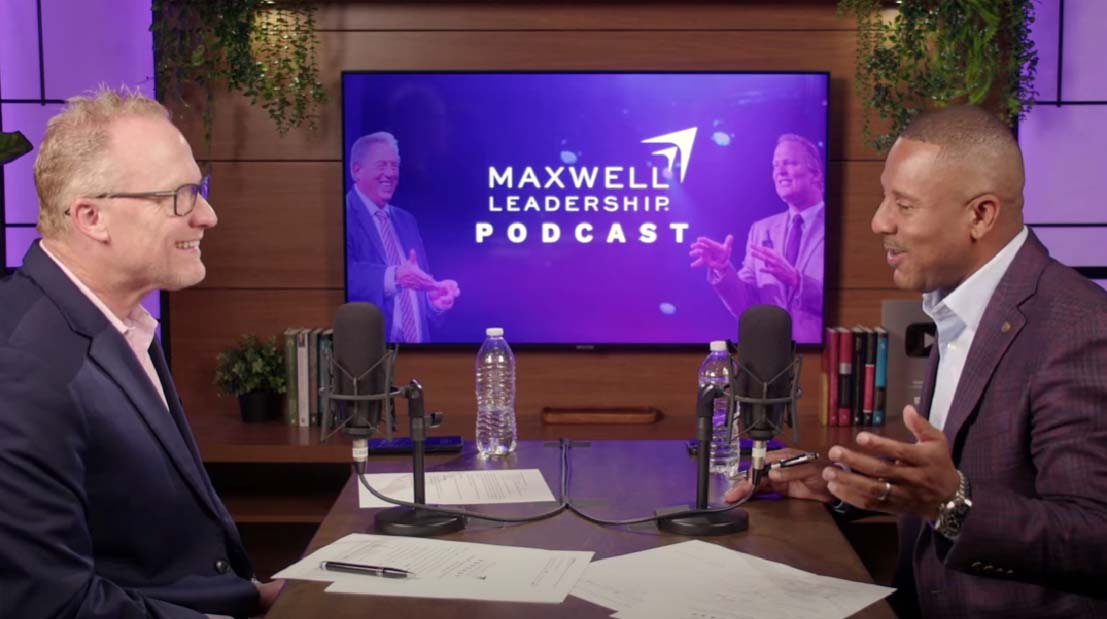
Hey, welcome to the Maxwell Leadership Podcast. I’m super excited to invite you into the studio today because I think today we’re getting ready to share a secret to sustained leadership. And I think that secret is not allowing yourself to get so caught up in success that you forget to be grateful. And Chris, you and I, I mean, we’re sitting in studio today. It’s a beautiful building, beautiful studio. We work for a guy like John Maxwell, but chances are you sitting in this seat is because you’re standing on the shoulders of somebody in your life down the road.
Mark Cole:
In the previous road. So talk to me, before we get into John’s content, talk to me about somebody whose shoulders you’re standing on while you’re sitting in this seat. And give me just a little bit of who you’re standing on the shoulders of.
Chris Goede:
So the first thing that comes to mind, and this is not just because this is his podcast or his company, is John. And the reason I say that, you and I have been able to be around for so many years, but I was reminded of a meeting that you and I were in several weeks ago, and we were just talking about some of the things in the organization. And the answer was, at least I put it out on the table, that I thought the issue was leadership.
Mark Cole:
Yeah.
Chris Goede:
And we got into a conversation about, well, what’s different maybe with what you’ve learned? And it just got me thinking about putting the time in and being invested in his content, his books, because his principles are simple, they’re just not easy, and I need simple.
Chris Goede:
But if you live them out, and I am a different person today, not just as a leader, but as a husband, as a father, because of those experiences of men and women like John, like yourself, around this type of environment. And so I’m grateful for it, because, matter of fact, my wife is grateful for it, because she’s like, I think early on, I saw some incredible growth from you spiritually, ’cause person of faith, leadership-wise, all this kind of stuff, just ’cause the environment that we’re in. So the person would be John, the environment would be what you and John have created here for so many years that I would be a different person without that, and I’m extremely grateful for it.
Mark Cole:
Yeah, and let me just fast-track you, and our podcast listeners and our podcast viewers, let me just fast-track you to say this. We hope to be that for you.
Chris Goede:
Yes.
Mark Cole:
But somebody has been that for you. And I want you, as we talk today, as John talks about the stabilizer between success and gratitude, I want you to kind of put that image, that person, that environment that you were a part of in front of you as you listen to this lesson. I think it’ll keep you stabilized as you pursue success. We all want success. That’s why you’re tuning into the podcast today. We want to add value to your success so you’ll multiply that value to others. And chances are you’re even on this podcast because somebody inspired you to the best you. Let’s keep those people in mind.
Mark Cole:
So here’s what I need you to do. I need you to get really excited. I need you to get ready because this is going to be an incredible, incredible podcast about success and gratitude. Hey, if you want to watch the YouTube version of this, if you want to pick up some things that we’ll drop in the show notes for other resources, you can go to MaxwellPodcast.com/Revisit, MaxwellPodcast.com/Revisit, and you’ll be able to also download the bonus resource. to follow along with John. So grab your pen, grab your paper, grab your thought of somebody, something you’re grateful for. Listen in, here’s John.
John Maxwell:
People that are successful, they feel very entitled a lot of times to things, and so they got this whole list of, here’s what I’m entitled to, and this should be mine, and I deserve this, that. That hope process. And to balance or stabilize that entitlement mindset is gratitude. Put gratitude alongside it. The problem with I deserve, people say, well, I deserve this, I deserve this, I deserve, is that it changes our perspective. It just does.
John Maxwell:
You know, a proud man is seldom a grateful man, for he never thinks that he gets as much as he deserves. So let me do a little teaching here. I think it’s good for all of us to go back and get what I call, go back and grab a gratitude experience. Let me explain. Go back and grab a gratitude experience.
John Maxwell:
So during the summer, we live in Highlands, North Carolina. Now I don’t know if you’ve ever been to Highlands. It’s a delightful, it’s just a little sleepy place up in the mountains, about 2 hours north of Atlanta, about 5,000 feet in the Smokies. Lovely, lovely, we love it. It’s wonderful. But it’s a mountain place, it’s mountain people, mountain town. And so Margaret and I were having some work done on our house up there. So the guy that was the head contractor, wonderful guy, his name’s Ronnie, delightful guy, really liked Ronnie.
John Maxwell:
And so we, you know, and he told me first day he met me, he said, oh my, he said, you know, it’s an honor to be here and do your house. He said, I read some of your books. And so we just hit it off. So after a few months together up there, Ronnie came up to me one day and he said, John, he said, I hate to ask you, but Everybody knows that I know you. And he said, I belong to the Highlands Rotary Club. And the Rotarians were wondering, they asked me to ask you. He said, I really hate to do this, but they just, would you like to come and speak at the Rotary Club? He says, we have about 80 people come out, good people, good people. Would you like to do that? I said, Ronnie, I’d love to do that.
John Maxwell:
He said, you’re kidding me.
John Maxwell:
I said, no, no, I’m not kidding you at all. I would love to do it. I said, the only challenge I’ll have is working out a date. So let’s get our calendars out and let’s see if And we had a little challenge. It took me, it was gonna be about 2 months before I could hit their day right and be there. So I said, yeah, I said, let’s do this. I’ll come and speak at the Rotary Club. He said, can we advertise? I said, you can do whatever you want.
John Maxwell:
I’m just gonna be there and I’m looking forward to it. And tell ’em I’m gonna speak at the Rotary Club. Oh, he said, this will be amazing. This will be amazing. So the date comes and I go down to the Rotary Club and they’re all excited. They’ve advertised it. They got a record crowd, record crowd. They got 140.
John Maxwell:
They had to move it to a new facility so they could have a little bit more room. And this is big. You got 140. And it was, you know, when I was younger, I spoke at Rotary Clubs. You know, when I was— starting off, I did Rotary Club speaking and I just wanted to go back again. I’m talking about grabbing a gratitude experience. And Rotary Club is as corny today as it was 35 years ago when I spoke. They got that bell that they ring and they got all these things that they do and I’m jumping through all the hoops and then came time for us to go Get our lunch at the buffet.
John Maxwell:
Got my paper plate and my paper cup, my plastic utensils, and put all the stuff there and sat down and we ate. Then we did the Rotary pledge and we did several things. Then I got to speak and I spoke and had a wonderful time. They were delightful. I had so much fun with them. At the end, because it’s up in mountain territory, they gave me a walking stick. Oh, I mean, you know, really a nice walking stick. And I thanked him.
John Maxwell:
So I came back home to my house and where you put the little thing where you put the umbrellas and stuff, I put the walking stick right there. It’s kinda right by the stairway by the front door that you kinda, you know, just you see the walking stick every day. So I had a friend come up to see me and he looked, he said, what’s that? I said, that’s a walking stick. He said, oh. He said, where did you get that? I said, at the Highlands Rotary Club. He said, why did you get it from them? I said, I spoke for them. And he looked at me and said, what do you mean? You spoke for a Rotary Club? I said, I did. I had a great time.
John Maxwell:
And I told him how much fun I had. And then I explained something to you. You always need to go back and visit where you came from. You never want to forget all the people and all the places that made you who you are today. And every year, I grab a gratitude experience. Every year I surprise somebody by doing something that nobody else, but I do it because I need to remind, I need to remind me, are you with me, of who I am and what made me and the journey that I took.
Mark Cole:
Hey, welcome back. So we did talk a lot in our opening about success and gratitude and who are you grateful for, but John really picks up the lesson today talking about entitlement. In fact, it reminded me of a quote Paul Gibbons said, feeling entitled is the opposite of feeling grateful. Gratitude opens the heart. Entitlement closes it. We really are today talking about a stabilizer. How do we make sure that success does not give us a sense of entitlement, but yet with success, we keep a heart and a mind of gratitude? And boy, I hope you picked up as much from John as Chris and I did. It was fun to watch him.
Mark Cole:
He lives it.
Chris Goede:
He absolutely lives it out. We were sitting here listening, kind of laughing with his story from the Rotary Club. And I looked at Mark and I was like, oh, can’t you just see him going in there and giving back and loving every— and hamming it up, loving every minute of it?
Mark Cole:
Love it.
Chris Goede:
I want to go a couple of different places today because I don’t want us to just fly right by that entitled part. Right. Because there’s no doubt that if you’re grateful, As a leader, as an individual, it is associated with, I think, being more resilient. I think building better relationships. I think lowering your personal stress. But we’ve all seen those leaders, and you know it, they’re just entitled. You know it right away when it just— you’re in communication, you’re in conversations with them. Talk to us a little bit about, in your mind, as a leader, you go into a meeting, and you’re connecting, networking, what are the differences that you see in leaders that just show up with gratitude or they’re like, hey, you know what? I deserve to be here.
Chris Goede:
By the way, I think entitlement is one of the biggest threats a leader could ever get involved in.
John Maxwell:
I agree.
Chris Goede:
And I know you would agree with that because all of a sudden you start believing your own press clippings and you don’t want other people’s opinions and you don’t want to do That is a huge threat to your leadership. How do you identify the difference between those 2? And talk to us a little bit about maybe some attributes, ’cause I want it to be handles that you share, that you see through your leadership lens, that our listeners can grab ahold of.
Mark Cole:
You know, I’ve watched a lot of leaders. You mentioned one. I walk into any meeting, whether I am the contracted consultant, advisor, or potential expert, or whether I am the learner, the person that needs to pick up something. And I always get a sense of gratitude before I walk in. I can’t believe I’m getting ready to learn, or I can’t believe I have earned the respect that I can come in as the authority of a subject. It’s always a moment to reflect. I can’t believe I get to sit into this room.
Chris Goede:
That’s awesome.
Mark Cole:
The other thing I’ve watched successful leaders do is when they’re going to give feedback, let’s call it constructive criticism so we can hide our nasty attitude. Okay? Let’s just call it corrective criticism for the moment. I’ve watched the people that just launch right in as if they’re an expert of negative feedback. And I’ve watched the people that says, hey, can I tell you what I just picked up from this environment, what I enjoy from your company? And they start with this gratitude and then they go, but let me tell you where I think it can get better. appreciate and listen to critical or positive feedback.
Chris Goede:
Feedback, yeah.
Mark Cole:
Critiquing when it is wrapped in a substantive, a tangible moment of gratitude, of affirmation. Now, I think that people that give criticism often come from a place of entitlement. I deserved better service from you, and so you should have given it to me. I know when I call a credit card company because they charged something that wasn’t even right, and I call and I’m justified, this is not right. This is not my charge. What did you do? And if I go like that rather than going, hey, thank you for taking some time to help me today. Here’s what happened. I got charged on a wrong thing.
Mark Cole:
It was wrong. It wasn’t right. But I have found I get much better service when I go, thank you for taking some time to help me with my problem today.
Chris Goede:
Yeah.
Mark Cole:
Rather than justifiably jumping right in with what’s wrong, I get worse customer service and I blame it on the rep rather than my attitude. And leaders that understand you earn the right to give critical feedback. You don’t have the right, you earn the right. How do I earn the right? With gratitude.
Chris Goede:
That’s so good. Yeah. You took the words exactly what I was thinking. Right? I like that. We have to, and we talk about influence. We talk about Being a leader is having influence no matter who you are, where you are, what position. And in order to be able to have conversations, maybe sometimes that you have to have, you need to earn the right to do that. And one of the ways to do that is by showing, and what Mark said was authentic gratitude.
Mark Cole:
Yeah.
Chris Goede:
Right? Like his example with the credit card, that was authentic. Hey, thank you for answering the call, and hopefully you still feel the same way at the end of the call. But that just changes everything on the dynamics of it. So let’s talk a little bit about— I want to go from this entitlement to these experiences. And wasn’t that a great—
Mark Cole:
grab a gratitude experience.
Chris Goede:
Experience. I love that. Yeah. I don’t know that I’ve heard him say that before. Yeah. But what I want to do is I want to talk a little bit about your gratitude experience or something that comes to mind. Right? You have had an incredible journey, and those that have listened to us or are watching us on YouTube, they know your journey to success. And there are oftentimes I see you living this out, no one else knows about it.
Chris Goede:
So I’d like for you just to pick one or two that you go, man, that’s a gratitude experience for me. That is something I’m doing because I’m so grateful for where I am and the success that I’ve attained.
Mark Cole:
Let me use a personal one and a professional one, if you don’t mind. And I hope I do this not to shine a light on me. Gratitude is extremely, extremely important to me.
Chris Goede:
It’s very important.
John Maxwell:
You live it out.
Mark Cole:
Extremely. And I’ll tell you why in just a moment. But for me, it is the most important attribute that I want to give to my kids. So I grew up as a preacher’s kid. Most of you know that. I was able to eat every meal because somebody had caught the vision of giving from their abundance to our church so that my dad could get a salary so that he could feed his family. And it indelibly, every time, you know, some people like to say grace, some people like to have a problem saying grace. Why don’t you pray all the other times rather than just right at food? I got all that.
Mark Cole:
But our family really recognizes God as our source for everything that we had. And that came from early on realizing that it was people’s generosity. So, to this day, I don’t know if this is hokey for some of you or not. It may be Southern. That is it. But to this day, every time we go out to eat, we expect every one of our kids and grandkids to say thank you when we get in the car. Every time we get done eating at home and Stephanie has cooked, We have a discipline of everybody goes around the table and say thank you. And often we go, what are you grateful for? What was your favorite part that you appreciated me fixing tonight? What was your favorite meal at that restaurant? In other words, it’s not just thank you for the food.
Mark Cole:
Thank you for taking us.
John Maxwell:
Yeah.
Mark Cole:
We want to go deeper. But let me tell you, I take it a step further. Everybody in our family, if you don’t say thank you, you stick out like a sore thumb. And Penelope, our 4-year-old granddaughter, will go, hey, Emory, You didn’t say thank you. We call each other out. We self-police gratitude. But I take it a step further because when Stephanie, as she does every time, she says, thank you, Mark, for the meal. And I go, Stephanie, thank you for the meal.
Mark Cole:
Now, some people go, well, I’m the earner. I’m the breadwinner. She provides a home. When I come home and she cooks with her busy schedule, I should say thank you to her. But when I pay for it, I should be the one thanked.
John Maxwell:
No.
Mark Cole:
I should be thanking somebody in our family that makes it possible too. So every time, you can ask Stephanie this, you can verify it, when our family finishes up a restaurant, she says thank you to me, I say thank you to her. I’m modeling to our kids that everybody should be grateful and nobody should think they are the single source of any blessing that we have, because all of our blessings come because of something else. I should call you sometimes and thank you for the meal because you work hard that I can have a company.
Chris Goede:
Mm-hmm.
Mark Cole:
I just thought about that. I should do that. Let me give you a professional experience that I do every year in November. I love Thanksgiving. Now, I appreciate Easter. I appreciate Christmas. I appreciate Memorial Day. I appreciate Labor Day.
Mark Cole:
I got all of them. With kids, I don’t appreciate Memorial Day and Labor Day as much because they get off of school and I want them to be at school. But that’s another story that I need to learn gratefulness to. Every November, my office, every day of November, finds somebody on our team that has helped us that year to achieve what we’ve achieved. And Kimberly or I will write them a text, send a note, pick up the phone. But every day of Thanksgiving— every day of November, I find somebody to be grateful for that has impacted my team.
John Maxwell:
That’s awesome.
Mark Cole:
office, my leadership office, every single day, every single year. That is a discipline of ours that we are going to find specific things, not general, specific things to do to be thankful. Now, you know what I just thought? You didn’t make the list this November. You did the previous November, but I’m sitting here going, how did I miss that?
Chris Goede:
That’s where I was. I just checked out completely. If you’re watching, you’re like, Chris looks stumped over there.
Mark Cole:
He’s stumped over there because he just didn’t think I did it this November. He just didn’t make the list.
Chris Goede:
Yeah, I want to go back. I know you—
Mark Cole:
terrible example.
John Maxwell:
Pull that back.
Chris Goede:
I know you want to go to another example or talk a little bit more, but what I love about what you said is, don’t we often— I mean, the entitlement. Do you see how quick the entitlement can jump in? It’s not like you go, hey, I’m never entitled. Mark just gave us a really quick example that I think I’ve thought before. No, no, I know that I’ve thought before, well, I paid for this food. Like, why are we— like, that is such a quick It is. Such a threat down to a negative path. And so you have to continually fight that as leaders. And the other thing for me, I think the older that I’m getting, the more I just realize how fragile life is.
Chris Goede:
And because I’m having the opportunity to be here yet another day and do what we love to do, why would I not show gratitude for that? Because it could be over in a second, right? And so when you think about the big picture, Chris really doesn’t matter much, no matter what Chris accomplishes. And I shouldn’t be entitled at all. Our flesh will jump in there in a heartbeat. But I appreciate you sharing that example. You want to share another professional example?
Mark Cole:
Yeah. So most of you know this story of how I got to Maxwell Leadership. I was washing trucks. My life was broke, messed up. And I got this opportunity to come to this company that was recognized as a leadership company that I had been following as a leader to make me a better leader. And all of a sudden now I got the opportunity, the invitation to be on the team. And it blew me away. It blew me away.
Mark Cole:
Even though I was a telesales representative, the fact that I was on this team blew me away.
Chris Goede:
Yeah.
Mark Cole:
And to this day I still go, wow, the guy David Hoyt gave me a chance to come in and be a telesales. Now, telesales was about 4 pay grades less than what I had been making. It was about 10 grades less of the amount of responsibility I had carried. But it was an opportunity to be on the stage.
Chris Goede:
And a longer commute. And a longer commute.
Mark Cole:
Yes, it was about an hour and a half commute. But I had a full circle moment recently about, and you were with me, I got to meet, many of you that don’t know Andy Stanley and his leadership podcast, go check it out. It’s incredible. It’s one of my favorite go-to leadership podcasts. A guy named Andy Stanley, huge communicator here in the Atlanta area. He and John Maxwell got together and decided that they were going to start an event called Catalyst for next generation leaders. And so we were going to use Andy Stanley’s venue and Andy Stanley’s voice and content and John Maxwell’s influence and voice to build this thing called Catalyst. You were in the first room brainstorming this.
Chris Goede:
I was, yeah.
Mark Cole:
Thank you, by the way, because your brainstorming and deciding to do it gave me my first job with Maxwell Leadership. I became a telesales representative selling the Event Catalyst. Well, just a few days ago, Chris Goede and I had a chance to go into Andy Stanley’s office here in Atlanta and help him figure out how to use his content and his leadership thinking at a different scale.
Chris Goede:
Yeah.
Mark Cole:
He’s hugely successful. It’s funny that he needed a different scale, but he wanted a different scale. And so he brought you and I in. as kind of the expert, the person that’s been there, done that for John Maxwell, to help Andy Stanley how to do that. And I had this full circle rotary moment to go, I’m sitting in the office—
Chris Goede:
That’s amazing.
Mark Cole:
Helping the guy expand his influence that made a decision to even give me any amount of influence. And you saw it. I just got overwhelmed with this appreciation. I said, Andy, I got to tell you, I’m sitting in this office today attempting to add value to you because 26 years ago you sit in room and made a decision to do something that gave me an opportunity. And it just truly, Chris, it blew me away.
Chris Goede:
It does.
Mark Cole:
In fact, I paused right here in the podcast and I just asked you real quick, who has made what you’re doing today possible? And when is the last time you took a moment to create a gratitude experience for them and for yourself to stabilize the success that you’re experiencing today?
Chris Goede:
What Mark’s talking about is his experience was, yes, giving back all that he’s learned over the last so many years to a guy that was part of what he started. What was awesome is we walked out of that meeting and the first thing Mark said, I mean, he was bouncing off. I mean, he has high energy anyway. He was ready to go. And it was at the end of the day and we all had a long day and he goes, man, that was fun. You guys want to do that again? We’re like, it was so much fun. Maybe not right now, but you could just tell the energy. That he had from being able to lead that meeting, to be able to pour back.
Mark Cole:
Can I say something on the energy and gratitude? I believe, again, we’re talking today, John gave great content on stabilizing success with gratitude and resisting the propensity of all of us after success to start feeling entitled. And I will tell you, entitlement is an energy drainer. Gratitude is an energy lifter. It gives you more energy when you take time to express gratitude. Every time.
Chris Goede:
Authentically.
Mark Cole:
Yes.
Chris Goede:
Right? And that’s the key to it, because you can just see it in other people. Let me ask you this question, a little bit off the path here about gratitude. Do you think in human beings and leaders, it’s a natural trait for them to feel gratitude, Or do you say, no, it’s something, it’s a skillset and you got to practice it in order to be able to be a person of gratitude?
Mark Cole:
I think it’s both. It’s like John, when he gets asked the question, do you think leaders are born or do you think they’re made? And I think there are people born with natural abilities to lead. You were, you led on football field, you led as a coach, you led in company. You’re going to rise to the top because you have this innate ability to mobilize people. But how you arrive at the top, how quickly you arrive at the top, and how long you stay at the top is dependent on developable or developed traits.
Chris Goede:
Yeah.
Mark Cole:
So I think it’s the same thing with gratitude. I think that I am absolutely a grateful person because of my dad, because of genetics of my dad, his dad, his dad’s dad. Every one of them have this trait of just Absolutely looking for ways to express gratitude. I’m grateful because of my upbringing. I ate because other people were generous. I was able to eat because other people were generous. So I have some natural, I have some learned, I have some adaptive, but I have some disciplines that makes me better at it. I have some things that I can do.
Chris Goede:
And so that’s exactly where I want to go. I want to talk about the system.
Mark Cole:
Yep.
Chris Goede:
And the discipline, you talked a little bit about it earlier in our session today. You said, when I get ready to go into a meeting, I’m thinking, man, I’m just so grateful to be sitting at the table. Like, that’s one of the things you mentally do going into that. But can you give us some additional handles of that system that you have and that process that you go through in order to make sure that you’re staying in that grateful mindset?
Mark Cole:
Yeah. So I’m going to give you 2 systems, and these are systems. They feel like just habits to you, perhaps. They’re systems. I’ll give you a personal one. Again, I’m kind of on a personal journey here, or personal bent here today too. And I’ll give you a professional one. The personal one is Stephanie and I are privileged right now to be very, very involved in our 4 grandchildren’s raising and their wellbeing.
Mark Cole:
And they’ve had some things given to them in life that’s just, I couldn’t even handle if it happened to me. And so watching these kids having to wrestle through a lot of that, And so there’s some emotional outbursts at times in our home, if you can imagine it, maybe even more accelerated than other homes I’ve been a part of because of all they’ve been through. And before they get frustrated with their sibling, and they’ll get frustrated, I’ll say, hold up. I’m going to let you express the frustration. I really am. You’re going to be able to have it out and scream and yell like you were just doing, but stop the screaming and yelling for just a moment. Tell me something you’re grateful for, for them. And then I’ll let you express the frustration.
Mark Cole:
That’s so good. And I’ve watched them all the time forget what they were frustrated about because they have to sit there and think about something they’re grateful for. And I won’t let them. If you can’t— they just slapped you in the head. This happened last night. They just slapped you in the head with a sword. Okay, I got it. Shouldn’t have had a sword in the house.
Mark Cole:
Got all that. Got all that. Popped you in the head. Got a mark to prove it. And you are getting ready to tell your brother how frustrated you are with him. But before you do, Tell Emery what you’re excited about, what you’re grateful for. And I watched this last night with Robert. I watched Robert go, Paul, I’m not.
Mark Cole:
I said, yeah, you are. There’s something you’re grateful for. And he said, Emery, I’m so thankful that you play with me. I said, now tell him what you’re frustrated about. He said, never mind.
Chris Goede:
Oh, that’s awesome.
Mark Cole:
And it just worked. It worked. Now, in the professional world, this is more of a personal discipline. I carry a good bit, as you do, as most of our podcast listeners, viewers do. You carry a lot. I know when I’m having a bad day. All these leaders that a bad day shows up and they go, man, I don’t know what was wrong. I was having a bad day.
Mark Cole:
Well, what was wrong is you didn’t discipline yourself to one, be aware you’re having a bad day, and number two, challenge yourself to get out of it. And so I have a discipline that when I’m feeling especially frustrated, especially stuck, or especially exasperated that I’m having to carry somebody else’s stuff, do something for somebody that they’re not doing for themselves, I have to stop and write down something I’m grateful for before I continue on. And it changes my attitude more than half the time. I get a change in my attitude because gratitude is the stabilizer to the success or the frustration that we have.
Chris Goede:
That’s awesome. There’s different handles for each of you out there to do that. And I love the awareness, piece first and then come up with a habit or a system or a process that works for you. Let me ask you this. When you think about your journey, the success road that you’ve had over the years, what do you do to keep yourself grounded? So this is going back to a little bit of the entitlement, but it’s still being grateful. Are there things you have in place where you go, man, maybe it’s a gratitude experience, But what keeps you grounded from being successful so that I think when you do that, you can be more grateful?
Mark Cole:
Well, one of the things I do to be grounded, I’ll just spell it for you. S-T-E-P-H-A-N-I-E. My wife. Her name is Stephanie and she is my grounding mechanism. I didn’t ask her to do it. It’s not assigned to her. She just decided.
Chris Goede:
She did. asked me to ask that question though. So that was completely—
Mark Cole:
Stephanie decided that she is the grounding force for my life and reminds me quite often of all the stupid, dumb, ignorant things that I have done with my life. Now, I’m not being funny, although that might be funny. I think we have to get people around us that cannot read us our press clippings. I think we need to get people around us that kind of look at our social media pages and go, yeah, that’s not the real story. And so, that’s not saying anything negative or nasty about loved ones. It’s saying that we need to be reminded that we’re just simple human beings, that probably some of us, for sure me, has been given way more privilege than I deserve, way more opportunities, that if somebody else that’s just as hardworking, that’s just as intelligent as I am, would be given that same opportunity, they would’ve exploded what I tried to accelerate.
Mark Cole:
And so I think having people around you to keep you grounded. I think the second thing really is what we’re talking about today, having an attitude of gratitude.
Mark Cole:
Having a commitment, a discipline that I am going to be grateful before I am going to be celebratory. Before I’m going to be critical, I must be grateful. I think the final thing I would say on the question though, Chris, that I hope is the biggest part of being grateful. I’m never satisfied.
Chris Goede:
Yeah.
Mark Cole:
Now, that can be a bad thing. There’s a dark side to that. There’s a greedy or an unhappy or an aspiration. Always, always, always want more. Never enough. Got all that. I got all that. And I work with that too.
Mark Cole:
I look for stabilizers with that. But I’m going to tell you, I’m never satisfied with yesterday’s success.
Mark Cole:
Steve Jobs’ quote that says, yesterday is the enemy. Yesterday’s success is the enemy of tomorrow’s opportunity.
Chris Goede:
Yeah.
Mark Cole:
Sticks with me all the time. And if I think just because I reached a CEO level or an owner level or a podcaster level that I have arrived, I think that is the enemy. And so it’s always this anticipation and this gratitude, Pursuit, there’s more to be grateful for. There’s more there that I think keeps me grounded in that.
Chris Goede:
All right, I want you to wrap up, but I’m going to throw it to you with a question that, by the way, is right off the cuff. So he doesn’t know it’s coming. But as a leader, as an individual, someone with influence, we’re all going to face adversity. You’re going through it. And if it doesn’t happen daily, One of the things that I think gratitude does is that it allows you to interpret the adversity that you’re going through in a different way. And the reason I’m bringing this up is I see you do this over and over and over again. Company gets into a situation, family gets into a situation, you and John, whatever. The adversity is showing up.
Chris Goede:
And because of your posture of gratitude, I think you interpret— I know you interpret that adversity and that challenge much different than most leaders do out there. So talk to us a little bit about practicing gratitude and how it impacts as a leader when you’re facing adversity.
Mark Cole:
I was struck by a— Justin Lee was his name, a PGA member we played golf with at the Pebble Pro-Am. And then John played in the Pebble Pro-Am with Mr. Lee. And I remember him telling— we went to dinner with him one night and we said, hey, what’s the greatest lesson you learned in golf? And I was waiting for him to talk about something he did with Jack Nicklaus because he had played with Jack Nicklaus. He’d played with Arnold Palmer. He’d played with some greats. And I couldn’t wait for this lesson, a question, the answer to the question that John asked that night. And he went— came from my mom.
Mark Cole:
And John and I both said it at the same time. I said, your mom played golf? He said, never touched a golf club in her life. And he said, well, what was the lesson? He said, she taught me how to always embrace the ball. Always embrace the ball. Okay, you got to tear that down. He said, well, I had such a head case in my life, in my golf game, that when I shot an errant ball, I would get so frustrated at what I had done that by the time I got to my shot, I was so frustrated that I would hit another bad shot. I would shank another ball. And he said, and my mom looked at me one day and she said, have you ever just been grateful that you found the ball no matter what condition it’s in?
Chris Goede:
Hmm.
Mark Cole:
And if you will learn to quit frustrating at the ball, rejecting last shot, and just go, I found my ball. I’ve got a chance to hit it again. And if you will embrace the ball, your mindset will change that you have an opportunity to swing again at the sport you love the most. And I’m just going to tell you—
Chris Goede:
That’s amazing.
Mark Cole:
Rocked me. So there’s been oftentimes I’m sitting at the leadership table and the problem is huge and the challenge is greater than I even know how to solve. You have to sit in some of these rooms with you and I’m going, I don’t know what to do. But rather than get frustrated, I go back to my 33-year young self where I said, I long to be at the table where leadership decisions are made in John Maxwell’s organization. And when I’m sitting down at a table and the problem is huge, I welcome the table. I’m sitting at the table. I’m here. I’m in the moment.
Mark Cole:
I am in the seat that I longed for. And so I welcome the table. I don’t welcome the problem always, but I’m thankful that I’m at the table where this problem is going to be solved.
Chris Goede:
I think one of the things, when you do that, when you live that out, and I’ll just close with this and let you wrap us up. John says, and this has been a statement that has impacted me most recently in the last couple years, especially as a dad in different places, where he says, oh, legacy is not what you leave for people, it’s what you leave in people.
Chris Goede:
And I think when you come with a sense of gratitude, both from not being entitled, to giving back with gratitude experiences, all the way to when adversity hits, no matter the size of it, you’re thankful that you found the golf ball.
Chris Goede:
Like, that’s amazing.
Chris Goede:
And so just think about all of the people from your standpoint, Mark, of how you do show gratitude that you’ve left in people and modeling it, because leadership is a visual sport. People are watching you all the time. And if you model that with true authenticity like you do, And that ends up in people that are in your network that will have a lasting impact on them.
Mark Cole:
Yeah. Speaking of gratitude, thank you all for listening, for paying attention to this, letting us come into your life and be a part of your life and your leadership. Chris and I, our team never takes that for granted, and I’m really grateful. In fact, we’d love to answer questions for you. We have a place wherever you listen to the podcast, wherever you view the podcast, there’s a place for you to make comments, write questions. We monitor those pages. love to offer what little bit of advice and what a whole lot of experience that we have to help you in your leadership journey. The other thing that I wanted to just remind you of today is I have an episode that we did.
Mark Cole:
We did this several episodes back called Succession: A Leader’s Lasting Value. We’re going to put that in the show notes. That’ll be another little value add for you. My challenge for you today is twofold. One, Find somebody. I said this earlier, find someone that has been a huge contributor to where you are today. Pick up the phone, send a text, write them a note. You remember how we used to do that?
Mark Cole:
And let them know how important they are to you and how grateful you are for them. The other thing is if you want to make your life about something more than you, John wrote a book called Change Your World. We created a digital resource off of it. We’d like to offer that to you for a third off. I’m sorry, 2/3 off. So $99 off of a $300 product. We’d like to make that available to you. I think it’ll make a difference for you and it’ll give you a period, a sense, a responsibility to gratitude so that we can stabilize all that success you have with a chance to give gratitude and do something significant for others.
Mark Cole:
Thanks for joining us today. We desire today and every day to add a tremendous value to you so that you can go do powerful, positive change in the world around you, because everyone deserves to be led well.