
Most leaders who want to improve run into the same obstacle: the workday leaves no room for it. The book goes half-read, the course stays bookmarked, and growth gets pushed to a slower season that never quite arrives. John C. Maxwell has spent his career studying how leaders grow, and his core finding is that leadership develops daily, not in a day. He has lived the principle through what he calls the Rule of 5, five actions he completes every day without exception: he reads, files, thinks, asks questions, and writes. None of it looks impressive on any given day, yet carried out consistently over the years, those five actions have added up to more than 75 books and a lifetime of teaching. The five habits below work the same way. Each takes about five minutes, and each comes with the steps to run it and the reason it works.
Habit 1: Capture one idea worth keeping
Keep one running file of ideas, and add a single entry to it every day. A note on your phone works fine: title it your quote file, and record each idea along with where you found it, whether a line from a book, a colleague’s observation, or a point from a podcast. The reason for writing them down is simple. Ideas you only hear are usually gone within days, while a written idea waits for you, ready to be pulled up months later when a situation calls for it. Maxwell has kept a quote file for decades and draws on it for his books and lessons, guided by a rule worth adopting as your own: if you don’t file it, you lose it.
Start today: create the note and add your first entry before the end of the day. One a day is the target; the value comes from accumulation over months, not from volume in any single week.
Habit 2: Ask one better question each morning
Before you open your inbox, write one question at the top of the day: how can I be a better leader today? Then answer it with one concrete action, maybe giving a teammate ownership of a decision you’d normally make, or preparing thoroughly for a conversation you’ve been improvising. Maxwell asks the question every day, and his reasoning applies to any leader: a team’s growth is capped by its leader’s growth, so the time you spend on yourself serves everyone who reports to you. You’ll also find the question changes what you notice. Prime your attention with it in the morning, and coaching opportunities, process gaps, and teammates who need support become easier to spot, because you’re looking for them.
Start today: pick your question and keep it for a full month. Comparing a month of answers will show you where your leadership keeps needing the same work.
Habit 3: Go one relationship deeper
Have one conversation a day that goes past status updates. Ask a teammate what they’re stuck on, ask a peer what they’re seeing in their corner of the organization, or follow up on something someone mentioned last week. Candid input gets scarcer as your role gets more senior, and unfiltered perspective is the input most likely to improve your decisions. Maxwell puts a number on it from his own practice: across hundreds of meetings where he asked his team to improve an idea, the idea never once came out worse.
If you want to build the habit faster, put some structure behind it. A mentor, a small peer circle, or a Leadership Coaching engagement gives you a standing relationship whose whole purpose is your development, with the candor built in.
Start today: contact one person with something specific: a question about their work, a follow-up, or a detailed thank-you. Rotate through your team before repeating anyone.
Habit 4: Reflect before the day ends
Close each workday by writing two answers: what belongs in front of me tomorrow, and what can I set aside? The first list holds the work connected to what you’re building. The second holds the noise that filled the day without moving anything. Maxwell teaches the sorting in those exact terms, put what matters before you and put distractions behind you, and the reason it works is how attention behaves: whatever you keep deliberately in front of you gets clearer and gets done, while whatever you consciously set aside gradually stops pulling at you.
Start today: set a recurring five-minute block at the end of the workday. Review the answers monthly; the pattern will show your working priorities more honestly than a self-assessment.
Habit 5: Name one win on your team
Once a day, tell one person specifically what they did well. Name the behavior rather than the person’s general quality, because “you caught the error before it shipped” gives someone an action to repeat, while “great job this week” gives them nothing to work with. In most teams, feedback flows toward problems, so wins pass unmarked and the habits behind them fade instead of spreading. A daily dose of specific recognition reverses the pattern one person at a time, and it costs you about a minute.
Start today: before your last meeting of the day, pick one win and deliver it directly to the person behind it, in person or in writing.
The 3 things every leader needs to thrive
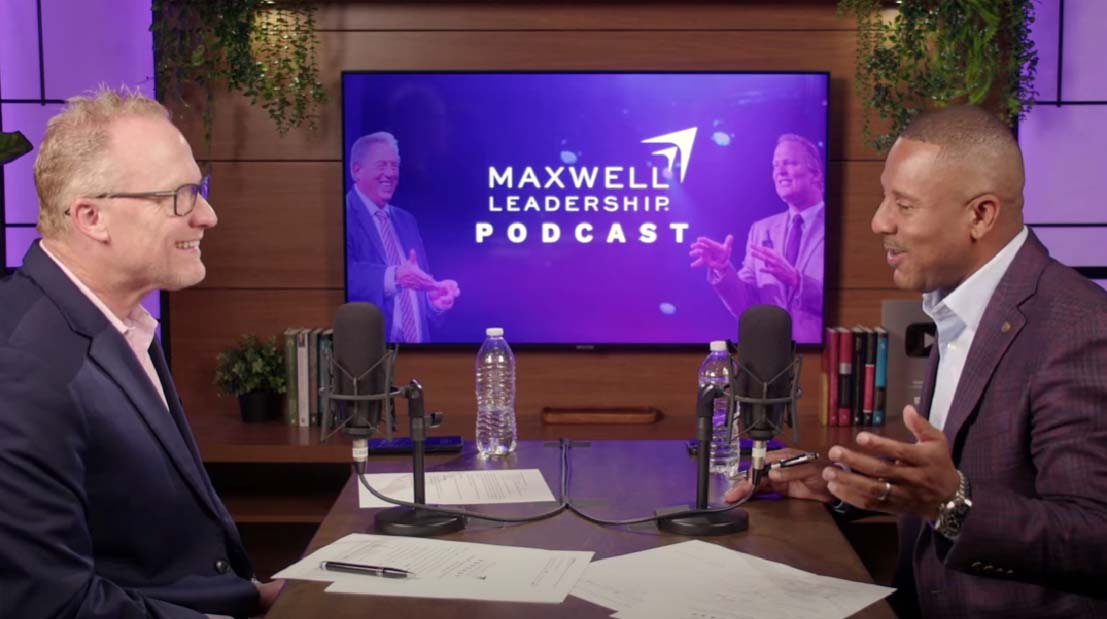
It helps to know what all the daily work is building. In a conversation on the Maxwell Leadership Podcast, Maxwell and Jon Gordon, a bestselling author and longtime Maxwell collaborator, identified three things every leader needs to thrive: a mission, a team, and a scoreboard. Each of the five habits develops at least one of them.
- A mission gives your attention somewhere to point, and it needs regular renewal. Gordon puts it plainly: “We don’t get burned out because of what we do. We get burned out because we forget why we do it.” The capture, question, and reflection habits keep the why in view a few minutes at a time.
- A team supplies the perspective and support no leader generates alone. The relationship habit builds yours one conversation at a time, whether with teammates, peers, or a coach.
- A scoreboard creates the awareness improvement depends on, since you can’t fix what you don’t know and you can’t repeat what you never identify. Daily recognition trains the skill, and Gordon suggests tracking two measures: the results your team achieves and the impact people have on each other.
For a deeper dive into all three, listen to the full episode, where Maxwell and Gordon unpack each one with stories from their own leadership.
The compounding math of daily leadership habits
Five habits at five minutes each comes to under 30 minutes a day, and across a working year the practice passes 100 hours, gathered in increments small enough to survive any schedule. Maxwell’s shorthand for the effect is that consistency compounds, and you’ll see the compounding in practice: captured ideas feed better questions, deeper relationships make honest feedback easier to come by, and the daily reflection keeps everything aimed at what matters. Give it a few years and the change can look sudden from the outside, even though you built it a day at a time.
Don’t grow your leadership alone
The habits above give you a development plan you can run without changing your schedule, and a coach helps you get more from it. Maxwell Leadership’s Leadership Coaching pairs you with a trusted partner, one-to-one or alongside your leadership team, to work through your specific goals and blind spots with practical application and checkpoints along the way. Honest feedback gets scarcer as you advance, and a coaching relationship keeps it coming when it matters most. We believe everyone can learn to lead well, and no one should do it alone. To find the right starting point, schedule a discovery call with our team. And for a regular supply of ideas worth filing, subscribe to the Maxwell Leadership Podcast wherever you listen.
FAQ
What makes someone a better leader?
Maxwell defines leadership as influence, nothing more, nothing less. Leaders improve by growing what influence rests on: credibility, relationships, judgment, and genuine care for the people they lead. Daily habits build each of those more reliably than occasional intensive effort.
How long does it take to become a better leader?
There’s no finish line, but visible change arrives sooner than most leaders expect. A few months of consistent daily practice typically shows up in faster decisions, stronger relationships, and a team more willing to bring problems forward.
What daily habits do good leaders have?
Common threads include reading and capturing ideas, asking a daily growth question, investing in one relationship at a time, reflecting at the end of the day, and recognizing specific wins. Maxwell’s own Rule of 5 is one model: every day he reads, files, thinks, asks questions, and writes.
Can anyone learn to be a leader?
Yes. Some people start with natural gifts, but leadership is a learnable set of skills and disciplines rather than an inborn trait. Maxwell’s entire body of work rests on the conviction that everyone can grow as a leader once growth becomes intentional.