
You can finish a week of decisions, meetings, and hard conversations feeling like your leadership went fine, while the people you lead walked away with something you never intended. That distance is the reason to run a leadership self assessment.
A self-assessment gives the distance a place to land. It helps you look at your influence honestly enough to see what is working, what is being avoided, and what your team experiences differently than you think. The goal is not self-criticism. It is to see your leadership clearly enough to grow on purpose, and to help the leaders around you do the same.
John C. Maxwell, the author and speaker who founded Maxwell Leadership, teaches that leadership is influence, not a title, a position, or a tenure. In daily work, that influence shows up in trust, clarity, ownership, and how people respond when the pressure rises. A self-assessment helps you read those signals before small patterns harden into bigger ones.
Start with how your team experiences your leadership
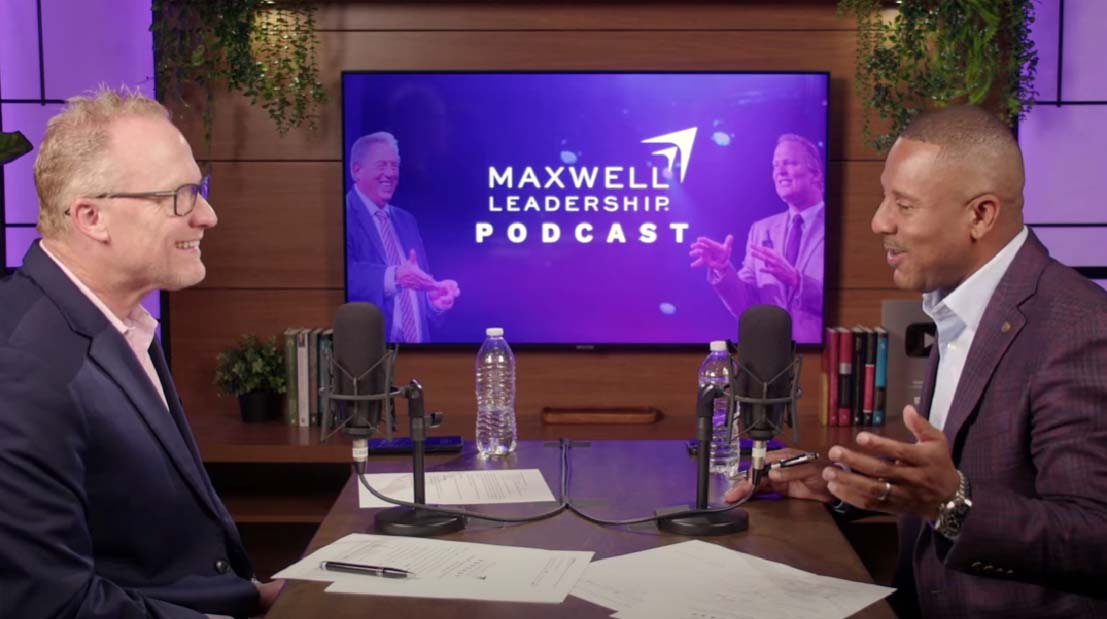
On Maxwell Executive Leadership Podcast #130: Self-Awareness and the Inclusive Leader, Chris Goede, a Vice President at Maxwell Leadership, offers a question he keeps returning to: what is it like to be on the other side of your leadership? It is uncomfortable on purpose. You know your own intentions, so you grade yourself on what you meant to do. Your team cannot see your intentions. They see what you do, and they respond to that.
Perry Holley, a Maxwell Leadership facilitator and coach, puts a picture to it on the same episode. He describes an inexperienced boater pulling into a marina at full speed, ignoring the no-wake zone, sending a wake that bangs every docked boat against the next. A leader without self-awareness does the same thing walking into a room. No sense of the wake they create, and people knocking against each other in it. Most leaders have no idea they are doing it, which is exactly why a self-assessment has to start with impact rather than intent.
There is a practical reason to care about your wake. Maxwell calls it the Law of the Lid: your leadership ability sets the ceiling on what your team can achieve. Get better, and your team gets better with you. A self-assessment is how you find where that ceiling currently sits, and an organization full of leaders asking the same question is how a culture rises.
To move past a vague impression, work from recent and specific moments: the last meeting you led, the last decision you communicated, the last expectation you set, the last hard conversation you avoided. Patterns surface when you study real moments instead of a general sense of how you lead.
Three questions your team is already asking
Maxwell teaches that every person you lead is quietly asking three questions about you: Do you care about me? Can you help me? Can I trust you? Most people never say these out loud, but the answers shape how fully they follow you.
A self-assessment gets sharper when you hold your recent behavior against those three questions. Do you care about me? shows up in whether you notice when something is off, or whether every interaction stays transactional. Can you help me? lives in whether people leave your conversations clearer and further along, or no better than before. Can I trust you? comes down to whether your actions match your words often enough that people stop bracing for surprises.
When the answer to any of the three is unclear, people hold back. Concerns stay quiet, effort gets measured, and the disengagement is easy to miss because the work still gets done. Asking yourself these questions is the first step toward making the answers clear to the people already wondering.
Leadership self-assessment questions to ask yourself
The longer we lead, the more complacent we tend to get and the less aware of ourselves we become. Asking better questions on a regular basis is one way to break that drift. On Maxwell Executive Leadership Podcast #54: Questions I Ask Myself as a Leader, Goede and Holley walk through five from John Maxwell’s book Good Leaders Ask Great Questions. Answer each with a recent example rather than a general impression.
Am I investing in myself? The personal growth question. You cannot give what you do not have, so your own development sets the limit on what you can pour into others. If you have not learned anything new in months, your leadership is running on what you already had.
Am I genuinely interested in others? The motivation question, and it gets at why you lead. Questioning your motives is not the same as questioning your character, but it is worth being honest about whether you are motivating people for the team’s sake or moving them for your own.
Am I adding value to my team? The teamwork question. A blunt way to test it: is the team better because of your presence? If your involvement mostly creates friction or bottlenecks, you want to know.
Am I staying in my strengths zone? The effectiveness question, and Holley tells on himself here. A weekly spreadsheet was part of his job, he was bad at it, and he was about to take a class to grind his way to mediocre when a teammate told him, “I come alive in a spreadsheet.” He handed it over. The teammate thrived, the work improved, and Holley got his energy back for what he did well. The math is simple: you can usually lift a weakness a point or two, while a strength has real room to climb, and your weakness is often someone else’s strength zone.
Am I taking care of today? The success question. It is easy to keep your eyes on the horizon and let the present slip. The test, from John Maxwell’s Today Matters: are you preparing or repairing? Preparing means doing today what tomorrow will require. Repairing means cleaning up what you let slide.
How feedback reveals your leadership blind spots
Self-assessment is necessary, but it has a built-in limit. You normalize your own habits over time, so the patterns most worth seeing are the ones you have stopped noticing. Feedback is how you see them.
The trick is asking questions people can answer. Broad questions like “How am I doing?” produce polite, useless responses because they are too large and too personal. More specific questions get more honest ones:
- When do I create the most clarity for the team?
- Where do I slow decisions down?
- How does my communication change under pressure?
How you receive the answers matters as much as the questions. People watch whether honesty produces defensiveness or curiosity, and they calibrate future candor accordingly. A steady response teaches your team that the truth is safe with you, which is the only thing that keeps real feedback coming. For leaders who want to build this skill deliberately, Maxwell Leadership’s feedback and critical conversations training helps leaders handle these moments with more clarity and less friction.
Outside input also reaches what self-reflection cannot. A personality profile tells you how you are naturally wired. A 360-degree assessment tells you how the people above, beside, and below you experience your leadership. As Goede points out, you do not get to decide what level you are operating at with someone in the 5 Levels of Leadership. The people you lead decide that, and structured feedback is how you find out where you actually stand.
Turning insight into a 30-day growth practice
Look back at the questions in this piece and find the one whose honest answer bothered you most. That is your starting point. Reflection only matters when it changes the next conversation, meeting, or decision, so build the next 30 days around a single behavior specific enough to observe.
A clarity goal might be ending every meeting by naming the decision, the owner, and the next step. A trust goal might be asking one more question before offering a solution. An accountability goal might be addressing missed expectations sooner, with a calm tone and a clear path forward.
The practice does not need to be complicated, but it needs structure and a witness. Name the focus, decide where it shows up each week, and ask one person to help you notice both progress and drift. That last part is not optional. You can set good intentions on your own, but you rarely sustain them unless someone is walking the road with you, asking how it is going and holding you to it.
When a formal assessment or coach adds what reflection can’t
Private reflection is a strong starting point, but some patterns need another set of eyes. Outside structure tends to help most when you keep hitting the same wall, step into a larger role, lead through significant change, or need a clearer read on how others experience you.
A formal tool earns its place here. The Maxwell Leadership Assessment measures a leader’s influence through the 5 Levels of Leadership framework, using 360-degree feedback to surface strengths and growth areas that are hard to see from the inside. Paired with a behavioral assessment like RightPath, it gives leaders and teams a shared language for development, which makes growth easier to coach across a whole leadership team rather than one person at a time.
Coaching adds the part an assessment cannot: a thinking partner. Maxwell Leadership’s executive coaching gives leaders a place to process decisions, work through where their intentions and their impact diverge, and apply what an assessment surfaces inside the real situations they face. An assessment shows the picture. A coach helps a leader act on it.
Build the leadership your team needs next
The leaders worth following are not the ones who have stopped needing to grow. They are the ones still willing to ask what they are like to follow, and to do something about the answer. A self-assessment is where that willingness becomes visible, first to you and then to everyone you lead. It points back to the belief Maxwell Leadership is built on: everyone can learn to lead well, and no one should have to do it alone.
If your organization is ready to turn that kind of self-awareness into measurable growth, through assessments, coaching, or a broader leadership development conversation, connect with Maxwell Leadership to find the right next step for your leaders.
FAQ
What is a leadership self assessment?
A leadership self assessment is a structured reflection process that helps leaders evaluate their habits, influence, strengths, and growth areas. A strong assessment looks at real behavior, feedback, decision-making, communication, trust, and accountability rather than relying only on good intentions.
How often should leaders assess themselves?
Leaders benefit from brief reflection weekly and a deeper assessment quarterly or during major role changes. Regular reflection keeps growth connected to daily leadership behavior instead of turning development into a once-a-year exercise.
What should be included in a leadership self-assessment?
A useful self-assessment pairs questions about your own leadership with the questions your team is effectively asking of you, then checks both against outside feedback. John Maxwell’s own questions are a strong anchor, covering personal growth, motivation, teamwork, strengths, and how well you handle today. Leadership impact is best understood through both self-awareness and others’ perspective, so the strongest assessments never rely on self-reflection alone.
How can leaders get more honest feedback?
Leaders get better feedback by asking specific questions, listening without defending, and showing people that honesty will be handled with respect. Feedback becomes more useful when the questions point at real situations, such as a recent meeting, decision, or communication habit, rather than asking a broad “how am I doing?”
When should an organization use a formal leadership assessment?
A formal assessment helps when leaders need clearer insight into their influence, team dynamics, or readiness for greater responsibility. Organizations often use tools like the Maxwell Leadership Assessment during leadership development, succession planning, executive coaching, or team growth initiatives, because a shared framework makes development easier to coach across a whole team.